


The spot price is one of the most important concepts in financial markets. Whether you trade stocks, commodities or currencies, understanding spot prices can help you make better trading and investment decisions.
But what exactly is a spot price? How is it different from a futures price or a strike price? And what factors cause it to change?
Let's understand the meaning of spot price, how spot markets work, and why this concept matters in financial markets.
What Is Spot Price?
The spot price is the current market price at which an asset can be bought or sold for immediate or near-immediate delivery or settlement.
It reflects the price buyers and sellers are willing to accept for an asset at a particular time. Unlike futures prices, which relate to contracts for a future date, the spot price represents the asset's current market value.
For example, if gold is trading at ₹60,000 per 10 grams in the spot market, this is its current spot price. Similarly, the exchange rate at which one currency can be exchanged for another in the foreign exchange market is known as the spot exchange rate.
Spot prices are influenced by market supply and demand and can change as market conditions evolve.
Characteristics of Spot Price
Some key characteristics of spot prices include:
- Current Market Value: It reflects the prevailing price of an asset in the market.
- Near-Immediate Settlement: Transactions are intended for immediate or near-immediate delivery or settlement, depending on the market.
- Market-Driven: Prices change according to supply, demand, liquidity and other market developments.
- Dynamic Nature: Spot prices can fluctuate throughout the trading day as new information and orders enter the market.
- Asset and Location Specific: Spot prices can differ across markets and locations due to transportation costs, taxes, currency exchange rates and other factors.
How Do Spot Markets Work?
A spot market is a financial market where assets are bought and sold at their current market prices for immediate or near-immediate delivery or settlement. In the stock market, it is commonly referred to as the cash market because transactions involve buying and selling actual shares rather than derivative contracts.
Spot markets exist across several asset classes, including stocks, commodities and currencies.
For example, suppose you buy 1,000 shares of a company at ₹500 per share on a stock exchange. The transaction value is ₹5 lakh, excluding applicable charges. The shares are purchased at the prevailing market price when your order is executed.
However, the transfer of funds and securities does not necessarily happen instantly. In India's equity cash market, the standard settlement cycle is T+1, meaning settlement generally takes place on the next working day after the trade. An optional T+0 settlement facility is also available for eligible securities through participating brokers, allowing trades to be settled on the same day.
Spot markets differ from futures markets, where buyers and sellers enter into contracts today for settlement or delivery on a specified future date.
Example of Spot Price vs Futures Price
Suppose crude oil is trading at a spot price of $80 per barrel. A six-month futures contract for crude oil is trading at $85 per barrel.
The difference between these prices may reflect the cost of carrying the underlying asset, including financing, storage and insurance expenses, along with factors such as supply conditions and the benefits of holding the asset.
Therefore, the futures price does not necessarily mean that traders expect the spot price to rise to $85. It also reflects the cost and benefits of holding the underlying asset until the futures contract expires.
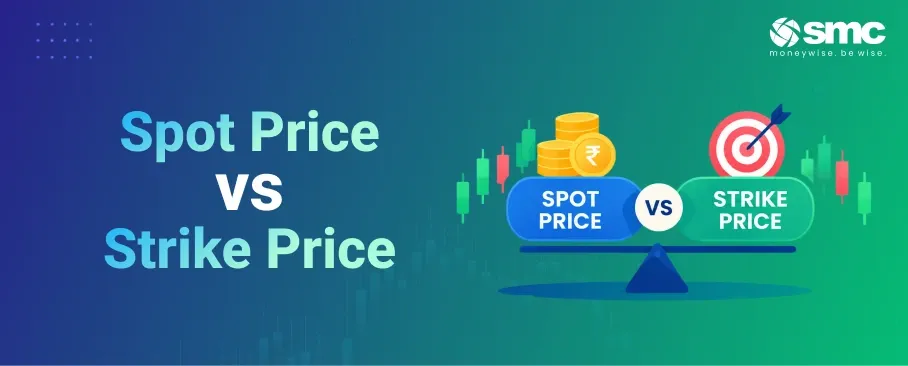
Spot Price vs Strike Price
Spot price and strike price are two important terms in options trading, but they have different meanings.
The spot price is the current market price of the underlying asset, whereas the strike price is the predetermined price at which an options contract allows its buyer to buy or sell the underlying asset, subject to the contract terms.
Example of Spot Price vs Strike Price in Options Trading
Suppose a stock is currently trading at ₹500, making its spot price ₹500.
An investor buys a call option with a strike price of ₹450. If the stock's spot price is ₹520, the call option has an intrinsic value of ₹70 per share, calculated as the difference between the spot price and the strike price.
This is because the investor has the right to buy the stock at ₹450 when its market price is ₹520.
However, the investor's actual profit depends on the premium paid for the option and other applicable costs. The intrinsic value alone does not represent the net profit.
Factors That Influence Spot Price
Spot prices can change due to several market and economic factors. Some of the key factors include:
1. Supply and Demand
Supply and demand are among the biggest factors influencing spot prices. When demand for an asset increases while supply remains limited, its spot price may rise. Similarly, an increase in supply without a corresponding rise in demand may put downward pressure on prices.
For example, a shortage of crude oil can push its spot price higher, while an increase in available supply may bring prices down.
2. Market Liquidity
Liquidity refers to how easily an asset can be bought or sold without significantly affecting its price.
Highly liquid assets generally have tighter bid-ask spreads and more active trading. In less liquid markets, even relatively small orders can cause larger price movements.
3. Geopolitical Events
Wars, political instability, trade restrictions and international conflicts can affect the supply and demand of assets.
For instance, geopolitical tensions in major oil-producing regions can disrupt supply expectations and influence crude oil spot prices.
4. Macroeconomic Indicators
Economic factors such as inflation, interest rates, GDP growth and employment data can influence financial markets.
For example, changes in interest rates can affect currency values, while inflation concerns may influence demand for assets such as gold.
5. Seasonal Variations
Seasonal factors can affect the prices of agricultural commodities.
For example, the availability of crops during harvesting seasons can influence supply and prices. Weather conditions, crop damage and changes in consumption patterns can also affect spot prices.
Why Is Spot Price Important?
Spot prices play an important role across different financial markets. Here are some of their key uses:
- Commodity Trading: Spot prices help determine the current market value of commodities such as gold, silver, crude oil and agricultural products.
- Currency Exchange: Spot exchange rates indicate the current price of one currency in terms of another.
- Stock Market Investments: Investors use prevailing stock prices to make buying and selling decisions.
- Derivatives Trading: Spot prices serve as a reference for pricing and evaluating futures and options contracts.
- Market Analysis: Comparing spot and futures prices helps traders understand market conditions, pricing differences and the cost of holding an asset.
For example, if gold's spot price is ₹60,000 per 10 grams and its three-month futures price is ₹61,000, the difference may reflect financing and storage costs, along with other market factors.
Spot Price vs Futures Price
Spot price and futures price are closely related, but they represent different types of transactions.
The spot price reflects the current market price of an asset for immediate or near-immediate settlement. The futures price is the price specified in a futures contract for settlement or delivery on a future date.
Example of Spot Price vs Futures Price in Commodities Trading
Suppose the spot price of gold is ₹60,000 per 10 grams, while its three-month futures contract is trading at ₹61,000 per 10 grams.
The futures price is ₹1,000 higher than the spot price. This difference may be due to financing costs, storage expenses, insurance and other factors associated with holding gold until the futures contract expires.
The difference between spot and futures prices can change depending on market conditions. When the futures price is higher than the spot price, the market is said to be in contango. When the futures price is lower than the spot price, it is known as backwardation.
Conclusion
Spot price represents the current market value of an asset and plays an important role in stock, commodity and currency markets.
Understanding spot prices helps investors evaluate current market conditions, while comparing them with futures prices provides insights into pricing differences and the cost of holding an asset. Similarly, knowing the difference between spot price and strike price is essential for understanding options trading.
Whether you are a beginner or an active trader, understanding spot prices can help you make more informed decisions in financial markets.


 1800 11 0909
 smc.care@smctradeonline.com