
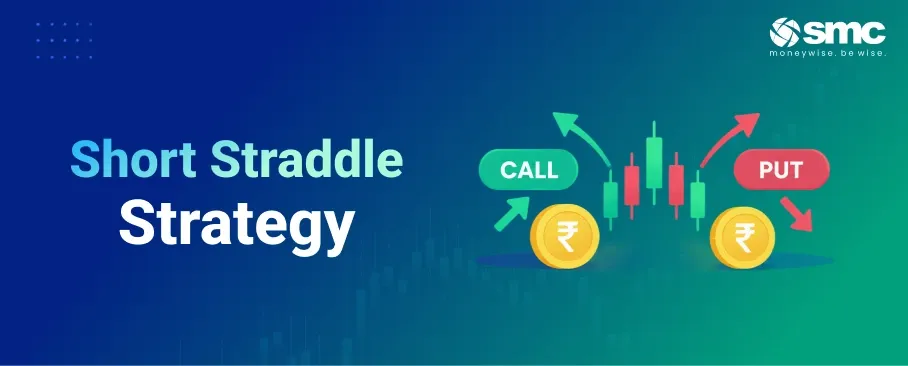


The short straddle strategy is an options trading strategy used by experienced traders who expect an underlying asset's price to remain relatively stable. It involves selling a call option and a put option with the same strike price and expiration date. The trader collects premiums from both options and aims to profit if the asset does not move significantly before expiry.
However, the strategy carries substantial risk. A sharp price movement can lead to losses that exceed the premiums collected, with unlimited potential losses on the upside. Understanding how the strategy works, its profit potential and its risks is essential before using it.
What Is the Short Straddle Strategy?
The short straddle strategy involves selling two options on the same underlying asset:
- One call option: Gives the buyer the right, but not the obligation, to buy the underlying asset at the strike price, subject to the contract's terms.
- One put option: Gives the buyer the right, but not the obligation, to sell the underlying asset at the strike price, subject to the contract's terms.
Both options have the same strike price and expiration date. The trader receives premiums from selling both options and aims to profit if the underlying asset stays close to the strike price.
For example, a trader may sell a call and a put on a stock trading near ₹1,000, with both options having a ₹1,000 strike price and the same expiry. If the stock closes at the strike price on expiry, both options expire worthless, and the trader keeps the entire premium, before transaction costs.
The strategy is generally market-neutral, but it is not risk-free. A significant price movement in either direction can result in losses.
How Does the Short Straddle Strategy Work?
To execute a short straddle option strategy, a trader follows these steps:
- Choose the underlying asset: Select a stock, index or another asset with listed options.
- Select the strike price: Choose a strike price based on the trading outlook, often close to the current market price.
- Sell a call option: Sell a call at the selected strike price.
- Sell a put option: Sell a put with the same strike price and expiry.
- Collect the premiums: Add the premiums received from both options to calculate the total credit.
The trader can hold the position until expiry or close it earlier by buying back both options. The profit or loss depends on the premiums received, the cost of closing the position and applicable charges.
Profit and Loss in a Short Straddle
Understanding the maximum profit, breakeven points and potential losses is essential before entering a short straddle.
Maximum Profit
The maximum profit is limited to the total premium received from selling the call and put options. It occurs when the underlying asset closes exactly at the strike price on expiry, causing both options to expire worthless.
Breakeven Points
A short straddle has two breakeven points at expiry:
- Upper breakeven = Strike price + Total premium received
- Lower breakeven = Strike price − Total premium received
Between these points, the position generates a profit at expiry. Beyond either breakeven point, it incurs a loss.
Potential Losses
If the underlying asset rises sharply, the short call can generate unlimited losses because there is no theoretical upper limit to a stock's price.
If the underlying asset's price falls sharply, the short put can also result in substantial losses. However, for a stock that cannot fall below zero, the downside loss is limited. If the stock falls to zero by expiry, the loss is equal to the strike price minus the total premium received per share, excluding transaction costs and taxes.
Example of a Short Straddle Strategy
Suppose a stock is trading at ₹1,000. A trader expects it to remain relatively stable until expiry and sells a call and put at the ₹1,000 strike price.
The trade details are:
- Call premium received: ₹50
- Put premium received: ₹50
- Total premium received: ₹100 per share
The breakeven points are:
- Upper breakeven: ₹1,000 + ₹100 = ₹1,100
- Lower breakeven: ₹1,000 − ₹100 = ₹900
The following table shows possible outcomes at expiry, excluding transaction costs and taxes.
If the stock closes at ₹1,000, both options expire worthless, and the trader earns the maximum profit of ₹100 per share.
If the stock closes at ₹1,050, the call has an intrinsic value of ₹50 while the put expires worthless. After accounting for the ₹100 premium received, the trader earns ₹50 per share.
If the stock rises to ₹1,150, the call has an intrinsic value of ₹150. After deducting the premium received, the trader incurs a loss of ₹50 per share. A fall below ₹900 creates losses in the same way through the short put.
Actual results may vary due to lot sizes, transaction costs, taxes and the cost of closing positions before expiry.
Advantages of the Short Straddle Strategy
1. Premium Income
The trader receives premiums from both options. This creates a larger initial credit than selling either option alone, but also exposes the trader to price movements in both directions.
2. Benefit From Time Decay
Options generally lose time value as expiry approaches, all else being equal. This can benefit a short straddle if the underlying asset remains relatively stable.
3. Benefit From Falling Implied Volatility
A decline in implied volatility can reduce the market value of the options sold, potentially allowing the trader to close the position at a lower cost.
These benefits are not guaranteed. Sharp price movements or rising implied volatility can increase the cost of closing the position.
Risks of the Short Straddle Strategy
A short straddle is an advanced strategy that requires careful risk management.
1. Significant Loss Potential
A sharp rise in the underlying asset can lead to unlimited losses on the short call. A steep fall can also cause substantial losses on the short put.
2. Margin Requirements
Selling options generally requires margin. Brokers may increase margin requirements when volatility rises, or the position becomes riskier. If the trader cannot maintain sufficient funds, the broker may square off the position in accordance with its policies.
3. Unexpected Market Events
Earnings announcements, economic data, policy decisions and geopolitical developments can trigger sudden price movements. Such events may push the underlying asset beyond the breakeven points.
4. Rising Implied Volatility
Even if the underlying asset's price remains relatively stable, rising implied volatility can increase the value of the options sold, resulting in mark-to-market losses.
Long Straddle vs Short Straddle
A long straddle and a short straddle have opposite objectives.
A long straddle may suit a trader expecting a significant price movement but uncertain about its direction. A short straddle is designed for the opposite outlook, where the trader expects limited movement.
Best Market Conditions for Using the Short Straddle Strategy
A short straddle may be considered under the following conditions:
- Limited expected price movement: The trader expects the underlying asset to remain relatively close to the selected strike price.
- Elevated implied volatility: Higher implied volatility may provide larger premiums, but it can also signal a greater risk of a sharp price movement.
- Stable volatility outlook: Falling or stable implied volatility can benefit the position, provided the underlying asset does not move sharply.
- Awareness of upcoming events: Traders should assess earnings announcements, economic releases and other events that could affect prices.
A quiet market alone does not make a short straddle suitable. Traders should also evaluate the expected price range and potential losses.
Short Straddle vs Short Strangle
A short strangle is another options strategy used when a trader expects limited price movement, but its setup differs from a short straddle.
In a short straddle, the trader sells a call and a put with the same strike price and expiry. In a short strangle option strategy, the trader sells a call at a higher strike price and a put at a lower strike price, with the same expiry.
A short strangle generally collects a lower premium than a comparable short straddle but has wider breakeven points. Both strategies have limited profit potential and substantial risk, including unlimited upside losses.
The choice depends on the trader's market outlook, desired breakeven range and ability to manage risk.
Risk Management Tips for the Short Straddle Strategy
Risk management is essential when using a short straddle.
- Set exit rules: Decide when to close or adjust the position. Stop-loss orders may not execute at the intended price during sharp market movements.
- Monitor the market: Track the underlying asset, implied volatility, margin requirements and upcoming events.
- Consider hedging: Buying options at other strike prices may help reduce or define risk, but it changes the strategy's payoff and cost.
- Manage capital carefully: Maintain sufficient funds to meet margin requirements and handle adverse price movements.
- Understand expiry risks: Review the contract's settlement rules and potential expiry-related obligations.
The premium received should not be treated as guaranteed income. Traders should understand their potential exposure before entering the trade.
Conclusion
The short straddle strategy allows traders to collect premiums by selling a call and a put with the same strike price and expiry. It may generate a profit when the underlying asset remains relatively stable and time decay works in the trader's favour.
However, the strategy has limited profit potential and significant risk, including the risk of unlimited losses if the underlying asset rises sharply. It is generally better suited to experienced options traders who understand options pricing, margin requirements and risk management.
Before using a short straddle or short strangle option strategy, assess market conditions and potential losses carefully. SMC Global Securities offers educational resources and market insights to help traders understand options strategies, but no strategy can eliminate market risk.

 1800 11 0909
 smc.care@smctradeonline.com