
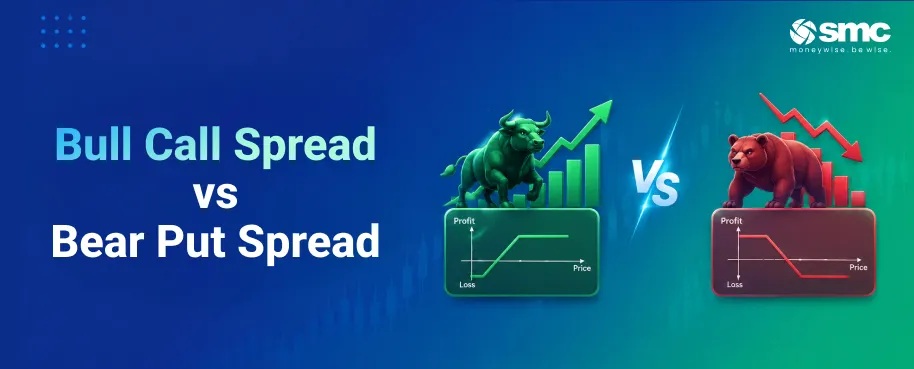


Pick a side first, then a structure. Most option traders skip that step and end up debating call versus put, when the cleaner question is whether the view is moderately bullish or moderately bearish. Bull call and bear put spreads are mirror twins: same construction logic, same defined risk, same SPAN treatment; just opposite directional bets. Both are two-leg vertical debit spreads on NSE that pay a net premium upfront, cap the loss at that premium, and cap the profit at the strike difference minus the debit.
In this blog, we will explain how bull call and bear put spreads are constructed, how their payoffs and Greeks differ, the India-specific rules around margin, STT, and settlement, and when each strategy is most appropriate.
Construction, Payoff, and Why Traders Use Spreads
A bull call spread is built by buying an at-the-money or in-the-money call and selling a higher-strike out-of-the-money call in the same expiry and lot size. The bear put spread does the same on the put side: long ATM or ITM put, short lower-strike OTM put. The long leg is closer to spot, so it costs more than the short leg fetches, and the net cash flow is a debit, which equals the maximum loss if the trade goes the wrong way.
A worked example: with Nifty at 24,500, buy the 24,500 call for ₹250 and sell the 24,800 call for ₹120. Net debit ₹130. Maximum loss ₹130 per unit if Nifty closes at or below 24,500. Maximum profit ₹170 per unit if Nifty closes at or above 24,800. Breakeven at 24,630.
Naked option buying carries two well-known leaks: time decay and volatility crush. A long call or put loses extrinsic value daily, and a decline in implied volatility after an event can torch the position even if the underlying moves in the right direction. Vertical debit spreads dampen both leaks because the short leg offsets some of the theta and vega on the long leg. The trade-off is capped upside. Spreads also fit better when IV is already rich. Pre-event IV is usually elevated and frequently collapses afterwards; a naked buyer often finds that the direction was right, but the IV crush wipes out the premium. The short leg absorbs part of that crush.
Greeks, India-Specific Mechanics, and When Each Spread Fits
Greek behaviour through time
The bull call spread carries positive delta: the long ATM call has higher absolute delta than the further-OTM short call, so the structure gains as the underlying rises toward the upper strike, then flattens as both deltas converge. The bear put spread mirrors this with negative delta. Theta works in two stages:and a naked buyer often finds the direction was right, but the IV crush wiped when spot is far from the long strike, net theta is mildly negative and each passing day hurts; once spot moves into the profitable zone near the short strike, the short leg's accelerated decay can offset or exceed the long leg's, making the position more resilient as expiry approaches. Vega is positive for both at inception but smaller than for a naked option, so a fall in implied volatility hurts a debit spread less than a naked position.
Margin treatment under SPAN
NSE Clearing applies the SPAN risk-based margining system, which shocks the underlying price and implied volatility to compute the largest one-day loss the portfolio could suffer. When a long option is paired with a short option in a defined-risk vertical, SPAN recognises the hedge and reduces the net margin to roughly the maximum loss plus a buffer, rather than the standalone short-leg margin. NSE's deep-OTM measures impose an additional 20% notional-value margin on large short positions in options whose strike is more than 30% from the underlying, which can affect very wide spreads with distant short legs.
STT, stamp duty, and other levies
Both legs incur statutory charges on entry and exit. Per NSE's SEBI turnover fees, STT, and other levies table, applicable from 1 April 2026, STT on the sale of options is 0.15% of the option premium. If a bought option is exercised at expiry, STT applies at 0.15% of the intrinsic value. Stamp duty on the buy side is 0.003%. Brokerage, exchange transaction charges, clearing charges, 18% GST on brokerage and exchange charges, and SEBI turnover fees apply on top. For narrow spreads with small net debits, the cost-to-debit ratio can be material.
Settlement style and expiry handling
Equity options on NSE are European-style and can only be exercised at expiry. Index options like Nifty and Bank Nifty are cash-settled in INR on the closing index value on expiry day. Stock options follow compulsory physical delivery since October 2019: ITM long calls and puts at expiry convert into delivery obligations, with margin raised sharply in the closing days. Most retail traders close stock verticals well before the last two sessions to avoid the margin spike.
When each spread fits
A bull call spread suits a moderately bullish view on an index where you expect a rise but not a runaway rally, or a post-event setup where IV is already elevated and the short leg offsets some vega. A bear put spread suits a moderately bearish view, where you expect a pullback rather than a crash, or a portfolio hedge against long equity: it offers cheaper downside protection than a plain ATM put, with the trade-off that protection caps once price falls to the lower strike. Neither is universally better; the choice comes down to direction, expected move size, IV regime, and capital, not an inherent superiority of either structure.
Pitfalls, Exits, and How to Adjust
Six pitfalls erode the theoretical edge in practice:
- Going too wide on strikes: Very wide spreads place the short leg in deep-OTM territory with poor liquidity and potentially higher margins under NSE's deep-OTM rules, so the realised payoff can fall well below the textbook maximum if exits are difficult.
- Legging in over-aggressively: Entering the long leg first and waiting for a better fill on the short leg exposes you to adverse moves, especially in thin stock options. Multi-leg basket orders fill both legs simultaneously at a net debit and remove the legging risk.
- Holding stock verticals into physical settlement: ITM legs at expiry create significant share-delivery obligations and margin spikes in the closing days. Closing the spread one or two days before expiry is the standard escape route.
- Ignoring transaction costs: STT on exercised ITM options is computed on intrinsic value from April 2026, raising the cost of holding ITM legs to expiry, and each leg accumulates brokerage, exchange charges, GST, stamp duty, and STT on both entry and exit.
- Failing to book profits: Once the spread has earned most of its theoretical maximum, holding on exposes you to late-stage reversals for little incremental payoff.
- Mis-reading Greek behaviour: Far-OTM spreads with very low initial delta may barely respond to price movement while still bleeding theta and commissions. Near-ATM long legs are usually a better default if you want the structure to actually track the underlying.
Most experienced spread traders manage actively rather than holding to expiry. Profit exits typically come when the spread has captured a large fraction of its potential and the remaining extrinsic value is small. Time-based exits work when the thesis hasn't played out by a chosen number of days before expiry. Rolling, closing the existing position and opening a new spread in a later expiry or different strikes that let you extend the thesis without locking in a loss. The art lies in matching strike spacing to expected move size, choosing an expiry that gives the thesis room without bleeding theta, and exiting before STT on intrinsic value and physical-settlement margin spikes erode a winning position.
Investments in securities markets are subject to market risks. Read all the related documents carefully before investing.
Conclusion
Bull call and bear put spreads are the same tool pointed in opposite directions: a defined-risk, defined-reward way to express a moderate directional view while blunting the time decay and IV crush that punish naked buyers. Choose the bull call when you're moderately bullish, the bear put when you're moderately bearish or hedging long equity, and let expected move size, IV regime, and the trade’s cost, rather than a belief that one strategy is inherently better, determine your strike selection. Keep the spreads on liquid strikes, mind the STT and physical-settlement traps, and exit once most of the profit is banked. Open a Demat account to trade option spreads across liquid NSE derivatives.



 1800 11 0909
 smc.care@smctradeonline.com