
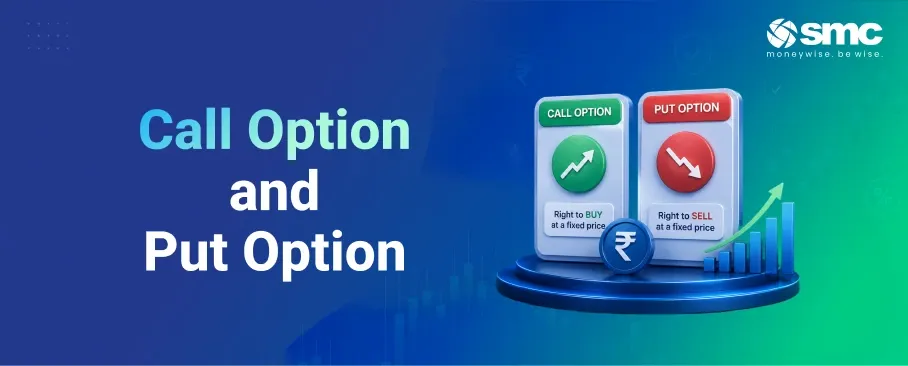


A call option gives the holder the right to buy an underlying asset at a fixed price by the expiry date. A put option gives the right to sell. Both are derivative contracts traded on NSE and BSE, priced as a premium per unit.
A Nifty 22,200 call bought at ₹150 premium costs ₹7,500 (50-unit lot) and profits if Nifty crosses 22,350 at expiry.
To trade options responsibly, you need clarity on contract structure, payoff mechanics, break-even calculations, moneyness classification, real index-based examples, and the risk statistics that define retail outcomes in India.
What Are Call and Put Options?
Options are derivative contracts that give the buyer the right, but not the obligation, to buy or sell an underlying asset at a specified strike price on or before an expiration date.
The buyer pays a premium to acquire this right. The seller (writer) collects the premium and takes on the obligation if the buyer exercises.
Two types dominate options trading in India.
Call Option
A call option grants the holder the right to buy the underlying asset at the strike price. Traders buy calls when they expect the price to rise.
Example: Stock XYZ trades at ₹100. A trader buys a call at ₹100 strike, paying ₹5 premium.
- If the stock rises to ₹120 at expiry, the profit is ₹120 - ₹100 - ₹5 = ₹15 per share.
- If the stock stays below ₹100, the option expires worthless, and the maximum loss is ₹5 per share, the premium paid.
Put Option
A put option grants the holder the right to sell the underlying asset at the strike price. Traders buy puts when they expect the price to fall, or when they want to protect an existing holding against a decline.
Example: Stock XYZ trades at ₹50. A trader buys a put at ₹50 strike, paying ₹3 premium.
- If the stock falls to ₹40 at expiry, the profit is ₹50 - ₹40 - ₹3 = ₹7 per share.
- If the stock stays above ₹50, the maximum loss is ₹3 per share.
What Is the Difference Between Call and Put Options?
Comparison Table
ITM, OTM, and ATM Classification
Options are classified by the relationship between the strike price and the current market price. This classification, called "moneyness," determines the option's intrinsic value and premium cost.
Practical example using Reliance at ₹2,500 spot price:
OTM options are cheaper but riskier; the underlying asset must move significantly in the trader's favour before expiry for the option to become profitable.
How Do You Calculate Call and Put Option Payoffs?
Call Option Payoff
Formula:
- Payoff per unit = max(0, Spot Price - Strike Price)
- Profit/Loss per unit = Payoff - Premium Paid
- Break-even = Strike Price + Premium Paid
Worked example:
- Strike price: ₹1,500
- Spot price at expiry: ₹1,700
- Premium paid: ₹50
- Payoff = max(0, 1700 - 1500) = ₹200
- Net profit = ₹200 - ₹50 = ₹150 per unit
- Break-even = ₹1,500 + ₹50 = ₹1,550
Put Option Payoff
Formula:
- Payoff per unit = max(0, Strike Price - Spot Price)
- Profit/Loss per unit = Payoff - Premium Paid
- Break-even = Strike Price - Premium Paid
Worked example:
- Strike price: ₹1,500
- Spot price at expiry: ₹1,300
- Premium paid: ₹40
- Payoff = max(0, 1500 - 1300) = ₹200
- Net profit = ₹200 - ₹40 = ₹160 per unit
- Break-even = ₹1,500 - ₹40 = ₹1,460
Nifty Options (Lot-Based Calculation)
Nifty options trade in lots of approximately 50 units. Total P/L = (P/L per unit) x Lot Size.
Example: Buy Nifty 21,100 CE at ₹120 premium. Lot size = 50. Total cost = ₹6,000.
- If Nifty reaches 21,300 at expiry: Payoff = (21,300 - 21,100) x 50 = ₹10,000. Profit = ₹10,000 - ₹6,000 = ₹4,000.
- If Nifty stays below 21,100: Loss = ₹6,000 (entire premium).
How Do Options Work in Practice?
Three case studies illustrate how traders use call and put options in different scenarios.
Case Study 1: Buying a Bank Nifty Call (Bullish View)
Bank Nifty is trading at ₹45,000. A trader expects a positive budget announcement to push the index higher and buys a 45,500 call at ₹250 premium per unit. Lot size is 40 units. Total investment: ₹10,000. Break-even: ₹45,750.
If Bank Nifty rises to 46,200: Intrinsic value = (46,200 - 45,500) x 40 = ₹28,000. Profit = ₹28,000 - ₹10,000 = ₹18,000 (180% return on investment).
If Bank Nifty falls to 44,500: The option expires worthless. Loss = ₹10,000, the premium paid.
Case Study 2: Buying a Put to Hedge a Portfolio
A trader owns Bank Nifty shares worth ₹1,80,000 (40 units at ₹45,000) and fears a market downturn. The trader buys a 44,500 put at ₹180 premium per unit. Total cost: ₹7,200. Break-even: ₹44,320.
If Bank Nifty falls to 43,500: Put payoff = (44,500 - 43,500) x 40 = ₹40,000. Net profit on put = ₹40,000 - ₹7,200 = ₹32,800. This offsets the loss on the share portfolio; the put acts as insurance.
If Bank Nifty rises: The put expires worthless (₹7,200 loss), but the share portfolio gains in value. The cost of protection is the premium paid.
Case Study 3: ITM vs ATM vs OTM Comparison
Assume Nifty spot is 21,000. A bullish trader compares three call options:
ITM options cost more but are safer; they profit even on small moves. OTM options are cheap but risky, requiring a large move to become profitable. ATM options balance cost and probability.
What Are the Benefits of Trading Options?
Hedging Portfolio Risk
Options serve as insurance against adverse price movements. A protective put strategy allows an investor holding stocks to buy put options that cap downside risk.
If the stock falls, the put gains value and offsets the loss. Protective puts, covered calls, collars, and spreads are all hedging strategies with distinct risk-reward profiles suited to different market conditions.
Speculating on Price Movements
Options offer leveraged exposure. A trader investing ₹6,000 in a call option can control a Nifty position worth significantly more.
A ₹100 move in Nifty can yield a 100%+ return on the option premium, while the same move represents a fraction of a percent on a direct equity position.
Generating Income Through Covered Calls
The covered call strategy involves owning shares and selling call options against them to collect premium income.
An investor holding Infosys at ₹1,500 (lot size 300) who sells a ₹1,600 call for ₹25 premium earns ₹7,500. If Infosys stays below ₹1,600, the option expires worthless, and the investor keeps the premium plus the shares.
Covered calls can generate a 1-2% monthly yield on blue-chip stocks in sideways or mildly bullish markets.
Diversifying Trading Strategies
Options enable strategies for every market condition, bullish, bearish, sideways, and volatile. Spread strategies (bull call spread, bear put spread, iron condor) allow traders to define maximum risk and reward upfront.
Limited Risk for Buyers
Unlike futures, where both parties face unlimited risk, options buyers can only lose the premium paid.
This asymmetric risk profile makes options attractive for risk-conscious traders who want defined downside exposure.
What Should Beginners Know Before Trading Options?
Start with buying, not selling: Options selling (writing) carries potentially unlimited risk and requires margin. According to SEBI data, 91% of individual F&O traders lost money in FY25, with collective losses exceeding ₹1 lakh crore. Beginners should start by buying options (long calls and long puts) where risk is limited to the premium paid.
Understand risk before committing capital: Starting capital of ₹25,000-₹50,000 is recommended for beginners, with risk per trade capped at 2-3% of capital. Monthly return targets of 5-10% are realistic with proper risk management.
Paper trade first: Spend 1-2 months paper trading before deploying real capital. Execute at least 20-30 simulated trades to understand option behaviour, time decay, and exit discipline. Focus on process before profit.
Know the numbers: Over 93% of retail traders incurred average losses of around ₹2 lakh per trader between FY22 and FY24. Despite consecutive years of losses, more than 75% of loss-making traders continued F&O activity.
Options trading requires a strong understanding of market direction, risk management, and disciplined execution. Whether you're exploring calls, puts, or hedging strategies, SMC provides traders with real-time market access, research-backed insights, and trading support. Open your Demat account with us to start trading with confidence.


 1800 11 0909
 smc.care@smctradeonline.com