
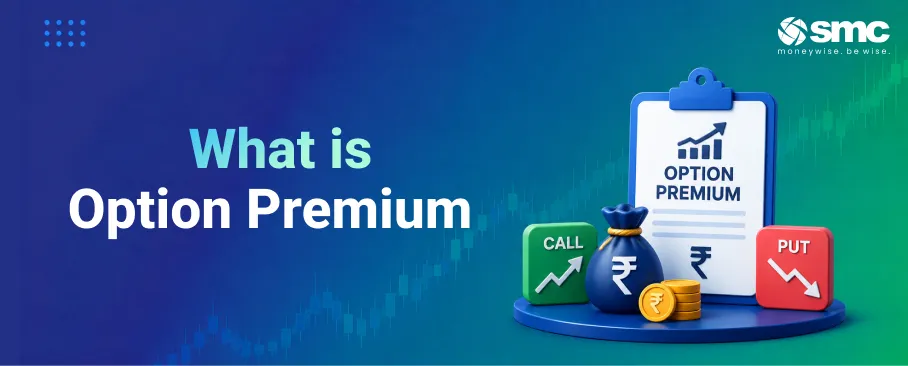


An option premium is the price the option buyer pays the seller for the right, but not the obligation, to buy or sell an underlying asset at a fixed strike price. It is quoted per unit, and your total outlay equals the premium multiplied by the contract lot size. For the buyer, the premium is the maximum possible loss; for the seller, it is the upfront income for assuming the contract's obligation.
At its core, option pricing rests on a simple idea: a premium equals intrinsic value plus time value, both shaped by volatility, time to expiry, and the spot price relative to the strike. In the sections below, we'll look at what makes up an option premium, the factors that move it, how it is calculated, and the option premium meaning in practice.
Components of Option Premium
Every option premium has two core components: intrinsic value and time value. The relationship is straightforward: Option Premium = Intrinsic Value + Time Value. Breaking it down shows what you are actually paying for when you enter an options position.
Intrinsic Value
Intrinsic value is the immediate exercise value of an option based on the current underlying price versus the strike price.
- For a call option, intrinsic value equals the spot price minus the strike price (or zero, whichever is greater).
- For a put option, it equals the strike price minus the spot price (or zero, whichever is greater).
Intrinsic value can never be negative. An at-the-money or out-of-the-money option has zero intrinsic value because exercising it now would not yield a profit; any positive premium is entirely time value.
For example, if a call trades at a premium of ₹250 and its intrinsic value is ₹200, the remaining ₹50 is time value. Deeper in-the-money options have more intrinsic value and tend to carry higher premiums, while deep out-of-the-money options have very low premiums made up purely of time value.
Time Value
Time value is the portion of the premium above the option's intrinsic value, reflecting the market's expectation that the option could gain intrinsic value before expiry. It captures the time remaining, expected volatility, interest rates, and dividends, all of which influence how likely the underlying is to move favourably.
Time value is highest for at-the-money options and longer-dated contracts. Even out-of-the-money options can carry significant time value if implied volatility is high. As expiry approaches, time value erodes through a process called time decay, or theta, and the decay usually accelerates in the final days. At expiry, the time value reaches zero, and the premium equals the intrinsic value only. Because of this decay, long option buyers must overcome a constant loss of extrinsic value, while sellers aim to profit from that erosion.
Factors Affecting Premiums
Several variables drive the level of an option premium. Pricing guides converge on a standard list of core factors:
- Underlying price
- Strike price
- Time to expiry
- Implied volatility
- Risk-free interest rates
- Expected dividends
Implied Volatility
Implied volatility (IV) reflects the market's expectation of future price swings in the underlying over the life of the option. A higher IV increases the mathematical probability that the option moves in the money, so premiums tend to be proportionately higher when IV is elevated.
IV tends to spike around known events such as earnings, policy decisions, or macro data releases, lifting premiums even when the spot price barely moves. After the event passes, IV often collapses in what traders call a "vol crush," which can sharply reduce premiums even if the underlying moves in your intended direction. That makes checking IV a mandatory risk step for option buyers entering positions just before major events.
Expiry Duration
- A longer time to expiry usually means higher time value, because there is a wider window for the underlying asset to move favourably.
- Options with longer maturities, monthly versus weekly contracts in Indian indices, typically trade at higher premiums, all else equal.
- As expiry approaches, time value erodes non-linearly: slowly in the early weeks, then sharply for at-the-money options in the final stretch.
- Weekly options see particularly rapid, aggressive time decay in their last two to three days of trading.
Price, Rates, and Dividends
The remaining factors set the immediate equity value and the opportunity cost of the contract:
The Black-Scholes Model
While splitting the premium into intrinsic and time value explains what the price represents, quantitative models estimate a theoretical "fair value." The Black-Scholes-Merton model is the canonical framework for pricing European options, using five inputs:
- Current spot price
- Strike price
- Risk-free interest rate
- Volatility
- Time to maturity
The model rests on several assumptions:
- Lognormal underlying returns
- Constant volatility and interest rates
- No transaction costs
- Continuous trading without arbitrage
In practice, real prices often deviate from model outputs. Traders frequently feed the market price of an option into the model and solve for the implied volatility that makes the theoretical price match the observed premium. Because real markets don't fully satisfy the assumption of constant volatility, systematic differences appear. These show up as volatility smiles and skews, graphs of how IV varies across strike prices, which reveal that markets often assign higher risk (and higher premiums) to deep OTM options than to ATM ones.
Applied Examples for Traders
Consider a call option on Reliance Industries with a strike of ₹2,400 trading at a premium of ₹120. If the lot size is 1,000 shares, the total premium outlay for the buyer is ₹1,20,000. The writer receives that amount upfront. If the option expires worthless, the seller keeps the entire premium as profit, while the buyer loses the full premium.
Now a payoff scenario. You buy a 700-strike call at a premium of ₹15 when the spot is ₹695. If the stock remains below 700 at expiry, the option will expire worthless, and your loss is limited to ₹15 per share. If the stock moves to 730, the intrinsic value at expiry is ₹30 (730 minus 700), leaving a net payoff of ₹15 per share after subtracting the premium.
Traders use built-in option calculators based on Black-Scholes to estimate fair values and the "Greeks" for each strike and expiry. These metrics define precisely how a premium reacts to market shifts:
A common mistake among retail traders is judging premiums purely by their absolute rupee value. A ₹5 premium on a deep OTM Nifty option may look "cheap," but if the probability of it expiring in the money is negligible, the entire amount is at risk. Checking the breakeven level gives a more accurate picture of whether a premium is mathematically viable:
- Call Breakeven: Strike Price + Premium Paid
- Put Breakeven: Strike Price - Premium Paid
Arbitrage-minded traders also scan for mispricing using put-call parity. Building a synthetic long call (long stock plus a long put) and comparing its cost to an actual call premium can indicate whether the call is overpriced relative to theory. Retail traders can use these parity checks as a sanity test when a quoted premium looks unusually high or low.
Investments in securities markets are subject to market risks. Read all the related documents carefully before investing.
Conclusion
The option premium is the price of possibility, what you pay, or receive, for the right attached to a contract. Understanding that it is only intrinsic value plus time value, and knowing what moves each part (volatility, time decay, rates, and dividends), is what lets you judge whether a premium is worth paying rather than just whether it looks cheap.
Always check the breakeven before you trade. When you're ready to put this into practice, you can open a free Demat account with SMC and access option-chain analysis, live Greeks, and volatility data to trade derivatives more confidently.

 1800 11 0909
 smc.care@smctradeonline.com