
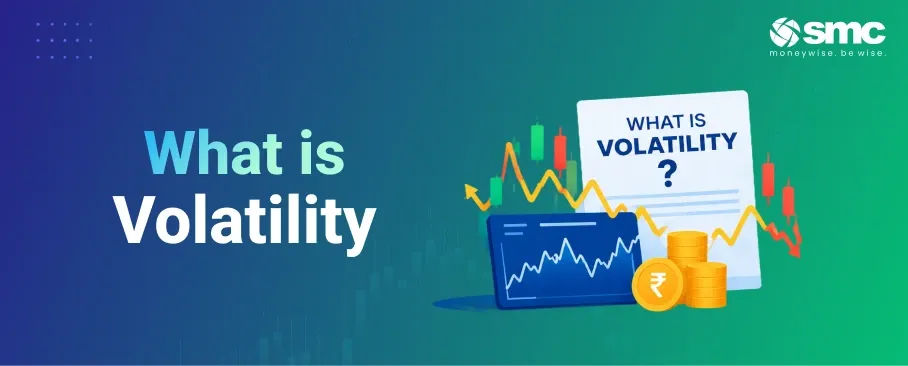


Share prices do not move in a straight line. They rise and fall based on changing economic conditions, company performance, investor sentiment and global events. These price movements can sometimes be gradual, while at other times they can be sharp and unpredictable. This is known as stock market volatility.
But what is volatility, and why does it matter to investors?
In simple terms, volatility refers to the extent and speed at which the price of a stock, index or other financial asset changes over a given period. A market with large and frequent price movements is considered volatile.
Understanding volatility can help investors avoid making decisions based purely on short-term market movements. It can also help traders identify opportunities while managing the risks associated with rapid price changes.
What is Volatility?
Volatility measures how much an asset's price fluctuates over a period of time. If a stock's price moves sharply up and down, it has higher volatility. If the price remains relatively stable, it has lower volatility.
For example, suppose Stock A moves between ₹95 and ₹105 over several weeks, while Stock B moves between ₹70 and ₹130 during the same period. Stock B has experienced greater price fluctuations and is therefore more volatile.
So, what is volatility in practical terms? It is essentially a measure of how widely and quickly prices move.
Volatility can be:
- High: Prices experience large and frequent movements.
- Moderate: Prices fluctuate, but the movements are relatively controlled.
- Low: Prices remain within a narrower range.
It is important to remember that volatility does not indicate the direction of the movement. A highly volatile stock can move sharply upward, downward or in both directions.
What is Volatility in Stock Market?
If you are wondering what volatility in the stock market is, it refers to the degree of fluctuation in the prices of stocks, indices or other securities.
For instance, if the Nifty 50 moves sharply in response to an unexpected economic announcement, the market may experience increased volatility. Similarly, an individual stock may become highly volatile after its quarterly results, a major corporate announcement or a significant change in its business outlook.
Market volatility is generally influenced by:
- Economic data
- Interest rate changes
- Corporate earnings
- Government policies
- Global market movements
- Geopolitical developments
- Currency and commodity price movements
- Investor sentiment
- Buying and selling activity
Volatility is a normal feature of financial markets. It does not necessarily mean that something is wrong with the market.
Volatile Market Meaning
The term "volatile market" is relatively simple: a market where prices experience significant and frequent fluctuations over time.
In a volatile market, an index or stock may rise substantially during one trading session and decline sharply during another. Such movements can make it difficult to predict short-term price behaviour.
For investors, a volatile market can increase uncertainty. For traders, however, larger price movements can create trading opportunities, although they also increase the possibility of losses.
This is why understanding risk management is particularly important when markets become volatile.
Volatile Meaning in Stock Market
The volatile meaning in the stock market refers to a stock or market experiencing relatively large price movements within a short period.
For example, if a stock regularly moves 5%-10% in either direction within a few trading sessions, it may be described as volatile compared with a stock whose price generally moves within a much narrower range.
The term "volatile shares" is often used to describe stocks that experience substantial price fluctuations. Such stocks may attract traders looking for short-term opportunities but may not suit every investor's risk profile.
Highly Volatile Meaning
The term "highly volatile" refers to an asset that experiences particularly large and frequent price fluctuations.
Highly volatile stocks may react strongly to:
- Company announcements
- Quarterly earnings
- Regulatory developments
- Changes in investor expectations
- Sector-specific news
- Global events
- Changes in liquidity or trading volumes
High volatility can increase both potential gains and potential losses. Therefore, investors should not consider volatility alone when deciding whether a stock is suitable for their portfolio.
What Causes Stock Market Volatility?
There is no single reason behind market volatility. Several factors can influence prices at the same time.
1. Economic Data
Economic indicators such as GDP growth, inflation, industrial production and employment data can affect investor expectations.
For example, higher-than-expected inflation may lead investors to reassess interest-rate expectations. This can affect borrowing costs, company earnings and stock valuations.
Similarly, stronger economic growth can improve expectations for corporate earnings and influence stock prices.
2. Interest Rate Changes
Interest rates have a significant influence on financial markets.
When interest rates rise, borrowing can become more expensive for companies and consumers. This can affect investment, consumption and corporate profitability.
On the other hand, lower interest rates can reduce borrowing costs and potentially support economic activity.
Changes in interest-rate expectations can therefore contribute to high volatility in equity markets.
3. Corporate Earnings
A company's share price is influenced by expectations about its future performance.
If a company reports earnings significantly above market expectations, its stock may rise sharply. If the results disappoint investors, the stock may decline.
This is why individual stocks can sometimes become particularly volatile around quarterly earnings announcements.
4. Geopolitical Events
Wars, diplomatic tensions, trade restrictions and other geopolitical developments can create uncertainty in financial markets.
Such events can affect crude oil prices, currencies, supply chains and investor sentiment. As a result, they can trigger sudden movements across different asset classes.
5. Investor Sentiment
Investor psychology can have a major impact on market movements.
When investors are optimistic, strong buying can push prices higher. During periods of fear, investors may sell assets quickly, leading to sharp declines.
This can sometimes create a cycle in which falling prices increase fear, which leads to more selling and further price declines.
6. Global Market Movements
Indian markets are connected to global financial markets. Movements in major international indices, commodity prices, currencies and overseas interest rates can influence domestic investor sentiment.
For example, a sharp movement in global equity markets can affect Indian stocks, particularly companies and sectors with significant international exposure.
7. Speculation and Trading Activity
Short-term speculation can also contribute to price movements, particularly in stocks with relatively lower liquidity.
When a large number of market participants try to buy or sell the same stock within a short period, the price can move rapidly.
Volatile Stocks vs Stable Stocks
Not every stock responds to market developments in the same way.
Volatile stocks generally experience larger price movements and may react strongly to news or changes in investor sentiment.
Stocks with relatively lower volatility may experience smaller price fluctuations.
However, volatility should not be confused with quality. A high-quality company can experience temporary volatility, while a fundamentally weak company can sometimes appear stable for a period.
Investors should therefore consider business fundamentals, valuation, financial performance and their own investment objectives alongside volatility.
How is Stock Market Volatility Measured?
One commonly used measure of expected market volatility is the Volatility Index (VIX).
In India, the India VIX is designed to reflect expected volatility in the Nifty 50 based on option prices.
Generally:
- A higher India VIX indicates greater expected market volatility.
- A lower India VIX indicates lower expected volatility.
However, VIX should not be interpreted as a prediction of whether the market will rise or fall. It primarily reflects the expected magnitude of market movement.
Price Volatility Meaning
Price volatility refers to the extent to which an asset's price changes over a specific period.
For example, if a stock moves from ₹100 to ₹120 and then falls to ₹95 within a short period, it has experienced considerable price volatility.
Price volatility can be measured using different statistical methods, including standard deviation and other volatility measures.
For ordinary investors, however, the key takeaway is simple: greater price fluctuations generally mean greater uncertainty around short-term price movements.
How Does Market Volatility Affect Investors?
Market volatility can affect investors differently depending on their investment horizon, portfolio allocation and risk tolerance.
Short-Term Traders
Traders may look for opportunities created by sharp price movements. However, higher volatility can also result in larger losses if trades move against them.
Long-Term Investors
Long-term investors may see temporary declines in portfolio value during volatile periods. However, short-term price movements may have less importance if the underlying investment thesis remains intact.
New Investors
New investors may find sudden market movements unsettling. Reacting to every price movement can lead to impulsive buying or selling decisions. This is why having a clearly defined investment plan can be useful.
Strategies to Manage Share Market Volatility
Volatility cannot be eliminated, but investors can take steps to manage its impact.
1. Diversify Your Portfolio
Diversification involves spreading investments across different companies, sectors and asset classes.
A diversified portfolio can reduce the impact of a sharp decline in any single investment.
2. Invest According to Your Time Horizon
Money required in the near term may need a different investment approach from money intended for long-term goals.
Understanding when you need the money can help determine how much market volatility you can reasonably tolerate.
3. Avoid Emotional Decisions
Sharp market movements can trigger fear and greed.
Selling purely because the market has fallen, or buying simply because prices are rising, can lead to decisions that do not align with your financial plan.
4. Consider Systematic Investing
Systematic investment approaches, such as investing a fixed amount at regular intervals, can reduce the need to make decisions based on short-term market movements.
For mutual fund investors, SIPs are one common example of this approach.
5. Review Your Portfolio
Portfolio review and rebalancing can help ensure that your asset allocation remains aligned with your investment objectives and risk tolerance.
For example, if one asset class grows significantly and becomes a much larger part of your portfolio than originally intended, rebalancing may help restore the desired allocation.
6. Use Risk Management Tools
Traders can use tools such as stop-loss orders to define the maximum loss they are willing to accept on a trade.
A stop-loss does not eliminate the possibility of a loss, and execution can differ from the trigger price in fast-moving markets. Therefore, investors should understand how the order works before using it.
7. Maintain Adequate Liquidity
Maintaining an appropriate emergency fund and avoiding investing money needed for immediate expenses can reduce the pressure to sell investments during a market downturn.
Is Volatility Always Bad?
No. Volatility itself is neither inherently good nor bad.
For a trader, large price movements may create opportunities as well as risks. For a long-term investor, short-term volatility may have limited relevance if the investment is based on a long-term objective.
The important point is to understand why the market is moving and whether the movement changes the fundamental reasons behind an investment.
Volatility vs Risk
Volatility and risk are related, but they are not exactly the same.
Volatility measures the extent of price fluctuations. Risk is broader and can include the possibility of permanent loss of capital, credit risk, liquidity risk and other factors.
For example, a stock may be volatile because investors are reassessing its future growth prospects. Another stock may show relatively low volatility but still carry significant business or financial risks.
Therefore, investors should not use volatility as the only measure of investment risk.
Conclusion
Understanding what volatility is important for anyone participating in the stock market. Stock market volatility simply reflects price fluctuations, but the reasons behind those movements can vary significantly.
A volatile market can be influenced by economic data, interest rates, corporate earnings, geopolitical events, global markets and investor sentiment. Similarly, volatile stocks can experience sharp movements because of company-specific developments or broader market conditions.
Rather than trying to eliminate volatility, investors can focus on managing its impact through diversification, disciplined investing, portfolio review, and appropriate risk management practices.
Understanding volatility in the stock market can help investors look beyond short-term price movements and make decisions aligned with their investment objectives and risk tolerance.



 1800 11 0909
 smc.care@smctradeonline.com