
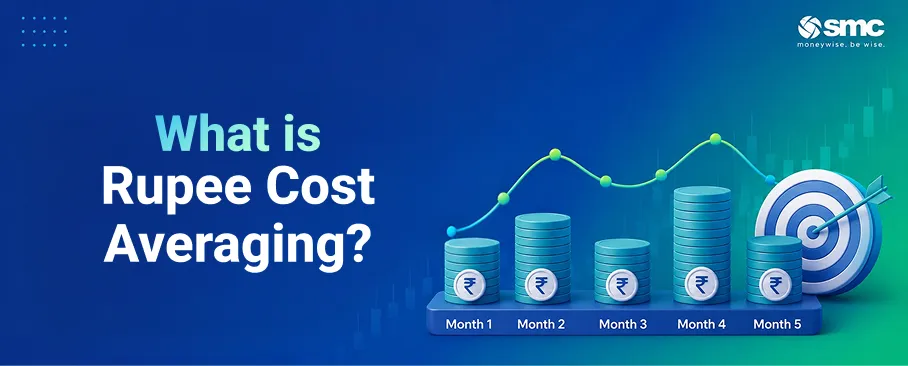


Investing in the stock market can be challenging, especially when prices fluctuate every day. Many investors often wonder whether it's the right time to invest, wait for a market correction, or invest a lump sum. Since consistently predicting market movements is difficult, many investors prefer a disciplined investment strategy known as rupee cost averaging.
Rupee cost averaging helps investors reduce the impact of market volatility by investing a fixed amount at regular intervals, regardless of whether markets are rising or falling. Instead of worrying about market timing, investors focus on staying consistent with their investments.
In this article, we'll understand what rupee cost averaging is, how it works, its benefits, and how investors can use this strategy to build long-term wealth.
What Is Rupee Cost Averaging?
Rupee cost averaging is an investment strategy in which a fixed amount of money is invested at regular intervals such as monthly, quarterly, or annually, irrespective of market conditions.
Since the investment amount remains the same, investors purchase more units when prices are low and fewer units when prices are high. Over time, this helps average the purchase cost of investments and reduces the impact of short-term market fluctuations.
Rather than trying to predict market highs and lows, investors follow a disciplined investment approach and allow market movements to work in their favour over the long term.
How Does Rupee Cost Averaging Work?
Let's understand this with a simple example.
Suppose you invest ₹5,000 every month in a mutual fund through a Systematic Investment Plan (SIP).
The average purchase cost is calculated using the following formula:
Average Cost Per Unit = Total Investment ÷ Total Units Purchased
₹20,000 ÷ 209.73 = ₹95.38 per unit (approx.)
Although the NAV fluctuated between ₹80 and ₹120, your average purchase cost was ₹95.38 because you accumulated more units when prices were lower. This demonstrates how rupee cost averaging helps smooth the overall cost of investment over time.
Benefits of Rupee Cost Averaging
Rupee cost averaging offers several advantages, particularly for investors with long-term financial goals.
1. Reduces the Need to Time the Market
One of the biggest advantages of this strategy is that investors do not have to predict the best time to invest. Since investments are made at regular intervals, market timing becomes less important.
2. Helps Reduce the Impact of Market Volatility
During market declines, the same investment amount purchases more units, while during rising markets it purchases fewer units. Over time, this helps average the overall purchase price.
3. Encourages Disciplined Investing
Investing a fixed amount regularly helps develop financial discipline. Investors remain focused on their long-term goals instead of reacting to short-term market movements.
4. Spreads Investment Risk
Instead of investing the entire amount at one market level, investments are spread over multiple periods. This reduces the risk associated with investing a large amount at an unfavourable time.
5. Suitable for New Investors
Beginners often find it difficult to decide when to invest. Rupee cost averaging provides a simple, systematic approach that reduces much of the uncertainty associated with investing.
6. Supports Long-Term Wealth Creation
Consistent investing over several years allows investors to benefit from compounding while reducing the impact of short-term market fluctuations.
Understanding the Rupee Cost Averaging Formula
The formula used to calculate the average purchase cost is straightforward:
Average Cost Per Unit = Total Investment Amount ÷ Total Units Purchased
This formula helps investors determine the average price paid for each unit over time. It measures the average acquisition cost of investments and should not be confused with investment returns or profitability.
Rupee Cost Averaging vs Lump Sum Investing
Both investment approaches have their own advantages, but they suit different types of investors and market conditions.
Neither approach is universally better. The right choice depends on your financial goals, risk appetite, investment horizon, and available funds. Many investors even combine both strategies depending on their financial situation.
Where Can You Use Rupee Cost Averaging?
This strategy can be applied across different investment options, including:
- Mutual Fund SIPs: The most common way to implement rupee cost averaging.
- Exchange Traded Funds (ETFs): Investors can purchase ETF units periodically through stock exchanges.
- Direct Equity: Investors may choose to buy shares of selected companies at regular intervals rather than make a one-time investment.
- Gold ETFs and Gold Mutual Funds: Periodic investments in gold-based investment products can also benefit from rupee cost averaging.
Among these, SIPs remain one of the most popular methods for implementing this strategy because they automate regular investing and promote financial discipline.
Rupee Cost Averaging vs SIP: Are They the Same?
Many investors use the terms SIP and Rupee Cost Averaging interchangeably, but they are not the same.
A SIP is a mode of investing in which a fixed amount is automatically invested in a mutual fund at regular intervals.
Rupee Cost Averaging, on the other hand, is an investment strategy. By investing a fixed amount regularly through a SIP, investors automatically buy more units when prices are low and fewer units when prices are high, thereby averaging their purchase cost over time.
In simple terms, a SIP is one of the most popular ways to implement the rupee cost averaging strategy.
Common Mistakes to Avoid
Although rupee cost averaging is simple, investors should avoid these common mistakes:
1. Skipping Regular Investments
Missing SIP instalments or delaying investments disrupts the averaging process and reduces the strategy's effectiveness.
2. Stopping Investments During Market Corrections
Many investors discontinue investing when markets fall. However, market corrections allow investors to purchase more units at lower prices, which can help reduce the average cost over time.
3. Trying to Time the Market
Frequently stopping and restarting investments in response to short-term market movements defeats the purpose of rupee cost averaging. Consistency is more important than predicting market direction.
4. Expecting Quick Returns
Rupee cost averaging is designed for long-term investing. Investors should avoid judging its performance over short periods, as meaningful results generally become more evident over longer investment horizons.
How to Start Investing Using Rupee Cost Averaging
Getting started with this strategy is straightforward:
Step 1: Choose an Investment Option
Select an investment vehicle that aligns with your financial goals, such as a mutual fund, ETF, or individual stock.
Step 2: Decide on a Fixed Investment Amount
Choose an amount that comfortably fits your monthly budget and can be invested consistently.
Step 3: Set Up Automatic Investments
Automating investments through a Systematic Investment Plan (SIP) or periodic investment instruction helps maintain discipline and ensures consistency.
Step 4: Stay Invested
Avoid reacting to short-term market fluctuations. Continue investing regularly to benefit from the averaging effect over time.
Step 5: Review Your Portfolio Periodically
Review your investments periodically to ensure they remain aligned with your financial goals, risk profile, and investment horizon. Avoid making frequent changes based solely on short-term market movements.
Is Rupee Cost Averaging Suitable for You?
Rupee cost averaging may be suitable if you:
- Want to invest regularly without worrying about market timing.
- Have a fixed monthly income and prefer systematic investing.
- Are investing for long-term goals such as retirement, children's education, or wealth creation.
- Prefer a disciplined investment approach over frequent trading.
- Want to reduce the emotional impact of market volatility.
However, like any investment strategy, rupee cost averaging cannot eliminate market risk or guarantee profits. Investors should choose investments that align with their financial objectives and risk tolerance.
Conclusion
Rupee cost averaging is one of the simplest and most effective strategies for long-term investing. Instead of trying to predict market highs and lows, investors focus on investing a fixed amount consistently, allowing market fluctuations to average out the purchase cost over time.
While this strategy does not guarantee profits or protect against market risk, it can help mitigate volatility, encourage disciplined investing, and support long-term wealth creation.
Whether you are a first-time investor or an experienced market participant, combining rupee cost averaging with a well-diversified portfolio and a long-term investment approach can help you stay focused on your financial goals. Investors can also use investment platforms such as SMC Global Securities to access mutual funds, research insights, and investment solutions that support systematic investing.






 1800 11 0909
 smc.care@smctradeonline.com