
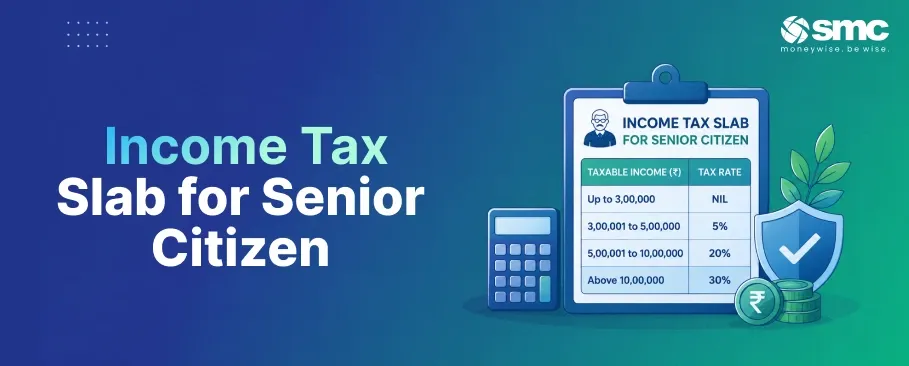


If you’re 60 or above, the term income tax slab for senior citizens is something you’ll likely come across while planning your taxes. It refers to the income brackets and applicable tax rates that determine how much tax you may have to pay. Understanding the senior citizen tax slab can help you plan your finances, make use of eligible deductions and rebates, and stay compliant with tax rules.
This article explains income tax for senior citizens, how the rules differ for those aged 60–80 and 80+, the available deductions and rebates, and how to choose between the old and new tax regimes.
#Who Counts as a Senior or Super Senior Citizen?
In India, taxpayers aged 60 years or above are generally classified into two groups for income-tax purposes:
- #Senior citizen: Age 60 years or above but below 80 years.
- #Super senior citizen: Age 80 years or above.
These age categories matter particularly under the old tax regime, where senior and super senior citizens have different basic exemption limits. Under the new tax regime, the slab rates are generally the same irrespective of age.
#Basic Exemption Limits – What You Can Earn Tax-Free
Under the old tax regime:
- If you are aged 60 to below 80 years, the basic exemption limit is ₹3 lakh.
- If you are 80 years or above, the basic exemption limit is ₹5 lakh.
Under the new tax regime, the basic exemption limit is ₹4 lakh, regardless of whether the taxpayer is a senior or super-senior citizen.
So, when you look at the income tax slab for senior citizens above 60 years, remember that the age-based difference in the basic exemption limit applies under the old regime.
#Tax Slabs: Old Regime vs New Regime
#A. Old Tax Regime – Senior Citizens (60–80)
For senior citizens aged 60 years or above but below 80 years:
#B. Old Tax Regime – Super Senior Citizens (80+)
For taxpayers aged 80 years or above:
#C. New Tax Regime
Under the new tax regime for AY 2026–27, the slabs are the same for senior and super senior citizens:
- #Up to ₹4 lakh: 0%
- #₹4 lakh–₹8 lakh: 5%
- #₹8 lakh–₹12 lakh: 10%
- #₹12 lakh–₹16 lakh: 15%
- #₹16 lakh–₹20 lakh: 20%
- #₹20 lakh–₹24 lakh: 25%
- #Above ₹24 lakh: 30%
For eligible resident individuals, the Section 87A rebate under the new regime can reduce tax liability to zero where taxable income does not exceed ₹12 lakh, subject to the applicable conditions.
#Quick Table of Rates
#Old Regime – 60–80 years
#Old Regime – 80+ years
#New Regime – Senior and Super Senior Citizens
#Standard Deduction and Rebate Benefits for Senior Citizens
The standard deduction depends on the type of income and the tax regime applicable to the taxpayer. For salaried individuals and pensioners, the standard deduction under the new regime is ₹75,000, while under the old regime it is ₹50,000.
The new regime also provides a higher Section 87A rebate for eligible resident individuals. For AY 2026–27, the maximum rebate is ₹60,000 where taxable income does not exceed ₹12 lakh, subject to the applicable conditions.
#Rebate and Surcharge Details
Section 87A can provide a tax rebate to eligible resident individuals.
Under the new tax regime for AY 2026–27, a rebate is available up to ₹60,000 if taxable income does not exceed ₹12 lakh, subject to applicable conditions.
Under the old regime, the rebate can be up to ₹12,500 where taxable income does not exceed ₹5 lakh.
A surcharge may also apply when total income crosses the prescribed thresholds. The surcharge rate depends on the income level and the chosen tax regime.
#Choosing Between the Old and New Tax Regimes for Senior Citizens
Choosing between the old and new tax regimes depends on your income, deductions and overall tax position. Here’s a simple comparison.
#The Old Tax Regime
The old regime allows taxpayers to claim a wider range of deductions and exemptions.
#Here’s what it offers:
- #More deductions: Eligible senior citizens can claim deductions under sections such as 80C, 80D, 80DDB and 80TTB, subject to the applicable conditions.
- #Higher basic exemption for seniors: The basic exemption limit is ₹3 lakh for senior citizens and ₹5 lakh for super senior citizens.
- #Tax-saving options: If you have significant eligible deductions and exemptions, the old regime may be worth considering.
#The New Tax Regime
The new regime has simpler slabs and is the default tax regime for individuals and HUFs, although eligible taxpayers can opt for the old regime.
#Here’s what it offers:
- #Simplified tax structure: The regime has lower slab rates across a wider range of income.
- #Higher standard deduction: Salaried individuals and pensioners can claim a standard deduction of ₹75,000.
- #Fewer deductions: Most deductions available under the old regime cannot be claimed under the new regime.
The right choice depends on how much income you earn and the deductions you are eligible to claim. It is better to compare the tax liability under both regimes before making a decision.
#What About Super Senior Citizens?
If you are #80 years or older, you fall under the super senior citizen category.
- Under the old regime, the basic exemption limit is ₹5 lakh.
- Under the new regime, the basic exemption limit is ₹4 lakh, the same as for other individual taxpayers.
- The tax slabs under the new regime do not differ based on age.
Therefore, the old regime may offer an advantage to a super-senior citizen with eligible deductions. Still, the final choice should be based on the individual's complete income and tax position.
#Deductions That Senior Citizens Can Claim (Under the Old Regime)
If you choose the old tax regime, some important deductions available to eligible senior citizens include:
- #Section 80C: Deduction of up to ₹1.5 lakh for eligible investments and payments such as PPF, EPF, life insurance premiums and specified fixed deposits.
- #Section 80D: Senior citizens can claim a deduction of up to ₹50,000 for eligible medical insurance premiums, subject to the applicable conditions.
- #Section 80DDB: Deduction of up to ₹1 lakh for eligible expenses incurred for the treatment of specified diseases in the case of a senior citizen, subject to the prescribed conditions.
- #Section 80TTB: Deduction of up to ₹50,000 on eligible interest income from deposits with banks, post offices or co-operative banks.
These deductions can reduce taxable income for senior citizens who meet the eligibility requirements.
#Why It Matters – Benefits & Practical Tips
Understanding the income tax slab for senior citizens aged 60 and above is more than just knowing the applicable rates. It can help you plan your finances and choose the tax regime that works better for your situation.
- Knowing the applicable tax slab helps you estimate your tax liability.
- Comparing both regimes can help you determine whether claiming deductions under the old regime is beneficial.
- Senior citizens should also consider eligible benefits such as Section 80TTB, 80D and 80DDB while planning their taxes.
- The Section 87A rebate under the new regime can significantly reduce the tax liability of eligible resident taxpayers.
Keeping track of the latest tax rules can help you make informed decisions and avoid surprises while filing your return.
#Conclusion
Understanding the income tax slab for senior citizens can help you plan your finances more effectively. Whether you are between 60 and 80 or fall under the super senior citizen category, the applicable tax treatment depends on the regime you choose, your income and the deductions or rebates you qualify for.
The old regime can be useful for those with substantial eligible deductions, while the new regime offers simpler slabs and fewer deductions. Comparing your tax liability under both regimes is therefore important before making a choice.
SMC Global Securities provides financial information, tools and services to help investors make informed financial decisions.


 1800 11 0909
 smc.care@smctradeonline.com