
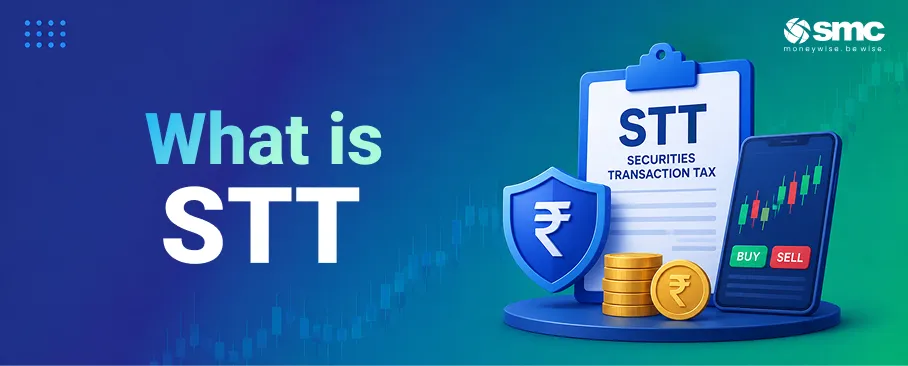


Securities Transaction Tax (STT) is a tax levied by the Government of India on the value of specified transactions executed on recognised stock exchanges. Introduced by the Finance (No. 2) Act, 2004, it was designed to capture tax directly at the point of exchange and minimise evasion. Unlike capital gains tax, which applies to your net profit, STT is a pure turnover tax; it applies to the total value of your trade whether you exit at a profit or a loss, and it is collected through the exchange and settlement system and reflected in your broker’s contract note.
In this blog, we'll look at the current 2026 STT charges by segment, how the auto-deduction is calculated, how the tax is treated in your income-tax return, and what it means for your trading costs.
The Current 2026 Securities Transaction Tax Schedule
Rates vary sharply by asset class and by the nature of settlement. The government keeps the tax on physical equity delivery moderate while pressing harder on high-frequency derivative trading. Following the latest Union Budget, effective 1 April 2026, the STT schedule mandates materially higher costs for futures and options traders.
2026 Rate Matrix
The most disruptive change here is the jump in derivative taxation. Previously, STT on futures sales was 0.02% and on options sales was 0.10%. The hikes to 0.05% and 0.15%, respectively, were designed to serve as a friction barrier against the explosion in very-short-expiry options trading. Intraday equity traders should note that the 0.025% tax applies only to the sell side, a slight relief compared with the double-sided taxation of delivery trades.
How Auto-Deduction and Settlement Work
You never pay STT to the government manually. The whole collection mechanism is automated and embedded in the settlement cycle: whenever you trade, your broker calculates the exact liability, debits it immediately from your trading ledger, and itemises it on your daily contract note. The exact calculation, however, varies by instrument, and brokers apply specific rounding rules and valuation metrics.
Calculating Delivery Average Prices
Because delivery trades are taxed on both the buy and sell side, brokers calculate a volume-weighted average price.
- Buy 500 shares at ₹100 each, and your buy turnover is ₹50,000. STT on the buy side is 0.10% of ₹50,000 = ₹50.
- Sell those 500 shares a month later at ₹105 each, and your sell turnover is ₹52,500. STT on the sell side is 0.10% of ₹52,500 = ₹52.50.
- The STT amount is rounded to the nearest rupee, so your ledger is debited exactly ₹53 for the sell leg.
Calculating Option Intrinsic Value
The most dangerous trap is letting an in-the-money option be exercised, which triggers the exercise tax.
- Say you hold one lot of 50 units of a Nifty call with a strike of 17,300.
- If the market expires at 17,350, the contract is in the money. Intrinsic value is the difference between spot and strike, multiplied by lot size.
- Here, the intrinsic difference is ₹50. Multiplied by the 50-unit lot, the intrinsic value is ₹2,500.
- The broker debits 0.15% of that ₹2,500 intrinsic value, resulting in a tax of about ₹4, rounded.
Capital Gains versus Business Income Deductibility
A common misconception is how STT interacts with your income-tax return. Its deductibility depends entirely on how you classify your trading activity.
Investor Classification (ITR-2)
If you buy and sell shares for long-term wealth creation, your profits are capital gains. Under those rules, STT is treated as a personal expense; you cannot deduct it from your profit to lower your capital-gains liability, add it to your acquisition cost, or subtract it from your sale consideration. It is a sunk cost.
Business Classification (ITR-3)
If you actively trade intraday equities or derivatives, that activity is classified as business income under "Profits and Gains from Business or Profession."
- Under Section 36(1)(xv) of the Income Tax Act, you can claim STT as a deductible business expense.
- If your derivative trading made a gross profit of ₹5,00,000 for the year and you paid ₹80,000 in STT, you can deduct the full ₹80,000 from gross profit.
- You then pay income tax only on the remaining net profit of ₹4,20,000.
To claim this, you must file ITR-3 and maintain proper books of account. Trying to claim it while filing ITR-2 will trigger a defective-return notice.
Why STT Also Unlocks Lower Capital-Gains Tax
STT is not only a cost; for certain listed-equity transactions, payment of STT is one of the conditions for availing concessional capital-gains tax rates. Under Section 111A, short-term gains on listed shares and equity-oriented funds are taxed at 20% when the applicable STT conditions are met; under Section 112A, long-term gains above the ₹1.25 lakh annual exemption are taxed at 12.5% when the applicable conditions are met. So while STT adds to your trading cost, it can also be relevant to the concessional tax treatment of certain equity gains, and this trade-off is worth remembering when comparing on-market and off-market routes.
Impact on Trading Strategies and Execution Costs
The 2026 hike changes the maths of high-frequency strategies. Scalpers who capture tiny price movements must now clear a higher profit target on every trade just to break even against the tax.
Combine the 0.05% futures STT with exchange transaction charges, SEBI turnover fees, stamp duty, and 18% GST on broker services, and the total friction becomes a serious hurdle. Strategy developers should update their backtesting to the 2026 parameters; a strategy that looked profitable under the old 0.02% futures regime may bleed capital under the 0.05% reality.
Investments in securities markets are subject to market risks. Read all the related documents carefully before investing.
Conclusion
STT is a small percentage on paper, but as a turnover tax it applies to every trade regardless of outcome, and after the 2026 hike, it is a real drag on active F&O strategies. Know the rate for each segment you trade; remember it is deductible only if you file as a business under ITR-3; and build the current figures into your cost calculations before assuming a strategy is profitable.
The one part you can control is your broker and execution quality, so choose them deliberately. When you're ready to trade with clear, itemised cost reporting, you can open a Demat account with SMC.

 1800 11 0909
 smc.care@smctradeonline.com