
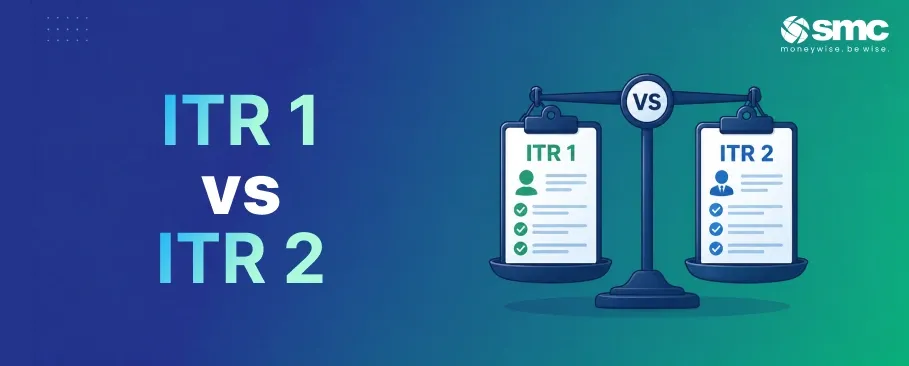


Filing your income tax return can get confusing when you have to choose between different ITR forms. The most common question is: ITR 1 vs ITR 2 – which one should you file?
The answer depends on your residential status, income sources, capital gains, assets and other financial details. Let’s understand the difference between ITR 1 and ITR 2 and when you need to use each form.
What is ITR?
An Income Tax Return (ITR) is a form used to report your income, deductions, taxes paid and tax liability to the Income Tax Department after the end of the financial year. Generally, for salaried taxpayers, the due date for filing the return is 31st July, unless extended by the government.
The correct ITR form depends on the type of income you earn and your financial circumstances.
ITR 1 vs ITR 2: What is the Difference?
The key difference between ITR 1 and ITR 2 lies in the types and complexity of income that can be reported.
ITR 1 (Sahaj)
ITR 1 is meant for resident individuals with total income up to ₹50 lakh. It can generally be used when income comes from:
- Salary or pension
- One house property
- Other sources such as interest, family pension and dividend
- Agricultural income up to ₹5,000
- Certain long-term capital gains under Section 112A, up to ₹1.25 lakh
However, ITR 1 cannot be used in several situations, including when the taxpayer has short-term capital gains; long-term capital gains under Section 112A exceeding ₹1.25 lakh; foreign assets or income; unlisted equity shares; or is a director of a company.
ITR 2
ITR 2 is meant for individuals and HUFs who do not have income from business or profession and are not eligible to file ITR 1.
It can cover income from:
- Salary or pension
- House property, including more than two house properties
- Short-term or long-term capital gains
- Other sources
- Agricultural income exceeding ₹5,000
ITR 2 is also applicable when total income exceeds ₹50 lakh, provided the taxpayer has no income from business or profession. It is also applicable in certain cases involving directors of companies, holders of unlisted equity shares, and taxpayers with specified foreign assets or income.
ITR 2 Filing: When Should You Use It?
You may need to file ITR 2 if:
- You have short-term or long-term capital gains that cannot be reported through ITR 1.
- You have income from more than the permitted house-property conditions for ITR 1.
- You are a director in a company.
- You held unlisted equity shares during the relevant year.
- You have foreign assets or foreign income.
- Your total income exceeds ₹50 lakh.
- You are an individual or HUF without business or professional income and are otherwise not eligible for ITR 1.
So, ITR 1 vs ITR 2 is not simply about whether you earn capital gains. Certain capital gains can be reported in ITR 1, while others require ITR 2.
ITR 2 Format: What Does It Include?
ITR 2 contains multiple schedules to capture different types of income and financial information.
Some of the key sections include:
- Part A – General Information: Personal and filing-related details.
- Schedule S: Salary income.
- Schedule HP: Income from house property.
- Schedule CG: Capital gains.
- Schedule OS: Income from other sources.
- Schedule FA: Details of foreign assets and income, where applicable.
- Schedule SI: Income chargeable at special rates.
- Schedule VI-A: Eligible deductions.
- Tax Paid: Details of TDS, advance tax and self-assessment tax.
- Verification: Declaration and verification of the return.
The exact schedules you need to complete depend on your income and circumstances. The ITR-2 form is therefore more detailed than the ITR-1 form.
How to File ITR 2?
Once you know that ITR 2 is the right form for you, the filing process is fairly straightforward. Keep your income and tax-related documents ready and follow these steps:
Step 1: Collect Your Documents
Keep documents such as Form 16, Form 26AS, AIS, capital gain statements, interest certificates and investment-related documents ready.
Step 2: Log in to the Income Tax Portal
Visit the official Income Tax e-Filing portal and log in using your PAN and other credentials.
Step 3: Select ITR 2
Go to e-File → Income Tax Returns → File Income Tax Return and select the relevant assessment year and ITR 2.
Step 4: Check Pre-filled Information
Review the information already available in the return, including salary, interest, TDS and other reported income.
Step 5: Add Required Details
Enter details that are not pre-filled, such as capital gains, house-property income, deductions and foreign assets or income, wherever applicable.
Step 6: Review and Submit
Validate the return, check the tax calculation and submit it after confirming that all details are correct.
Step 7: Verify Your Return
Complete the required e-verification after submission. The Income Tax Department currently provides ITR-2 filing through both online and offline utilities for AY 2026–27.
Difference Between ITR 1 and ITR 2
The important point is that ITR 2 is not simply the “higher-income” version of ITR 1. It is mainly used when an individual or HUF has income or circumstances that make them ineligible for ITR 1.
Common Mistakes to Avoid While Choosing Between ITR 1 and ITR 2
Choosing the correct ITR form is important. A few common mistakes can make the filing process unnecessarily complicated.
1. Choosing ITR 1 Without Checking Eligibility
Don't assume that being a salaried individual automatically makes you eligible for ITR 1. Check your capital gains, foreign assets, directorship status and other conditions first.
2. Assuming All Capital Gains Require ITR 2
This is a common misconception. Certain Section 112A long-term capital gains up to ₹1.25 lakh can be reported in ITR 1 if all other conditions are satisfied. However, short-term capital gains make the taxpayer ineligible for ITR 1.
3. Forgetting Foreign Assets or Income
If you have foreign assets or income, check the relevant disclosure requirements carefully. Such taxpayers generally need to use ITR-2 rather than ITR-1.
4. Not Checking AIS and Form 26AS
Before submitting your return, compare the income and tax details in your ITR with AIS and Form 26AS. This can help identify missing income or differences in TDS information.
Conclusion
Understanding the difference between ITR 1 and ITR 2 can make tax filing much easier. ITR 1 is designed for eligible individuals with relatively straightforward income, while ITR 2 is used when income or financial circumstances fall outside the conditions for ITR 1.
Before filing, carefully review your income sources, capital gains, foreign assets, and other details to select the correct form.



 1800 11 0909
 smc.care@smctradeonline.com