
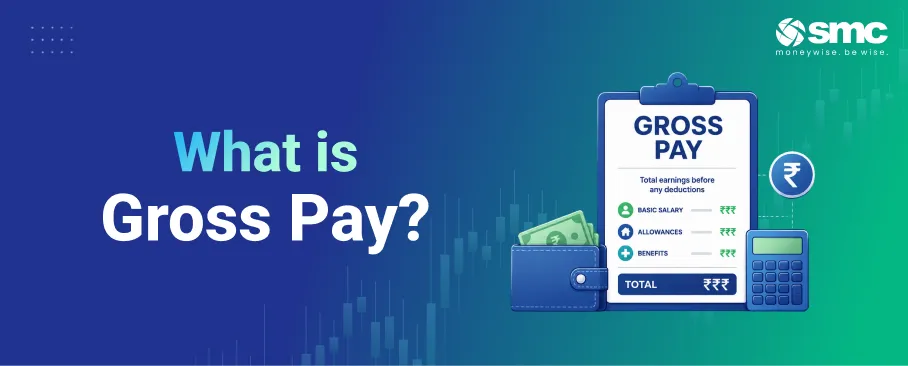


Gross pay is the figure that sits between your CTC and your take-home salary, making it one of the most useful numbers for understanding a payslip or comparing job offers. It shows how much of your compensation is actually paid as salary before statutory and voluntary deductions reduce the amount that reaches your bank account.
Knowing how gross pay is built also makes it easier to see why two employees with similar CTCs can receive different net salaries. In this blog, we'll explain how gross pay is calculated, which salary components are included, how it differs from CTC, basic salary, and net pay, and how the numbers work through practical examples in rupees.
What is gross pay?
Gross pay, also called gross salary, is the total amount your employer pays you before any deductions are applied. It is the sum of your basic pay, dearness allowance, house rent allowance and every other allowance you receive, taken before provident fund, professional tax or TDS is removed.
The gross pay definition that matters on a payslip is narrower than the tax definition. Under Section 17 of the Income-tax Act, 1961, salary is an inclusive term that includes gratuity, pensions, perquisites, commissions, and leave encashment. Payroll teams track several of those separately, so treat the payslip version, basic plus allowances before deductions, as the working definition, and the Income Tax Act version as the wider base used to compute tax.
The gross pay formula
The formula works in two directions depending on which number you already have.
Built up from components:
Gross pay = Basic Salary + DA + HRA + other allowances + Bonus and overtime
Gross pay represents the total earnings before deductions such as employee PF, ESI, professional tax and TDS. The exact components included can vary depending on the employer's salary structure.
What makes up your gross pay
Basic pay is the fixed core, fully taxable, and the base on which PF, gratuity and part of the HRA exemption are calculated. Dearness allowance is added to basic pay for PF purposes, as it forms part of retirement benefits. House rent allowance is partly exempt under Section 10(13A), yet counts fully towards gross pay whether or not you claim that exemption. Special allowances, overtime, and incentives are added on top and are fully taxable.
Allowances and reimbursements behave differently, and the distinction changes your gross figure. An allowance is a fixed amount paid whether or not you spend it, so it always forms part of gross pay. A reimbursement repays an actual documented expense and, when properly substantiated, is generally not treated as part of gross salary in the same way.
Gross pay, CTC, basic salary, and net pay
The gap between CTC and gross is the one that catches people out. CTC includes money your employer spends on you that never passes through your hands, so it will always read higher than the gross figure on your payslip.
What gets deducted from gross pay
- Employee provident fund: 12% of basic plus DA. The statutory wage ceiling for mandatory PF contributions is ₹15,000 a month, making the standard employee contribution ₹1,800 a month. Contributions on higher wages may be made subject to applicable EPF provisions.
- ESI: generally applies when wages are ₹21,000 a month or less, with special rules for employees with disabilities. The employee pays 0.75% and the employer 3.25%. Once you are covered, you stay covered for the rest of the contribution period even if a mid-period raise takes you past the ceiling.
- Professional tax: a state-level deduction, so the amount depends on where you work. Maharashtra charges nothing up to ₹7,500 a month and ₹200 above ₹10,000, while Karnataka charges nothing up to ₹25,000 and ₹200 above it. Annual liability is capped at ₹2,500 by law. Check your own state's portal, since states revise these without any central coordination.
- TDS on salary: calculated on your annualised taxable salary under whichever regime you have chosen. For FY 2026-27 (AY 2027-28), the new regime runs nil up to ₹4 lakh, then 5%, 10%, 15%, 20% and 25% through to ₹24 lakh, and 30% above that, with a standard deduction of ₹75,000 and a Section 87A rebate that leaves income up to ₹12 lakh effectively untaxed. The old regime remains nil up to ₹2.5 lakh, 5% to ₹5 lakh, 20% to ₹10 lakh, and 30% above ₹ 10 lakh, with a ₹50,000 standard deduction.
Worked examples in rupees
These three cases use the same method a gross pay calculator applies: EPF at 12% of basic plus DA, ESI where the ₹21,000 test is met, and gratuity provisioning at 4.81% of basic plus DA.
Example 1 sits inside the ESI ceiling, so both shares apply. Example 2 clears it by ₹9,000 and drops out of ESI entirely. Example 3 shows the PF ceiling at work, where basic pay of ₹50,000 far exceeds ₹15,000, so the employer has restricted the mandatory contribution to ₹1,800. That is common practice rather than a rule, which is one reason two people on identical gross pay can take home different amounts.
With an annualised gross of ₹12 lakh, Example 3 pays no tax under the new regime once the ₹75,000 standard deduction and the Section 87A rebate are applied. Under the old regime, the same salary amounts to roughly ₹1,63,800 a year, including cess, or about ₹13,650 a month.
Where your gross pay figure matters
Gross pay is often used as a reference point when another party needs to assess your earning capacity before deductions.
- Loans and credit cards: Lenders may use gross monthly income, along with existing liabilities, credit history, and other eligibility criteria, when assessing repayment capacity.
- Rental and visa applications: Payslips and salary certificates showing gross pay are commonly used as proof of employment income when such documentation is required.
- Salary comparisons: Gross pay helps compare offers more consistently when employers structure allowances and deductions differently.
- Income documentation: Gross salary is a standard figure on payslips and salary certificates and is often used to establish regular employment income.
- HRA calculations: HRA exemption is not based on full gross pay. It uses basic salary plus qualifying DA for the relevant calculation.
Conclusion
Gross pay is the figure that connects the two numbers people actually care about. Work down from CTC by removing what your employer spends but never pays you, then work down again by removing PF, ESI, professional tax and TDS to reach what lands in the bank.
Once you know your real monthly surplus, putting a part of it to work each month is the natural next step, and you can open a demat account with SMC to begin investing it.

 1800 11 0909
 smc.care@smctradeonline.com