


When it comes to filing your Income Tax Return (ITR), one of the first questions is: “Which ITR form should I file?”
The answer depends on your sources of income, residential status, taxpayer category, and other financial details. The Income Tax Department has seven main ITR forms, from ITR 1 to ITR 7, with each form designed for a specific category of taxpayers.
Whether you are a salaried individual, freelancer, business owner, company or trust, choosing the right ITR form is an important part of filing your return correctly.
For AY 2026–27, taxpayers are filing returns for income earned during FY 2025–26. Here’s a simple guide to the different types of ITR forms and who should use them.
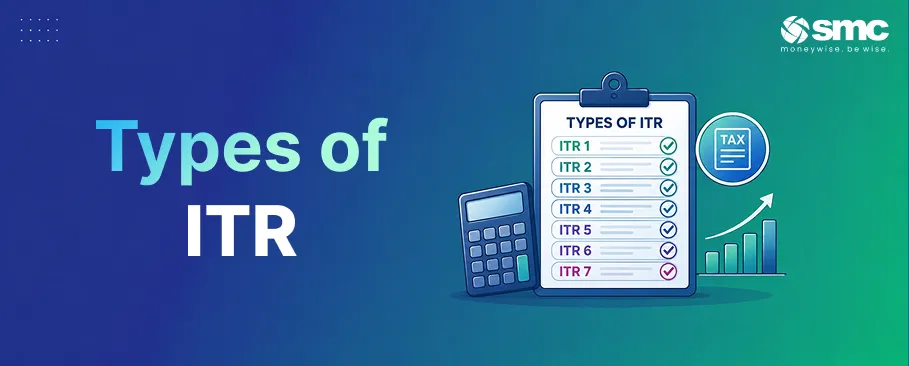
What Are the Types of ITR?
ITR stands for Income Tax Return. It is a form through which taxpayers report their income, deductions, taxes paid and other required information to the Income Tax Department.
There are seven main ITR forms:
- ITR 1 (Sahaj)
- ITR 2
- ITR 3
- ITR 4 (Sugam)
- ITR 5
- ITR 6
- ITR 7
Each form is meant for a different category of taxpayer. Choosing the correct form is important because filing an inappropriate return can result in the return being treated as defective and may require correction or refiling.
Why Is It Important to Choose the Right ITR Form?
The correct ITR form depends on more than just your salary or total income.
For example, a salaried person with certain capital gains may need to use ITR-2 instead of ITR-1. Similarly, a freelancer earning professional income may need ITR 3 or, if eligible for presumptive taxation, ITR 4.
Therefore, before deciding which ITR to file, check your income sources, capital gains, house properties, foreign assets and other applicable conditions.
Types of ITR Forms for Individuals and HUFs
The first four ITR forms mainly cover individuals and Hindu Undivided Families (HUFs). The form you need depends largely on your source of income and whether you have business or professional income.
ITR 1 (Sahaj)
Who Can File ITR 1?
ITR-1 can be filed by a resident individual who is not a Not Ordinarily Resident (RNOR) and whose total income does not exceed ₹50 lakh.
The income can include:
- Salary or pension
- Income from up to two house properties
- Income from other sources such as interest, family pension and dividend
- Agricultural income up to ₹5,000
- Long-term capital gains under Section 112A up to ₹1.25 lakh
Who Cannot File ITR 1?
ITR 1 cannot be used if, among other conditions, you:
- Have short-term capital gains
- Have Section 112A long-term capital gains exceeding ₹1.25 lakh
- Have total income exceeding ₹50 lakh
- Have income from business or profession
- Are a director in a company
- Have held unlisted equity shares during the relevant previous year
- Have certain foreign assets or foreign income
- Have income from more than two house properties
- Have certain other specified types of income
In simple terms: ITR 1 is meant for eligible resident individuals with relatively straightforward income from salary or pension, up to two house properties, other sources and certain Section 112A capital gains.
ITR 2
ITR 2 is meant for individuals and HUFs who do not have income from business or profession and are not eligible to file ITR 1.
It can be used when you have income from:
- Salary or pension
- One or more house properties
- Short-term or long-term capital gains
- Other sources
- Agricultural income exceeding ₹5,000
There is no ₹50 lakh total-income limit for ITR 2. It can also be used by individuals who are company directors or have held unlisted equity shares, subject to the applicable conditions.
What Is ITR 2 Used For?
If you have sold shares, mutual funds or property and have capital gains, own multiple house properties, or have certain foreign assets or income, ITR 2 may be the appropriate form, provided you do not have business or professional income.
ITR 3
ITR 3 is meant for individuals and HUFs having income from profits and gains of business or profession who are not eligible to file ITR 1, ITR 2 or ITR 4.
It can include income from business or profession along with other income such as:
- Salary
- House property
- Capital gains
- Other sources
If you are a freelancer, consultant, professional, or self-employed person with business or professional income and do not qualify for ITR 4, ITR 3 may be applicable to you.
ITR 4 (Sugam)
ITR 4 is a simplified return form for eligible resident individuals, HUFs, and firms other than LLPs that have income from business or profession computed under the presumptive taxation provisions of Sections 44AD, 44ADA, or 44AE.
For AY 2026–27, the total income limit for ITR 4 is ₹50 lakh.
It can also include:
- Salary or pension
- Income from up to two house properties
- Other sources such as interest and dividend
- Agricultural income up to ₹5,000
- Section 112A long-term capital gains up to ₹1.25 lakh
ITR 4 is a simplified return form available to eligible taxpayers opting for the applicable presumptive taxation provisions.
Who Cannot File ITR 4?
ITR 4 cannot be used by taxpayers who, among other conditions:
- Have short-term capital gains
- Have Section 112A LTCG exceeding ₹1.25 lakh
- Have total income exceeding ₹50 lakh
- Are directors in a company
- Have held unlisted equity shares
- Have certain foreign assets, signing authority in a foreign account, or foreign income
- Have income from more than two house properties
- Are not otherwise covered by the eligibility conditions
ITR 1 vs ITR 2: Key Difference
The important point is that ITR 1 vs ITR 2 is not simply about whether you earn capital gains. Certain Section 112A long-term capital gains can be reported in ITR 1, while other capital gains require ITR 2 if the taxpayer does not have business or professional income.
Types of ITR Forms for Firms, Companies and Other Entities
The remaining ITR forms are primarily intended for firms, companies, trusts, and other specified entities. Choosing the correct form depends on the taxpayer's legal status and the provisions under which the return must be filed.
ITR 5 – For Firms, LLPs and Certain Other Entities
ITR 5 is generally used by:
- Firms
- Limited Liability Partnerships (LLPs)
- Association of Persons (AOPs)
- Body of Individuals (BOIs)
- Artificial juridical persons
- Local authorities
- Cooperative societies
- Certain other entities
ITR 5 is not meant for individuals, HUFs or companies, as separate ITR forms apply to these taxpayers.
ITR 6 – For Companies
ITR 6 is meant for companies other than those required to file a return under Section 139(4A), 139(4B), 139(4C) or 139(4D).
Companies filing ITR 6 generally have to provide detailed information about their income, financial statements, depreciation and other tax-related details.
The return must be furnished electronically with a digital signature.
ITR 7 – For Trusts, Political Parties and Certain Institutions
ITR 7 is used by persons, including companies, who are required to furnish a return under:
- Section 139(4A): Persons receiving income from property held under a trust or other legal obligation wholly or partly for charitable or religious purposes
- Section 139(4B): Political parties
- Section 139(4C): Certain specified institutions, associations and entities
- Section 139(4D): Universities, colleges and other specified educational institutions
Therefore, ITR 7 is generally associated with charitable or religious trusts, political parties and certain specified institutions.
Quick Comparison of All ITR Forms
Which ITR Form Should You File?
If you are still wondering which ITR to file, start by identifying your taxpayer category and sources of income.
If you are an individual:
- Salary/pension and other specified simple income up to ₹50 lakh: ITR 1 may apply.
- Capital gains or other circumstances that make you ineligible for ITR 1, but no business/professional income: ITR 2 may apply.
- Business or professional income: ITR 3 may apply.
- Eligible business or professional income under presumptive taxation: ITR 4 may apply.
If you are an entity:
- Firm/LLP/AOP/BOI and certain other entities: ITR 5 may apply.
- Company: ITR 6 may apply, subject to the specific provisions.
- Specified trusts, political parties and institutions: ITR 7 may apply.
The exact form should always be selected after checking the eligibility conditions applicable to your particular circumstances.
Common Mistakes While Choosing an ITR Form
1. Assuming Every Salaried Person Can File ITR 1
Being salaried does not automatically mean that ITR 1 is the correct form. Capital gains, foreign assets, directorship, unlisted shares and other factors can affect eligibility.
2. Assuming Any Capital Gain Means ITR 2
This is also not always correct. Certain Section 112A long-term capital gains up to ₹1.25 lakh can be reported in ITR 1 if the taxpayer meets all other eligibility conditions.
3. Choosing ITR 4 Simply Because You Are a Freelancer
Freelancers with professional income may be eligible for ITR 4 only when they satisfy the conditions for presumptive taxation. Otherwise, ITR 3 may be required.
4. Ignoring Foreign Assets or Income
Foreign assets and income have specific disclosure requirements. Check your eligibility carefully before selecting ITR-1 or ITR-4.
5. Not Checking AIS and Form 26AS
Before filing, compare the information in your return with your Annual Information Statement (AIS) and Form 26AS. This can help identify differences in reported income, TDS and other transactions.
How to File Your Income Tax Return?
Once you identify the correct ITR form, you can file your return online through the Income Tax e-Filing portal.
Step 1: Log In
Log in to the Income Tax e-Filing portal using your PAN and password.
Step 2: Select the Assessment Year
Select AY 2026–27 for income earned during FY 2025–26.
Step 3: Select the Appropriate ITR
Choose the ITR form applicable to your income and taxpayer category.
Step 4: Check Pre-filled Information
Review details such as salary, interest, dividend, TDS and other information available in the return.
Step 5: Enter the Required Details
Add your income, deductions, capital gains, tax payments and other information required under the selected ITR form.
Step 6: Submit and Verify
Review the return, submit it and complete the required verification.
ITR Filing Deadline for AY 2026–27
For AY 2026–27, the original due date for taxpayers covered by the regular non-audit provisions was 31 July 2026.
For taxpayers having business or professional income whose accounts are not required to be audited, the due date was 31 August 2026.
Taxpayers subject to audit or other specified requirements may have different due dates.
If the original deadline is missed, a belated return may be filed subject to the applicable rules and late-filing consequences.


 1800 11 0909
 smc.care@smctradeonline.com