
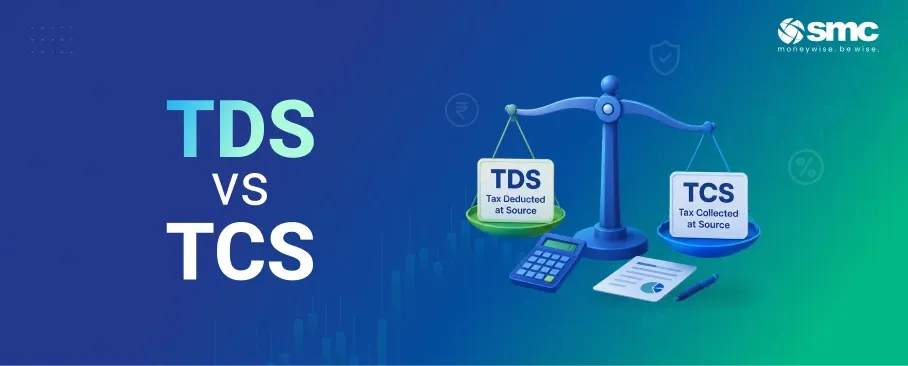


Taxes can feel intimidating, but understanding the basics does not have to be complicated. One topic that often confuses taxpayers, investors and business owners is the difference between TDS and TCS.
TDS stands for Tax Deducted at Source, while TCS stands for Tax Collected at Source. Although both are mechanisms for collecting tax during a transaction, they work differently.
In this guide, we explain what TDS and TCS are, how they differ, when they apply, and how taxpayers can track the tax credited to them.
#What is TDS (Tax Deducted at Source)?
TDS, or Tax Deducted at Source, is a mechanism under which tax is deducted from certain specified payments when they are made or credited, depending on the applicable provision.
For example, an employer deducts TDS from an employee's salary before paying it. Similarly, TDS may apply to certain payments, such as interest, rent, commissions, professional fees, and contractual payments, when the applicable conditions and thresholds are met.
The person making the payment is generally responsible for deducting the applicable tax and depositing it with the government.
#Example of TDS
Suppose a payment of ₹50,000 is subject to TDS at 10%. The payer deducts ₹5,000 as TDS and pays the recipient ₹45,000. The ₹5,000 deducted is deposited with the government and is generally available as a tax credit to the recipient, subject to reporting and matching in the tax records.
The exact TDS rate and threshold depend on the nature of the payment, the recipient's status, and the applicable tax provisions.
#TDS Under the Income-tax Act, 2025
From 1 April 2026, TDS provisions for transactions governed by the new law are covered under the Income-tax Act, 2025. The provisions have largely been consolidated into Sections 392 and 393. The Income Tax Department has clarified that the TDS rates and monetary thresholds have been retained; the major change is the consolidation and renumbering of provisions.
For transactions where the relevant credit or payment event occurred on or before 31 March 2026, the provisions of the Income-tax Act, 1961 continue to apply. For the relevant events occurring on or after 1 April 2026, the Income-tax Act, 2025 applies.
#What is TCS (Tax Collected at Source)?
#TCS, or Tax Collected at Source, works differently from TDS. Here, the seller or a designated collector collects tax from the buyer on certain specified goods or transactions and remits it to the government.
TCS applies only to transactions and categories specifically covered by the tax law. It is therefore not applicable to every sale of goods or services.
#Example of TCS
Suppose a transaction falls under a category on which TCS is applicable. The seller collects the prescribed tax from the buyer along with the transaction amount and deposits it with the government.
The buyer can generally claim the TCS as a tax credit when computing their final tax liability, subject to the tax records correctly reflecting the collection.
#TDS vs TCS: A Quick Comparison
In simple terms:
#TDS = Tax is deducted from certain payments.
#TCS = Tax is collected on certain specified transactions.
#TDS and TCS Rates
There is #no single TDS or TCS rate. The applicable rate depends on the nature of the payment or transaction, the recipient or buyer, applicable thresholds and other conditions prescribed under the tax law.
For example, TDS provisions cover categories such as salary, interest, rent, commission, professional fees, and contractual payments, with varying rates and thresholds.
Similarly, TCS provisions cover specified transactions such as certain sales and specified remittances.
Therefore, taxpayers should not apply a general TDS or TCS rate without checking the applicable provision, threshold and current tax rules.
The Income Tax Department has clarified that the commencement of the Income-tax Act, 2025 did not itself change the TDS rates and monetary thresholds.
#Why Do TDS and TCS Exist?
TDS and TCS help the government collect tax during the year rather than waiting until taxpayers file their income tax returns.
These mechanisms serve several purposes:
- Facilitate collection of tax at the source of specified transactions
- Improve tax compliance and reporting
- Create a record of specified financial transactions
- Provide taxpayers with tax credits against their final tax liability
- Help reduce tax leakage and under-reporting
Although TDS and TCS work differently, both form part of the government's broader tax collection and reporting framework.
#TDS and TCS Compliance for Individuals and Businesses
The compliance requirements depend on the nature of the payment or transaction and whether the person is required to deduct or collect tax.
For example, an employer responsible for deducting TDS from salary has reporting obligations. Similarly, a business required to collect TCS on specified transactions must collect, deposit, and report the tax within the prescribed timelines.
Under the #Income-tax Act, 2025, TDS and TCS provisions have been reorganised, and the prescribed reporting forms have also been renumbered.
For example:
- #Form 138 is the quarterly statement for specified salary TDS reporting and was earlier known as Form 24Q.
- #Form 140 is the quarterly TDS statement for specified non-salary payments to residents and was previously known as Form 26Q.
- #Form 143 is the quarterly statement for specified TCS transactions.
The standard quarterly filing due dates are #31 July, 31 October, 31 January and 31 May for the respective quarters.
#How to Track TDS and TCS Credits
Keeping track of your TDS and TCS is important when filing your income tax return. The Income Tax Department provides two key tools for this purpose: Form 26AS and the Annual Information Statement (AIS).
#Form 26AS
Form 26AS primarily shows #TDS and TCS-related information associated with your PAN. You can access it through the income tax e-filing portal.
#Annual Information Statement (AIS)
AIS provides a broader view of the information reported to the Income Tax Department. Its TDS/TCS section displays tax deducted or collected at source, along with other reported financial information. Taxpayers can also provide feedback on information appearing in AIS.
Before filing your return, it is advisable to compare your TDS/TCS records with Form 26AS and AIS. If there is a mismatch, you may need to contact the relevant deductor or collector for correction. The Income Tax Department states that TDS credit claimed in the return is restricted to the amount reflected in Form 26AS.
#Is TDS Refundable? What About TCS?
TDS and TCS are #tax credits, rather than separate final taxes on top of your actual income tax liability.
Suppose your final tax liability for the year is ₹30,000, but you have ₹50,000 in eligible TDS and TCS credits. In this case, you will be eligible for a tax refund of ₹20,000.
However, you must understand that the actual refund will depend on the computation in your income tax return and the tax credit recognised by the Income Tax Department. Current income-tax return forms separately provide for TDS and TCS as taxes paid and calculate a refund where eligible taxes paid exceed the final liability.
#TDS vs TCS: What Taxpayers Need to Remember
The simplest way to remember the difference is:
#TDS: Tax is #deducted from certain payments before the recipient receives the amount.
#TCS: Tax is #collected on certain specified transactions by the person responsible for collecting it.
A few important points:
- Both TDS and TCS can become available as tax credit to the relevant taxpayer.
- The applicable rate and threshold depend on the nature of the payment or transaction.
- TDS/TCS information should be checked against your tax records before filing your return.
- Form 26AS and AIS can help identify discrepancies.
- TDS or TCS does not necessarily represent your final tax liability.
#Conclusion
Understanding the difference between TDS and TCS is important for individuals, investors, freelancers, landlords and businesses.
While TDS involves deducting tax from specified payments, TCS involves collecting tax on specified transactions. Both mechanisms help the government collect and track taxes during the year, while the tax credited to your PAN can generally be considered while calculating your final tax liability.
Keeping your TDS and TCS records up to date and checking Form 26AS and AIS before filing your income tax return can help you identify discrepancies and avoid unnecessary complications.
For investors and taxpayers, understanding these basic tax mechanisms can make managing investments, income and tax compliance considerably easier.


 1800 11 0909
 smc.care@smctradeonline.com