
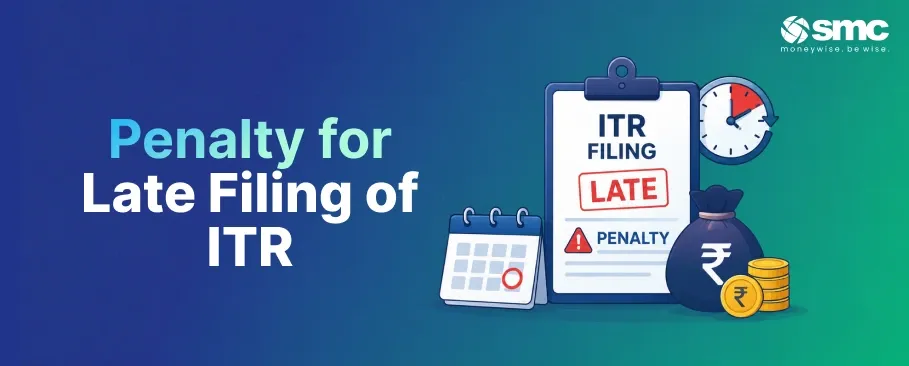


Filing an Income Tax Return (ITR) on time is important to avoid unnecessary costs and stay compliant with tax laws. If you miss the prescribed due date, you may have to pay a late filing fee under Section 428 of the Income-tax Act, 2025.
The late filing fee depends on your total income. In this guide, we’ll explain the penalty for late filing of ITR, how much you may have to pay, who needs to pay it, and what happens if you file your return after the deadline.
#What is the Penalty for Late Filing of ITR?
The penalty for late filing of ITR is the late-filing fee charged when a taxpayer submits their return after the prescribed due date.
For Tax Year 2026–27, Section 428 of the Income-tax Act, 2025 provides:
- ₹1,000 if your total income does not exceed ₹5 lakh.
- ₹5,000 in all other cases.
The fee is separate from any interest that may be payable on outstanding tax.
#Understanding Section 428 of the Income-tax Act, 2025
Section 428 of the Income-tax Act, 2025 deals with the fee for delayed filing of an income-tax return for Tax Year 2026–27 onwards.
The fee is:
This means the ₹5 lakh threshold determines the late filing fee amount. It should not be confused with the basic exemption limit under the tax regime.
#Late Filing Penalty Amount
Here’s a simple view of the late ITR filing penalty for Tax Year 2026–27:
So, if your total income is up to ₹5 lakh and you file your return late, the fee is ₹1,000. If your total income exceeds ₹5 lakh, the fee is ₹5,000.
#ITR Filing Due Dates for Tax Year 2026–27
The Income-tax Act, 2025 introduces the Tax Year system from 1 April 2026. Returns for income earned during 1 April 2026 to 31 March 2027 will therefore relate to Tax Year 2026–27.
The exact ITR due date depends on the taxpayer and on whether the return is subject to a tax audit or transfer pricing requirements. The Income Tax Department's e-filing system will provide the relevant filing option and deadline for each category.
If you miss the original due date, you can file a belated return, subject to the late-filing fee under Section 428. The new Act specifically provides this fee for returns from Tax Year 2026–27 onwards.
#What If You File Very Late or Don’t File at All?
Missing the ITR deadline can have consequences beyond the late filing fee.
- You may have to pay the late filing fee under Section 428.
- Interest may be charged on unpaid tax.
- Certain losses may not be carried forward when the return is filed late.
- The Income Tax Department may issue a notice if you fail to file a return that you were required to file.
- In serious cases of wilful failure to file a return, prosecution provisions may apply.
A belated return under Section 263(4) can be filed within 9 months from the end of the relevant Tax Year, or before completion of assessment, whichever is earlier.
#What About Interest on Tax Payable?
The late filing fee and interest on unpaid tax are separate.
If you have tax payable and do not pay it on time, interest can also be charged under the relevant provisions of the Income-tax Act, 2025. The amount depends on your tax liability and the period of delay.
Therefore, filing your return late can result in both a late filing fee and interest on unpaid tax.
#Late Filing Penalty for Salaried Individuals
Being a salaried employee does not automatically exempt you from filing an ITR.
If you are required to file a return and submit it after the prescribed due date, the Section 428 late filing fee applies:
- ₹1,000 if total income does not exceed ₹5 lakh.
- ₹5,000 if total income exceeds ₹5 lakh.
Even if your employer has deducted TDS from your salary, you may still need to file an ITR based on your income and other filing requirements.
#Late Filing Penalty for Freelancers and Business Owners
Freelancers, consultants, and business owners may have additional reporting and tax compliance requirements.
If you are required to file an ITR and miss the due date, the Section 428 late filing fee applies. The amount is:
- ₹1,000 for total income up to ₹5 lakh.
- ₹5,000 for total income above ₹5 lakh.
If tax remains unpaid, interest can also be charged separately.
#Late Filing Penalty for Senior Citizens
Income tax for senior citizens does not have a separate Section 428 late filing fee. The fee is determined by total income:
The tax regime and age-based tax slabs determine the tax payable, but they do not change the Section 428 fee amount.
#Can You Avoid the Penalty?
The simplest way to avoid the late filing fee is to file your ITR within the prescribed due date.
Section 428 provides for a late-filing fee when a return is filed after the due date. The fee is ₹1,000 when total income does not exceed ₹5 lakh, and ₹5,000 otherwise.
If you miss the original deadline, you can still file a belated return under Section 263(4) within the prescribed time limit. However, the late filing fee will apply.
#Belated Return vs Revised Return – Don’t Confuse
These two types of returns serve different purposes:
- Belated Return: Filed after the original due date.
- Revised Return: Filed to correct an error or omission in a return that has already been filed.
Under Section 263 of the Income-tax Act, 2025:
- A belated return can be filed within 9 months from the end of the relevant Tax Year, or before completion of assessment, whichever is earlier.
- A revised return can be filed within 12 months from the end of the relevant Tax Year, or before completion of assessment, whichever is earlier.
- Fee on late-filed revised return: If a revised return is filed after 9 months, Section 428 may levy a fee of ₹1,000 if the total income does not exceed ₹5 lakh, and ₹5,000 in other cases.
#Filing After the Deadline – Step-by-Step
If you have missed your ITR filing deadline, you can file a belated return through the Income Tax e-Filing portal.
- Visit the official Income Tax e-Filing portal.
- Log in using your PAN and password.
- Select Income Tax Return under the e-File section.
- Choose the relevant Tax Year.
- Select the option for filing a belated return.
- Enter your income, deductions and tax-paid details.
- Pay the Section 428 late filing fee, if applicable.
- Submit the return and complete the required verification.
The e-Filing portal supports return filing under both the Income-tax Act, 1961 and the Income-tax Act, 2025 during the transition period.
Once the return is submitted and verified, keep the acknowledgement and supporting documents for your records.
#Conclusion
Filing your ITR on time can help you avoid unnecessary fees, interest and compliance issues. For Tax Year 2026–27 onwards, the late filing fee is governed by Section 428 of the Income-tax Act, 2025.
The fee is ₹1,000 if total income does not exceed ₹5 lakh, and ₹5,000 if it exceeds ₹5 lakh. If you miss the original deadline, you can file a belated return under Section 263(4) within 9 months from the end of the relevant Tax Year, subject to the prescribed conditions.
SMC Global Securities offers financial information and services to help investors manage their financial and investment needs.


 1800 11 0909
 smc.care@smctradeonline.com