


Large-cap, mid-cap, and small-cap stocks classify listed companies by market capitalisation, giving investors a quick way to assess a company's size and its typical risk profile. In India, the categories are based on market-cap rankings: the top 100 companies are large-cap, companies ranked 101st to 250th are mid-cap, and those ranked 251st onward are small-cap. Because these rankings change with market value, a company can move from one category to another over time.
In this blog, we'll explain how market capitalisation works, how large-cap, mid-cap, and small-cap stocks differ in risk and growth potential, and where other labels such as blue-chip and penny stocks fit in.
What market capitalisation means
Market capitalisation, or market cap, is the total stock-market value of a company. You work it out with a single formula: the share price multiplied by the total number of shares the company has issued.
If a company has 50 crore shares and each share trades at ₹200, its market cap is 50 crore × ₹200 = ₹10,000 crore. As the share price moves through the day, so does the market cap.
The category system uses full market cap, which counts every share a company has issued, including promoter and government holdings. That is different from the free-float figure the stock exchanges use to build their indices, which counts only the shares freely available to trade.
How stocks are grouped into large-cap, mid-cap and small-cap
The three categories are based on rank, not on a fixed rupee amount. The Association of Mutual Funds in India, or AMFI, prepares the list based on average full market capitalisation data from the recognised stock exchanges and updates it every six months.
The split runs like this:
- The top 100 companies by market cap are large-cap.
- The next 150, ranked 101st to 250th, are mid-cap.
- Every company ranked 251st and below is small-cap.
Because the categories are ranked, the rupee value at each cut-off is not fixed. When the market rises, the market cap of the 100th or 250th company rises with it, so a company can move between bands over time as the list is refreshed.
This same list decides how equity mutual funds are labelled, so a large-cap fund invests in the top 100 companies and a small-cap fund in those ranked 251st and below. Knowing the band a company falls into gives you a quick read on where it sits in the market before you look any deeper.
Large-cap stocks
Large-cap stocks are shares of the country's biggest and most established companies. They generally have better liquidity than smaller companies, though liquidity varies by stock.
Because these businesses are mature, their share prices tend to swing less than smaller companies. Large-cap stocks are generally less volatile than mid- and small-cap stocks, although they can still experience significant declines. That relative steadiness is why large-caps are often held as the core of a portfolio, suited to investors with a moderate risk appetite and a three-year or longer horizon.
Mid-cap stocks
Mid-cap stocks sit between the two ends. These are growing companies past their early stages, but not yet among the largest, so they offer more growth potential than large caps but carry more risk.
Mid-caps draw plenty of trading interest for their size. As of 30 March 2026, the Nifty Midcap 150 accounted for about 18.18% of the free-float market value on the exchange but around 23.77% of its trading value. Their prices move more sharply through economic cycles, which is why mid-caps generally suit investors who can stay invested for five years or more.
Small-cap stocks
Small-cap stocks are shares of smaller companies, ranked 251st and below by market cap. They hold the widest range of businesses, from fairly liquid mid-sized firms to very small ones that trade thinly.
This band carries the highest risk. Small-cap stocks generally experience higher volatility and liquidity risk than large- and mid-cap stocks, and prices can fall sharply during market downturns. Over very long horizons, small-caps have delivered strong returns, but past performance does not guarantee future results. They usually suit investors with a high risk tolerance and a 7-10 year horizon, and are often held as a smaller satellite component of a wider portfolio.
Blue-chip, penny stocks and other labels you'll hear
You will hear other words used for stocks, and they are worth separating from the market-cap bands.
Blue-chip is a common term for large, well-known, financially sound companies. It usually overlaps with large-caps, but it is a colloquial description, not an official category defined by any regulator.
Penny stock refers to very low-priced, thinly traded shares. Investors sometimes treat small-cap and penny stock as the same thing, but they are not. Many small-caps are sizeable companies worth thousands of crores, whereas true penny stocks are often much smaller and riskier.
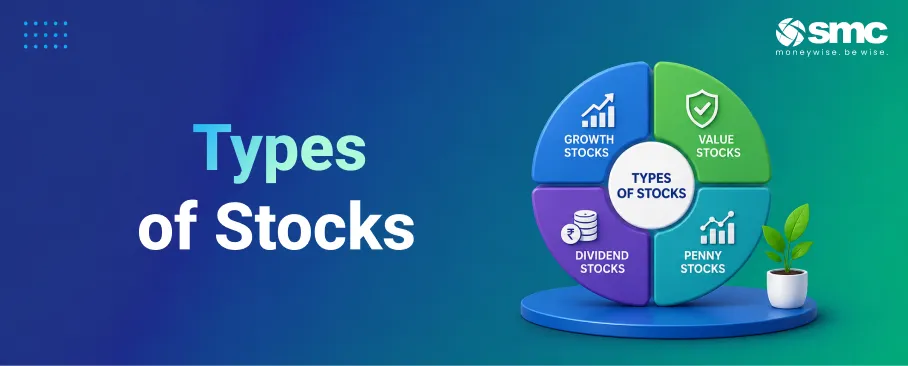
You may also see stocks split by style rather than size, such as growth versus value or cyclical versus defensive. These describe how a company earns or how its price behaves, and they cut across all three market-cap bands.
Conclusion
The large-cap, mid-cap and small-cap split gives you a quick way to judge the typical risk and growth profile of a stock. Large-caps tend to be more stable, mid-caps offer higher growth potential with more volatility, and small-caps carry the greatest upside potential along with the sharpest swings. A balanced portfolio can include all three, depending on your goals, risk appetite, and investment horizon.
Open a demat account with SMC to start building a portfolio across large-cap, mid-cap, and small-cap stocks.
Investments in securities markets are subject to market risks. Read all the related documents carefully before investing.





 1800 11 0909
 smc.care@smctradeonline.com