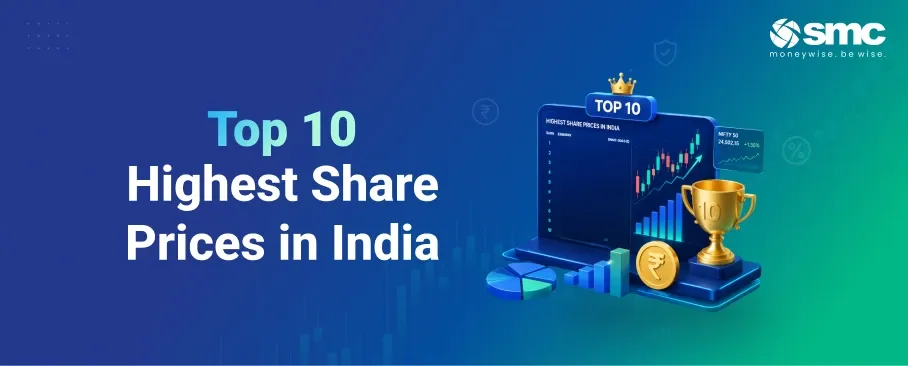


MRF trades at ₹1,26,390 per share, the highest stock price in India, yet its P/E ratio of 23.4x is lower than many mid-cap stocks priced under ₹500. A high share price does not mean a stock is overvalued.
Price reflects the number of shares outstanding, face value, and stock split history. Valuation measured by P/E, P/B, and ROE determines whether a stock is actually expensive relative to its earnings.
This guide ranks the 10 highest share price in india, explains why they trade at such levels, and covers what investors should evaluate before buying.
Top 10 Highest Share Price in India
Data as on April 2, 2026
What is the Difference Between High Share Price and High Valuation?
Share price is simply the cost of one unit of stock. It depends on face value, number of shares outstanding, and whether the company has ever split its stock. Valuation measures how expensive a business is relative to its earnings, book value, or sales.
MRF trades at ₹1,26,390 per share with a P/E of roughly 23.4x. Nestle India (no longer in this list) trades at just ₹1,191 per share but carries a P/E of 72.3x.
Despite MRF being over 100 times higher in share price, Nestle is far more "expensive" on a valuation basis relative to its earnings. Investors should focus on P/E, P/B, ROE, and ROCE when assessing whether a stock is worth buying, not the sticker price.
Why Do Some Stocks Trade at Very High Prices?
Five factors explain why certain Indian stocks trade command share prices in the tens of thousands or even lakhs.
No or rare stock splits: MRF has never split its stock; the last corporate action resembling a split was in 1975. By contrast, Nestle India executed a 1:10 split in January 2024, bringing its price from roughly ₹27,000 to ₹2,700.
Low public float and limited share availability: MRF has only approximately 42.4 lakh shares outstanding. Honeywell Automation India has a free float of just 24%. Fewer shares available for trading, combined with sticky institutional and retail holdings, keeps per-share prices elevated.
Strong brand dominance and pricing power: These companies typically hold monopoly or oligopoly positions in their niches, MRF in tyres, Page Industries with the exclusive Jockey licence, and Honeywell in industrial automation.
Consistent earnings over long periods: Companies like Abbott India and Page Industries have demonstrated decades of stable profitability, attracting long-term investors who rarely sell.
Face value: Companies with ₹10 face value (MRF, Page Industries, Bosch) naturally have higher per-share prices than peers with ₹1 face value. If the face value were the same across all companies, the price gaps would narrow significantly.
How Do the Top 10 Highest-Priced Stocks Compare?
1. MRF: India's Highest-Priced Stock
Best for: Investors seeking exposure to India's tyre market leader with demonstrated long-term wealth creation.
India's largest tyre manufacturer by revenue, with a market cap of ₹1,26,390 crore. MRF holds the strongest brand recall in the Indian tyre market, ahead of Balkrishna Industries and Apollo Tyres. The company has delivered consistent profitability over decades with an operating profit margin (OPM) of 15% in FY25.
The price is this high because MRF has never executed a stock split, maintains a face value of ₹10, and has only approximately 42.4 lakh outstanding shares. Promoters hold 27.73%, FIIs 18.18%, DIIs 12.50%, and retail investors 41.58% as of December 2025. The low debt/equity ratio of 0.16x and consistent dividends reinforce long-term investor confidence. MRF returned 12% returns over the last 1 year.
2. Elcid Investments: Hidden Holding Company Play
Best for: Investors who understand holding companies and are comfortable with low liquidity in exchange for deep value exposure.
Elcid Investments is an investment holding company with a significant stake in Asian Paints. Its extremely low liquidity and tiny market cap of ₹1,818 crore mean the share price is driven primarily by the value of its underlying holdings and minimal float, not business operations.
Financially, Elcid is almost debt-free, with very low return ratios (ROE 1.47%) since it operates as a passive investment vehicle with minimal operating income.
3. Page Industries: Exclusive Jockey Licensee
Best for: Quality-focused investors seeking high-ROE consumer plays with brand moats.
Exclusive licensee of Jockey International for India and 11 other countries. Also holds the Speedo licence for India. Page runs 16 production units across 2.9 million square feet, keeps over 70% of production in-house, and sells through 110,487 points of sale. Revenue is 98.5% from Jockey.
Exceptional ROE of 48.54% and ROCE of 59.4%, among the highest in Indian consumer markets. Near-zero debt. The exclusive licensing moat means no competitor can sell Jockey in India. Strong dividend yield of approximately 2.65% adds to investor stickiness.
4. Bosch: Auto Ancillary Leader
Best for: Investors seeking MNC-backed auto sector exposure with EV transition upside.
India's largest auto ancillary company by market cap (₹94,778), promoted by Robert Bosch GmbH of Germany. Historically dominant in diesel engine components with approximately 70% market share. Q3 FY26 saw a 16% year-on-year profit increase driven by 18.5% growth in the automotive segment product sales. The two-wheeler segment surged 58.3% due to OBDII norm compliance. Bosch operates the largest development centre outside Germany through 12 group companies in India.
MNC parentage (Robert Bosch GmbH holds the majority stake), face value of ₹10, and no stock splits keep the per-share price elevated. Bosch surged 18% in the last 1 year with a P/E of approximately 41x as compared to the auto ancillary sector median of 28-30x.
5. 3M India: Diversified Industrial Conglomerate
Best for: Investors looking for diversified MNC exposure across industrial verticals.
Indian subsidiary of 3M Company (US), a diversified technology and manufacturing leader. Revenue grew 12.7% in Q3 FY26 with broad-based growth across all segments: Safety & Industrial (+20.1%), Transportation & Electronics (+3.9%), Healthcare (+13.5%), and Consumer (+12.3%). Produces brands including Scotch-Brite and Post-it alongside medical equipment and industrial materials.
The P/E of 102x is high even relative to peers, reflecting the premium for extreme diversification across 11 priority verticals, from aerospace to semiconductors to home cleaning. Very limited competition for its branded industrial products, MNC parentage, and limited float all contribute to the elevated price.
6. Yamuna Syndicate: Trading and Distribution
Best for: Investors looking for steady cash-flow businesses with hidden value through a low-float structure.
Yamuna Syndicate operates as a trading and distribution company with a strong presence in automobile dealerships (primarily for Escorts Kubota Limited), petroleum products (HPCL lubricants), and electrical equipment.
The company generated a revenue of ₹65 crore with stable operating profit margins of 2% in FY25, typical for distribution businesses. It has a small market cap of ₹839 crore and an extremely limited equity base of around 307,370 shares, which results in very low liquidity and infrequent trading.
7. Honeywell Automation: Industrial Automation Pioneer
Best for: Investors seeking smart cities and infrastructure automation exposure.
Subsidiary of Honeywell International (Fortune 500). India's leading provider of integrated automation and software solutions across industrial automation, building management, aerospace, and IoT platforms.
Extremely low free float with the parent holding the dominant stake. Caters to a niche B2B industrial automation market with limited domestic competition. At a P/E of 46.4x, the stock trades at a significant premium reflecting both scarcity value and growth expectations.
8. Abbott India: Pharma MNC Powerhouse
Best for: Defensive investors seeking MNC pharma exposure with low debt.
Subsidiary of Abbott Laboratories (US). One of India's top pharma MNCs with 125+ products across women's health, gastroenterology, CNS, and metabolics. Key brands include Thyronorm (India's leading thyroid brand), Duphaston, Udiliv, and Digene (7% market share in antacids). The company has consistently outpaced the broader Indian pharmaceutical industry in growth.
Near-zero debt (D/E of 0), ROCE of 46.2%, and a P/E of approximately 36.6x, below its 10-year average of around 43x. The defensive nature of pharma, plus the power brand portfolio, keeps the stock sticky with institutional investors.
9. Hitachi Energy India: Power & Grid Infrastructure Leader
Best for: Investors seeking exposure to India’s power transmission and electrification
Hitachi Energy India is a leading player in power and grid infrastructure, and a subsidiary of Hitachi Ltd. The company provides products and solutions across transformers, high-voltage equipment, grid automation, and renewable integration.
Hitachi Energy India maintains healthy operating profit margins of 17% in FY25, with improving profitability due to operating leverage. The company is almost debt-free, backed by strong parentage and technology leadership. It trades at a premium valuation of 128x P/E, reflecting high growth expectations from India’s power capex cycle.
10. Shree Cement: Low-Cost Cement Producer
Best for: Investors seeking cement sector exposure with a clean balance sheet.
India's third-largest cement producer with an installed capacity of 46.4 MTPA and one of the lowest-cost producers in the country. Competes with UltraTech Cement and Ambuja Cements. Sales de-grew 5.49% YoY in FY25, but the company maintains a healthy operating profit margin of 20%.
High promoter holding (62.56%), face value of ₹10, and no stock splits keep the price elevated. The company trades at approximately 46.6x P/E, below the cement industry median of around 52.9x, reflecting its low-cost producer status and very clean balance sheet (D/E of 0.04).
Should You Invest in Stocks With High Share Prices?
High share price does not equal higher returns: A stock priced at ₹1,00,000 has no inherent advantage over one priced at ₹100. Returns depend on earnings growth, valuation, and business quality. MRF returned 12% in one year, while Shree Cement declined 25% in the same period, despite both being among the highest-priced stocks.
Evaluate valuation, not sticker price: P&G Hygiene trades at a P/E of 36.8x versus the FMCG industry P/E of 48.1x, meaning it is relatively undervalued despite a share price around ₹10,000. Meanwhile, 3M India at a P/E of 102x is expensive even for its sector. Always compare P/E to the industry average, review ROE, ROCE, and debt levels before buying.
Minimum purchase is 1 full share: Unlike US markets, where fractional shares are widely available, Indian exchanges require purchasing at least one complete share. Buying one share of MRF requires approximately ₹1.26 lakh. SEBI greenlighted a pilot for fractional shares through its innovation sandbox in July 2025, but the framework is not yet broadly available.
Alternatives to direct purchase: Investors can gain exposure to these stocks through mutual funds and ETFs that hold them in their portfolios. Index funds tracking the Nifty 50 or Nifty Next 50 contain several of these companies, offering indirect access without the high per-share cost.
High share price stocks require careful evaluation, from valuation metrics to capital allocation and long-term fit. Execution and access matter just as much as the idea itself.
Open a Demat account with SMC to start investing in equities with access to research insights and a reliable trading platform across segments.

 1800 11 0909
 smc.care@smctradeonline.com