
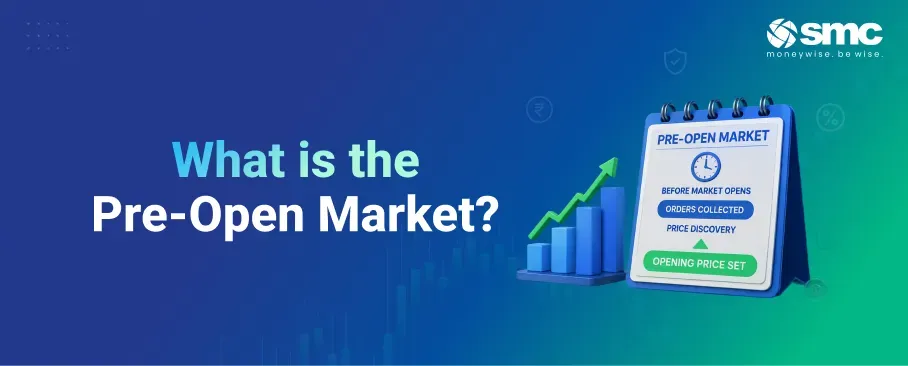


If you track stock prices before the opening bell, you may notice a short window during which buy and sell orders are collected, and an indicative opening price begins to take shape. This is known as the pre-open market. It bridges the gap between overnight developments and the start of regular trading, helping exchanges determine a fair opening price in an orderly manner, especially after significant news or events.
In this article, you will learn what the pre-open market is, how it works, how to trade during the pre-open session, and the role it plays in India's stock market.
Why Do Exchanges Have a Pre-Open Session?
Markets often react sharply to overnight developments such as corporate announcements, policy decisions, or global market movements. If all orders entered the market simultaneously at the opening bell, price volatility could increase significantly.
The pre-open market provides a structured environment to:
- Discover a fair opening price through a call auction mechanism.
- Reduce excessive volatility by matching the maximum possible buy and sell orders.
- Display an indicative opening price that helps market participants prepare before regular trading begins.
While the pre-open session cannot eliminate volatility, it helps ensure a smoother transition into the regular trading session.
The Three Phases of the Pre-Open Session
Although exchanges specify the exact timings, the process can be understood in three simple stages.
Order Entry
During this phase, investors place buy and sell orders. Orders can generally be entered, modified, or cancelled. Based on incoming demand and supply, exchanges also display an indicative opening price.
Order Matching
The exchange matches buy and sell orders to determine the price at which the highest tradable quantity can be executed. This price is known as the equilibrium price.
During this brief phase, order modifications and cancellations are generally not permitted while the matching process is underway.
Buffer and Transition
A short buffer period allows the exchange to complete system processes before the market moves into regular continuous trading.
Rather than focusing only on the pre-open market timing, it is more useful to understand the sequence: order collection, price discovery, and transition to live trading.
How the Equilibrium Price is Determined
The pre-open auction is designed to identify the price at which the maximum number of shares can be traded.
In simple terms:
- All eligible buy and sell orders are collected.
- The exchange identifies the price at which the maximum executable quantity is available.
- If more than one price satisfies this condition, additional exchange rules are applied, such as minimising unmatched orders and taking the previous closing price into account.
The resulting equilibrium price reflects the balance between eligible buy and sell orders at that point in time. It is not a prediction of where prices will move after the market opens.
Order Types in the Pre-Open Session
The order options available may vary depending on your broker and exchange rules.
Generally:
- Limit orders allow you to specify the maximum price you are willing to pay or the minimum price you are willing to accept. These are commonly used during the call auction.
- Depending on the exchange framework and your broker's platform, certain other order instructions may also be available. Always check the supported order types before placing an order.
- Order validity settings determine whether an unmatched order expires after the auction or continues into the regular trading session.
If you are new to pre-market trading, using limit orders can help you define your intended price more clearly and manage execution risk.
NSE Pre-Open Market vs BSE Pre-Open Market
You may come across the terms "NSE pre-open market" and "BSE pre-open market". Both exchanges use a call auction mechanism before regular trading to facilitate price discovery and determine the opening price.
Although certain operational rules may change over time, the overall objective remains the same: to ensure an orderly opening of the trading session.
How to Trade in the Pre-Open Market
Trading during the pre-open session is less about speed and more about preparation.
1. Prepare Before the Market Opens
- Track important corporate announcements, policy updates, earnings releases, and global market developments.
- Mark important support and resistance levels from the previous trading session.
- Focus only on stocks that are likely to be affected by overnight developments.
2. Build Possible Scenarios
- Assess whether the news is likely to impact the overall market or only specific stocks.
- Consider both positive and negative outcomes before placing any order.
- Prepare an alternative plan if the opening price differs significantly from your expectations.
3. Choose the Right Order Strategy
- Use limit orders whenever possible.
- Decide whether the order should remain active after the auction if it is not executed.
- Avoid placing multiple unnecessary orders that may complicate execution.
4. Monitor the Indicative Opening Price
The indicative opening price may change as new orders enter the system.
If the indicative price is forming near an important support or resistance level, observe how demand and supply are developing before making a decision.
5. Accept That Not Every Idea Needs to Be Traded
- If the equilibrium price differs significantly from your original trade thesis, consider waiting for the regular trading session before taking a position.
- Use the pre-open session primarily as a price discovery tool rather than feeling compelled to place a trade every day.
Pre-Open Session vs Regular Trading Session
Although both are part of the trading day, they serve different purposes.
Matching Process: The pre-open session uses a call auction to determine a single opening price, while the regular session follows continuous order matching.
Market Information: During the pre-open session, exchanges display indicative prices and quantities. Once regular trading begins, prices update continuously as trades are executed.
Order Flexibility: During the order-matching phase, modifications and cancellations are generally not permitted. The regular trading session offers greater flexibility, subject to exchange rules.
Trading Approach: The pre-open session is useful for investors who prefer to plan their trades in advance, whereas the regular session is more suitable for traders who adjust to live market movements.
Neither session is better than the other. Each serves a different purpose in the trading process.
Pre-Open Market Timing: What You Should Remember
Rather than focusing only on the clock, understand how to use the pre-open session effectively.
- Log in before the session begins and keep your watchlist ready.
- Review important price levels before placing orders.
- Avoid making last-minute changes unless new information significantly alters your investment view.
- If you are trying a new strategy, start with smaller position sizes until you become comfortable with the process.
A disciplined routine is generally more important than reacting quickly.
Risk Management During the Pre-Open Session
The pre-open session should always be approached with proper risk management.
- Decide in advance what price movement would invalidate your trade once regular trading begins.
- Be aware that prices can move rapidly after the opening bell, even if the equilibrium price appears stable.
- Treat the indicative opening price as a reference point rather than a confirmation of future price direction.
- Maintain a trading journal and review how the indicative opening compares with actual market behaviour over time.
Building Your Pre-Open Trading Routine
A structured routine can help improve consistency.
1. Before the Session
- Complete your news review.
- Finalise your watchlist.
- Mark important support and resistance levels.
- Prepare possible trading scenarios.
2. Before Placing Orders
- Review your limit orders.
- Check order validity settings.
- Ensure there are no duplicate or conflicting orders.
3. During the Auction
- Monitor the indicative opening price and executable quantities.
- Avoid reacting to every small movement.
- Stay focused on your original trading plan unless the underlying market outlook changes.
4. As the Regular Session Begins
- If your order has been executed, manage the position in accordance with your predefined trading plan.
- If your order has not been executed, reassess the market using fresh price action before entering a trade.
5. After the Market Opens
- Compare the indicative opening price with the actual opening price.
- Record your observations and identify lessons that can improve future decision-making.
Conclusion
The pre-open market provides a structured mechanism for discovering a fair opening price before regular trading begins. Collecting and matching buy and sell orders through a call auction helps exchanges determine an opening price that reflects the balance between demand and supply.
Whether you actively participate in the pre-open session or simply observe it, understanding how the process works can help you interpret overnight developments more effectively. Prepare your watchlist in advance, use limit orders where appropriate, and avoid making decisions based solely on the indicative opening price.
Over time, reviewing your trades and maintaining a consistent routine can help you make better-informed trading decisions.
Start your investment journey today by opening a free Demat account with SMC.


 1800 11 0909
 smc.care@smctradeonline.com