
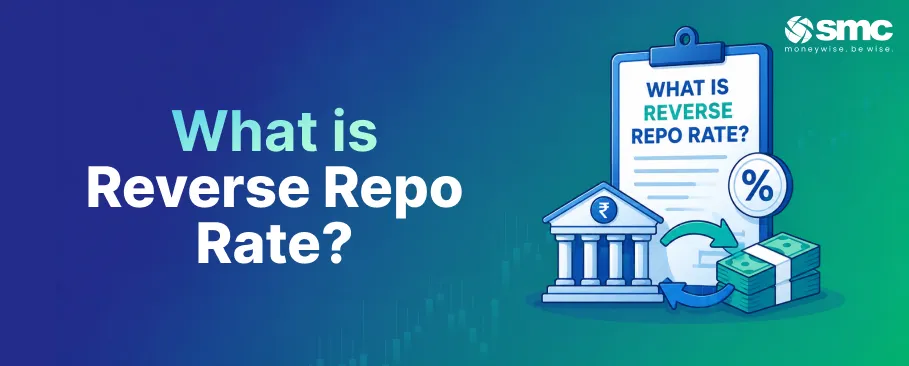


The reverse repo rate is one of the Reserve Bank of India’s (RBI) key monetary policy tools. While it may sound like a technical banking term, it plays an important role in managing liquidity, controlling inflation, and maintaining economic stability.
Understanding the reverse repo rate also makes it easier to understand why loan rates, deposit rates, and overall borrowing conditions change over time.
In this guide, we explain the meaning of the reverse repo rate, how it differs from the repo rate, and how both fit into India’s monetary policy framework.
What is Reverse Repo Rate?
The reverse repo rate is the interest rate at which the RBI absorbs surplus funds from banks through reverse repo transactions against eligible securities.
In simple terms, when banks have excess funds, they can park them with the RBI and earn interest. This helps the RBI reduce excess liquidity in the banking system whenever required.
Simply put:
- Banks lend money to the RBI.
- The RBI pays interest to banks.
- Excess liquidity is absorbed from the banking system.
The reverse repo rate is therefore a liquidity management tool used by the RBI to influence short-term money market conditions.
Reverse Repo Rate Meaning
The easiest way to understand the meaning of the reverse repo rate is to think of it as the opposite of borrowing.
Instead of banks borrowing from the RBI, the RBI temporarily borrows funds from banks. This encourages banks to park surplus funds with the central bank rather than deploying all of them into the financial system.
The higher the incentive to park surplus funds, the easier it becomes for the RBI to manage excess liquidity when needed.
Why Does the Reverse Repo Rate Matter?
The RBI's monetary policy framework focuses on maintaining price stability while keeping growth in mind. Liquidity management is an important part of how the RBI implements monetary policy and maintains orderly conditions in the financial system.
Why it matters:
- Helps manage surplus liquidity in the banking system
- Supports monetary policy transmission
- Influences short-term money market rates
- Contributes to overall financial stability
It’s important to note that India’s monetary policy framework has evolved. Today, the Standing Deposit Facility (SDF) is the RBI’s primary standing liquidity absorption facility, while the fixed reverse repo rate remains part of the broader liquidity management toolkit.
What Is Repo Rate?
To fully understand the reverse repo rate, you also need to know the repo rate.
The repo rate is the interest rate at which the RBI lends short-term funds to commercial banks against eligible securities.
When banks face a liquidity shortage, they borrow funds from the RBI and pay interest at the repo rate.
Simply put:
- RBI lends money to banks.
- Banks pay interest to the RBI.
- Liquidity is injected into the banking system.
The repo rate is also the RBI’s key policy rate, making it one of the most closely watched economic indicators in India.
Repo Rate vs Reverse Repo Rate
Although both are monetary policy tools, they serve opposite purposes.
The easiest way to remember this is:
- Repo Rate = RBI lends money
- Reverse Repo Rate = RBI absorbs money
How Does the Reverse Repo Rate Affect the Economy?
The reverse repo rate doesn’t directly change the interest rate on your loan or fixed deposit. Instead, it influences liquidity and short-term interest rates, which gradually affect the broader economy.
1. Banking Liquidity
When the RBI absorbs surplus funds, banks have less excess liquidity available for lending and other market activities.
2. Interest Rate Environment
Changes in liquidity conditions can influence money market rates, which eventually affect lending and deposit rates across the banking system.
3. Inflation
By absorbing excess liquidity, the RBI can help reduce inflationary pressures and maintain price stability over time.
4. Economic Activity
Tighter liquidity conditions can moderate borrowing and spending, while easier liquidity conditions can support credit growth and economic activity.
In short, the reverse repo rate should be viewed as one part of the RBI’s broader monetary policy and liquidity management framework, rather than a standalone tool that directly determines borrowing costs.
Historical Context of the Reverse Repo Rate in India
The reverse repo rate has been an important part of India's monetary policy framework for managing liquidity.
Its role became particularly evident during periods when the RBI needed to manage large liquidity surpluses in the banking system. During the COVID-19 pandemic, for instance, the RBI used a combination of monetary and liquidity measures to support financial conditions and maintain credit flows.
Over time, however, the RBI's operating framework has evolved. The introduction of the SDF in April 2022 allowed banks to deposit surplus funds with the RBI without providing collateral. This changed the role played by the fixed reverse repo rate in day-to-day liquidity management.
Therefore, older references that describe the reverse repo rate as the primary tool for absorbing surplus liquidity may not accurately reflect the current framework.
What Is the Current Reverse Repo Rate in India?
Currently, the fixed reverse repo rate is 3.35%.
However, investors should also consider the SDF rate and the policy repo rate when assessing the RBI's current monetary policy framework. The SDF is now the standing facility that banks use to deposit funds with the RBI without collateral.
RBI monetary policy rates can change when the Monetary Policy Committee (MPC) reviews its stance. Therefore, the latest rates should always be checked on the RBI's official website rather than relying on older figures published elsewhere.
What Happens When the Reverse Repo Rate Changes?
A change in the reverse repo rate can influence banks' decisions about where to deploy their surplus funds. However, its impact should not be viewed in isolation.
For example, if the incentive to park surplus funds with the RBI increases, banks may have a stronger incentive to keep excess liquidity with the central bank. On the other hand, lower returns from liquidity-absorption facilities may encourage banks to consider other avenues for deploying surplus funds.
The eventual impact on loans, deposits, investment and economic activity depends on several factors, including the repo rate, liquidity conditions, market interest rates, inflation expectations and the RBI's overall monetary policy stance.
Repo Rate and Reverse Repo Rate in Monetary Policy
The repo rate and reverse repo rate form part of the RBI's broader framework for managing liquidity and influencing monetary conditions.
When the RBI wants to influence borrowing conditions, the policy repo rate is particularly important. Changes in the repo rate can affect banks' cost of funds and, over time, influence lending and deposit rates.
To absorb liquidity, the RBI can use instruments such as the Standing Deposit Facility and reverse repo operations, depending on prevailing conditions.
Therefore, understanding the repo rate and reverse repo rate together provides a clearer picture of how the RBI manages liquidity. At the same time, the broader monetary policy framework determines how these tools are used.
How to Keep Track of Repo Rate and Reverse Repo Rate?
Investors, borrowers and savers can track RBI policy changes through the central bank's official communications.
Useful sources include:
- RBI Monetary Policy Statements: These provide information on policy decisions and the MPC's assessment of economic conditions.
- RBI policy rates: The RBI publishes its current policy rates and related information.
- Financial news: Business and financial publications generally report changes soon after an RBI announcement.
- Bank announcements: Banks may adjust lending and deposit rates in response to changes in market conditions and the transmission of monetary policy.
Tracking these developments can help investors understand the broader interest-rate environment, although no single rate should be used as the basis for an investment decision.
Conclusion
The reverse repo rate is an important component of India's monetary policy framework. It represents the rate for reverse repo transactions, through which the RBI can absorb liquidity from banks.
At the same time, the framework has evolved significantly, with the Standing Deposit Facility now playing a key role in absorbing surplus liquidity. This is why the reverse repo rate should not be viewed as the sole indicator of the RBI's liquidity stance.
For investors and borrowers, understanding the relationship between the repo rate, reverse repo rate, SDF, and broader monetary policy can provide useful context for changes in interest rates and financial market conditions.
Since RBI rates can change with monetary policy decisions, investors should refer to the latest RBI announcement for the current rates and policy stance.




 1800 11 0909
 smc.care@smctradeonline.com