
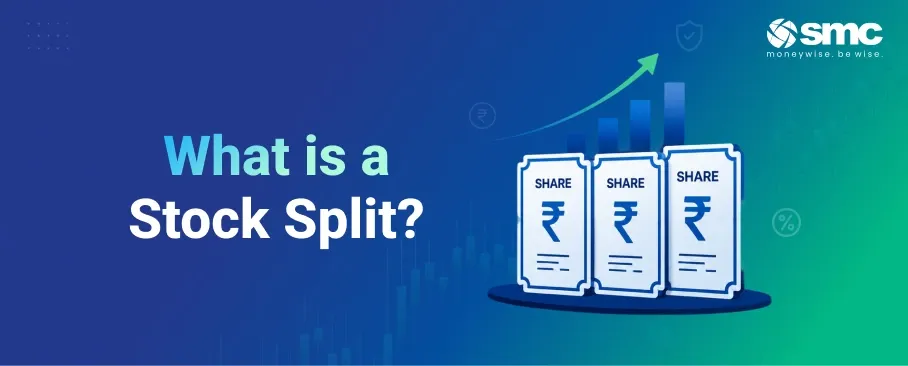


You open your portfolio one morning and find the share count higher, yet the total value looks roughly unchanged. Nothing alarming has happened. You have simply experienced a stock split.
If you have searched for the meaning of a stock split or asked yourself what a stock split is, this guide explains how it works in an Indian demat account and offers practical checklists you can use whenever you read about recent stock splits in the news.
#Understanding Stock Split
A stock split is a corporate action in which a company increases the number of its outstanding shares while reducing the price per share in the same proportion. Although the number of shares increases, your overall investment value and ownership percentage remain unchanged immediately after the split.
A quick picture helps. Imagine exchanging one large currency note for several smaller notes. You now hold more pieces of paper, but the purchasing power is unchanged. A stock split works similarly.
Key idea: more units, lower price per unit, broadly unchanged total value at the moment of the split.
#Why do Companies Announce a Share Split?
There is no single reason. Boards consider several practical factors.
- #Accessibility for new investors: A lower trading price can feel less intimidating for first-time buyers building a small, regular plan.
- #Liquidity: With a lower price per share, more investors can place orders, which can deepen the order book and make buying or selling easier.
- #Psychology: A four-digit share price may appear expensive to retail investors even when the company's valuation remains unchanged. A stock split reduces the share price without changing the company's fundamentals.
- #Wider participation: A lower ticket size can attract more retail participation, potentially broadening ownership.
- #Index and lot-size housekeeping: Exchanges and clearing systems operate with certain lot conventions. A split can help align the traded price with those conventions.
None of these points guarantees a better investment outcome. They simply explain the administrative and behavioural motivations that often sit behind a board decision.
#What Actually Happens During a Stock Split?
Here is the typical flow from an investor’s perspective in India.
- #Board approval and public notice: The company discloses its intention to split its shares and states the proposed ratio.
- #Record date announcement: A “record date” is set. Shareholders on the register at the close of that date are eligible for split benefits.
- #Ex-split date: From this date, the share trades at the adjusted price, and your demat account will eventually reflect the increased quantity.
- #ISIN update: In many cases, the security may receive an updated International Securities Identification Number (ISIN) following the stock split as part of the corporate action process.
- #Credit for additional shares: Your demat statement shows a higher quantity after the operational processes are complete.
- #Contract notes and statements: Brokers and depositories issue the usual trade and holding documents for your records.
Timelines are operational. Always rely on the actual corporate notice and your broker’s communication for the exact sequence of your account.
#What Changes For You as a Holder?
- #Quantity increases, price per share reduces: The arithmetic cancels out at the moment of the split.
- #Cost of acquisition per share adjusts: Your total cost does not change, but the cost per unit is recalculated proportionally for tax records.
- #Dividends per share: If the company declares a dividend after the stock split, the per-share dividend is generally adjusted to reflect the revised face value. Your total dividend depends on the dividend declared by the company and the number of shares you hold.
- #Charts and alerts: Charting platforms typically adjust historical prices to avoid artificial gaps. If you use price alerts, re-check them after the ex-split date.
#How a Split Shows up in Your Demat Account
Indian investors hold listed securities in electronic form. After the ex-split date and operational processing, your share split allotment appears as an increased quantity in the same demat account. Download an updated holding statement to verify:
- Security name and updated ISIN
- Total quantity after the split
- Average price per share adjusted for the split
- Pledged or lien status, if any, updated correctly
- File the company’s corporate action notice, your broker’s email, and the new statement together. These records matter at tax time and during future transfers.
#Impact on Derivatives and Pledged Holdings
If you trade futures and options, a split triggers contract adjustments. Exchanges and clearing corporations typically adjust strike prices, futures prices, and market lot sizes to ensure the contract's notional value remains consistent.
If you have pledged shares for margin, the pledge quantity and haircut calculations are also updated to reflect the new unit count. Check your broker’s contract notes on the day adjustments go live.
#A Simple Analogy That Works
Think of a large cake shared among friends. Whether it is cut into six slices or twelve, the size of the cake remains the same. Similarly, in a stock split, the number of shares you own increases, but your overall ownership in the company remains unchanged.
#Stock Split Vs Reverse Split
Sometimes, a company takes the opposite approach through a reverse stock split (also known as a share consolidation). Multiple shares are merged into one, raising the per-share price and reducing the number of shares outstanding. Reasons can include housekeeping around traded price levels or compliance requirements. Again, the total value of your holdings does not change when the consolidation takes effect.
#Quick contrast
Stock split: more units, lower price per unit, ownership unchanged.
Reverse split: fewer units, higher price per unit, ownership unchanged.
#Stock Split Vs Bonus Issue
Investors often mix up splits with bonus shares. A bonus issue gives you additional shares out of accumulated reserves. A stock split does not change reserves; it merely changes the face value and the number of units. The two actions feel similar in your demat because the quantity goes up in both cases, but the accounting and trigger logic are different.
#How Traders and Long-Term Investors Think About Splits
Short-term traders: Some watch for activity around ex-dates because price levels are reset. Activity can rise briefly as alerts and round numbers shift. This is an observation, not advice.
Long-term investors: Many treat a split as administrative. It does not change the underlying business quality, cash flows, or competitive position. They review fundamentals as usual.
Either way, a split should not, by itself, be treated as a signal of improved profitability. It is a mechanical action.
#Practical Checklists You Can Use
#Before The Record Date
- Confirm you actually hold the shares in your demat account.
- Read the company announcement and your broker’s note.
- Re-check any open orders or good-till-cancelled instructions around the ex date.
#On or After The Ex Date
- Download a fresh holding statement.
- Verify the quantity, the updated ISIN, and the average cost.
- Re-set price alerts, stop losses, and take-profit levels because the price scale has changed.
- If you keep a personal journal, note the split for future reference.
#Costs, Taxes, And Paperwork
A stock split is not a taxable event by itself. Tax arises when you sell and realise gains or losses. The method for calculating the cost of acquisition per share changes proportionally, so keep all statements and contract notes.
If you use a portfolio tracker, ensure it has a corporate actions ledger that correctly adjusts historical prices. When in doubt, speak to a tax professional who understands demat records and corporate action adjustments.
#Conclusion
At its core, a stock split is an administrative corporate action. It changes the number of shares and reduces the share price proportionately while keeping your ownership percentage unchanged. Companies generally undertake stock splits to improve accessibility, enhance liquidity, and encourage broader investor participation. For investors, the overall process is largely administrative.
You will see a higher quantity, an adjusted average price, and an updated ISIN. The business you own has not magically improved because of the split, and sensible research habits still matter more than ratio maths.
Whenever you read about recent stock splits, follow the checklists in this guide, verify your statements, and stay focused on your long-term investment plan. A disciplined approach is far more effective than reacting to headlines alone.


 1800 11 0909
 smc.care@smctradeonline.com