
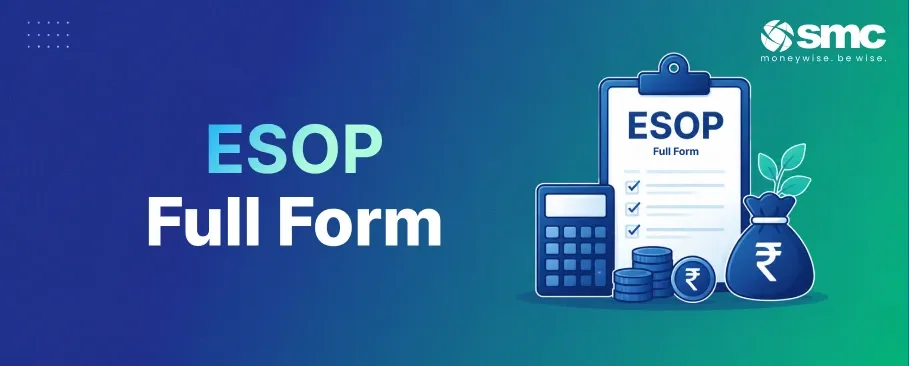


If your company has offered you ESOPs, you may have wondered what they actually mean and how they can benefit you. ESOPs allow employees to buy company shares at a predetermined price, subject to the scheme's terms.
From the grant and vesting period to exercising the options and eventually selling the shares, there are a few important things to understand before you make a decision.
ESOP Full Form: What Does ESOP Mean?
ESOP stands for Employee Stock Option Plan.
Under an ESOP, a company gives eligible employees the right, but not the obligation, to buy its shares at a predetermined price after meeting specified conditions, such as a vesting period.
For example, suppose your company gives you the option to buy its shares at ₹100 per share, while the market value later reaches ₹300 per share. If you exercise the option at ₹100, you can acquire the shares at the predetermined price, subject to the scheme's terms.
Companies use ESOPs to attract and retain employees, reward their contribution and align their interests with the company's growth. They are particularly common among start-ups and growing companies.
How Do ESOPs Work?
An ESOP typically involves a few important stages:
1. Grant of Options
The company grants you a specified number of stock options. At this stage, you have the right to buy shares in the future, but you don't own them yet.
2. Vesting
You need to complete the required vesting period before you can exercise the options. The vesting schedule and conditions are decided under the company's ESOP scheme.
For listed companies subject to SEBI regulations, the minimum vesting period is generally 1 year.
3. Exercise
Once the options have vested, you can exercise them by paying the predetermined exercise price and acquiring the shares, subject to the scheme's terms.
4. Holding or Selling the Shares
After exercise and allotment, you hold the shares. If the shares are transferable and there is no applicable lock-in or other restriction, you can sell them later.
The price at which you eventually sell the shares determines whether you make a capital gain or loss. Tax may also apply at this stage.
What Is the Exercise Price?
The exercise price is the amount you need to pay to acquire each share under your ESOP.
For example, if you have 1,000 vested options with an exercise price of ₹50, exercising all of them would require:
1,000 × ₹50 = ₹50,000
The exercise price is fixed according to the terms of the ESOP scheme and may be lower than the prevailing value of the company's shares.
Why Do Companies Offer ESOPs?
Companies use ESOPs to reward employees and give them a chance to benefit from the company's growth. They can also help companies:
- Attract talent: ESOPs can make a compensation package more attractive, especially for start-ups and growing companies.
- Retain employees: Vesting conditions can encourage employees to stay with the company for longer.
- Align employee interests: Employees who become shareholders may have a greater interest in the company's long-term performance.
- Manage cash compensation: ESOPs can form part of the overall compensation package without requiring the company to pay the entire value in cash upfront.
What Is the Vesting Period?
The vesting period is the time an employee must complete before gaining the right to exercise stock options.
For example, suppose you receive 1,000 options with a four-year vesting schedule. The options may become exercisable in stages over those four years, depending on the company's ESOP scheme.
For listed companies subject to SEBI regulations, the minimum vesting period for an ESOP is generally 1 year. The actual vesting schedule can vary from one company to another.
What Happens If You Leave the Company?
What happens to your ESOPs after you leave depends on the company's ESOP scheme and the reason for leaving.
Unvested options may lapse, while vested options may remain exercisable for a specified period, subject to the scheme's terms.
Before leaving, check:
- How many options have vested
- The deadline for exercising vested options
- The exercise price
- Any applicable lock-in or other restrictions
What Are the Benefits of ESOPs for Employees?
ESOPs can allow employees to benefit from the company's growth.
Potential Wealth Creation
If the company's share value rises above your exercise price, the options can become valuable. However, there is no guarantee that the share price will increase.
Ownership in the Company
Once you exercise the options and the shares are allotted, you become a shareholder, subject to the applicable terms and restrictions.
Additional Compensation
ESOPs can complement your regular salary and other benefits, providing an additional source of wealth.
What Should You Check Before Exercising ESOPs?
Before exercising your options, don't look only at the difference between the exercise price and the current share value. Also consider:
- Vesting schedule: Check how many options have vested.
- Exercise price: Calculate how much you will need to pay.
- Company valuation: A high valuation does not guarantee future returns.
- Liquidity: Shares of an unlisted company may not be easy to sell.
- Tax: Exercising and selling ESOP shares can have separate tax implications.
ESOP Taxation
ESOPs have tax implications at two stages. When shares are allotted after exercise, the benefit received at a concessional price is generally treated as a taxable perquisite. When the shares are subsequently sold, any resulting gain or loss is considered under the capital gains provisions.
The exact tax depends on factors such as the type of shares, their holding period and the applicable tax provisions.
Also read: ESOP Taxation in India: Tax on Exercise and Sale of ESOP Shares
Conclusion
ESOPs can allow employees to participate in the growth of the company they work for. But before exercising your options, understand the vesting schedule, exercise price, company valuation, liquidity and tax implications.
An ESOP can be valuable, but it is not guaranteed wealth. The eventual value depends on the company's performance and the terms of the ESOP scheme.



 1800 11 0909
 smc.care@smctradeonline.com