
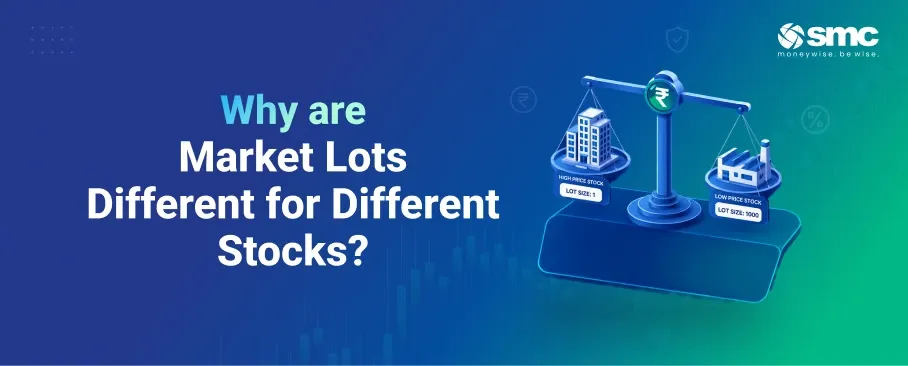


A market lot size is the minimum standardised quantity of shares or contracts that can be bought or sold in a single F&O transaction. In India's cash market, investors can buy as little as 1 share of any listed stock; there is no SEBI-mandated lot size.
In the derivatives segment, SEBI requires each contract to fall within a specific value range: ₹15-20 lakh for index derivatives and ₹5-10 lakh for stock derivatives. A stock trading at ₹34,600 (Page Industries), therefore, has a lot of 15, while a stock at ₹8 (Vodafone Idea) has a lot of 71,475.
This guide explains how SEBI determines lot sizes, what causes them to change, and why they matter for capital requirements, risk management, and trading costs.
What Is Market Lot Size?
A market lot size is the fixed number of units of an underlying asset per derivative contract. All trades in the F&O segment must occur in multiples of this lot; for example, if the Nifty lot size is 65, a trader must trade 65, 130, 195 units, and so on. Fractional lots are not permitted.
The cash (equity) market operates differently. SEBI does not mandate lot sizes for cash trades. Investors can buy or sell as few as 1 share of any listed stock on NSE or BSE. This distinction is fundamental: lot sizes are a derivatives-specific concept in India.
Why Lot Sizes Vary Across Stocks
Different stocks have different share prices. SEBI mandates that each derivative contract falls within a specific value range. The lot size is essentially the target contract value divided by the current stock price, rounded to the nearest permissible multiple.
Why Does Market Lot Size Matter to Investors?
Risk Management
Lot size directly determines position size and, therefore, risk per trade. Each point movement in the underlying generates profit or loss equal to the lot size in rupees.
With Nifty's current lot of 65, each 1-point Nifty move equals ₹65 in profit or loss per lot. Traders cannot fine-tune exposure to exact amounts; they must trade in whole-lot multiples, making precise risk calibration challenging for smaller accounts.
Capital Requirements
The minimum capital to trade F&O is a function of lot size. For futures, the contract value equals the lot size multiplied by the current price. For options, cost equals lot size multiplied by premium.
The November 2024 lot size revision alone caused a 3.2x increase in margin requirements for Nifty, directly pricing out traders who previously operated with ₹70,000-₹80,000 in capital.
Liquidity Impact
Standardised lot sizes create uniform order sizes, improving price discovery and market depth. Larger lots reduce market noise from very small speculative trades.
However, excessively large lots can reduce retail participation and hurt overall liquidity. SEBI's periodic reviews attempt to balance between deterring excess speculation and maintaining sufficient market participation.
Cost and Brokerage Implications
Transaction taxes (STT, exchange charges, stamp duty) are calculated on the total transaction value, which increases with larger lots. Traditional brokers charge per lot, so larger lots mean higher per-trade brokerage, though flat-fee brokers are unaffected.
For multi-leg option strategies (spreads, strangles), more contracts are needed to achieve equivalent exposure after lot size changes, increasing cumulative transaction costs.
How Does SEBI Determine Market Lot Sizes?
Index Derivatives (Nifty, Bank Nifty, Sensex)
SEBI's Master Circular (Chapter 5, updated December 2024) specifies:
- A derivative contract shall have a value of not less than ₹15 lakh at introduction (post-November 2024)
- On the day of review, contract value must fall within ₹15-20 lakh
- Lot size must be a multiple of 5, with a minimum of 10 units
- Before November 2024, the range was ₹5-10 lakh
Lot Size Formula: Lot Size = ₹15,00,000 ÷ Current Index Price (rounded to nearest multiple of 5)
Stock Derivatives (Individual Stocks)
For stock-specific contracts, the SEBI framework specifies:
- Contract value target range: ₹5-10 lakh
- Lot size = multiple of 25, minimum 50 shares
- If the contract value at minimum lot of 50 exceeds ₹10 lakh: lot size as a multiple of 5, minimum 10
- If still exceeding ₹10 lakh: lot size can go as low as 5
Mandatory Review Process
SEBI prescribes a rigorous periodic review:
- Stock exchanges review lot sizes once every 6 months
- Based on the average closing price of the underlying for the last 1 month
- Must give at least 2 weeks advance notice before changes take effect
- If the revised lot is higher than the existing lot, it applies only to new contracts (existing contracts retain the old lot)
- SEBI mandates the same lot size across all exchanges (NSE and BSE) for the same underlying
What Factors Cause Market Lot Size Variations?
Stock Price: The Primary Driver
Stock price is the single biggest factor. As a stock's price rises, the contract value exceeds SEBI's prescribed range, triggering a lot size reduction. Conversely, falling prices lead to lot size increases.
A stock with a lot size of 1,000 at ₹225 per share has a contract value of ₹2.25 lakh. If the price rises to ₹620, the value becomes ₹6.20 lakh, exceeding the range. SEBI then reduces the lot to 300, bringing the contract value to ₹1.86 lakh.
Liquidity, Volatility, and Investor Demand
More liquid stocks can support larger contract values because orders get filled efficiently. Illiquid stocks may need smaller lots or risk removal from the F&O segment. SEBI's MQSOS (Median Quarter Sigma Order Size) criterion, raised from ₹25 lakh to ₹75 lakh in August 2024, ensures minimum market depth before allowing F&O trading.
Highly volatile stocks carry greater risk per lot. SEBI uses EWMA volatility estimates for margin calculations, and volatility also influences whether a stock remains in the F&O segment.
When lot sizes become too large, retail investors get priced out. After SEBI tripled the Nifty lot from 25 to 75 in November 2024, traders who operated with approximately ₹73,000 in margin suddenly needed ₹2.34 lakh. Many shifted to riskier options buying (which requires only the premium upfront), while some exited F&O entirely.
Corporate Actions
Bonuses, stock splits, mergers, rights issues, and consolidations trigger proportional lot size adjustments. These adjustments occur on the last cum-date to maintain equivalent position value before and after the action.
Regulatory Policy Decisions
SEBI's broader policy objectives drive major lot size changes beyond mechanical price-based reviews.
The October 2024 overhaul raised the index derivative minimum contract value from ₹5 lakh to ₹15 lakh, motivated by a SEBI study showing that 93% of individual F&O traders incurred net losses between FY2022 and FY2024.
How Do Market Lot Sizes Differ Between Cash and F&O Segments?
In the cash market, there is no lot size concept; an investor can buy 1 share of any company, making the equity market accessible to all budget levels. The exception is IPO applications, which have minimum lot sizes (typically ₹15,000 minimum application value).
In the F&O market, lot sizes are fixed and standardised by exchanges per SEBI guidelines. Trading in fractions of a lot is not permitted. F&O lot sizes change periodically due to price movements, SEBI policy shifts, corporate actions, and the mandatory 6-month review cycle.
What Are the Current Lot Sizes?
Index Derivatives
Historical Lot Size Timeline
What Should Investors Know About Lot Sizes?
- SEBI primarily regulates derivatives lot sizes; the cash market trades in single shares with no lot restriction.
- Lot sizes are identical across NSE and BSE for the same underlying; this is a SEBI mandate.
- Holding an "odd lot" position (not a multiple of the revised lot) after a revision attracts an additional 5% margin and may be forcibly squared off by the broker's risk management team.
- Physical delivery obligation exists for stock F&O since October 2019, holding until expiry requires the full lot value in cash for delivery.
- SEBI's August 2024 circular tightened F&O eligibility: stocks must meet higher thresholds for MQSOS (₹75 lakh), MWPL (₹1,500 crore), and ADDV (₹35 crore). Failing for 3 consecutive months leads to removal with a 1-year re-inclusion ban.
- Retail traders should verify lot sizes before planning trades; a mid-contract lot size change affects per-point profit/loss and margin requirements.
Understanding lot sizes can help traders manage capital and trading risk more effectively. Trade smarter with an SMC Demat account and access equity and derivatives markets with ease.






 1800 11 0909
 smc.care@smctradeonline.com