
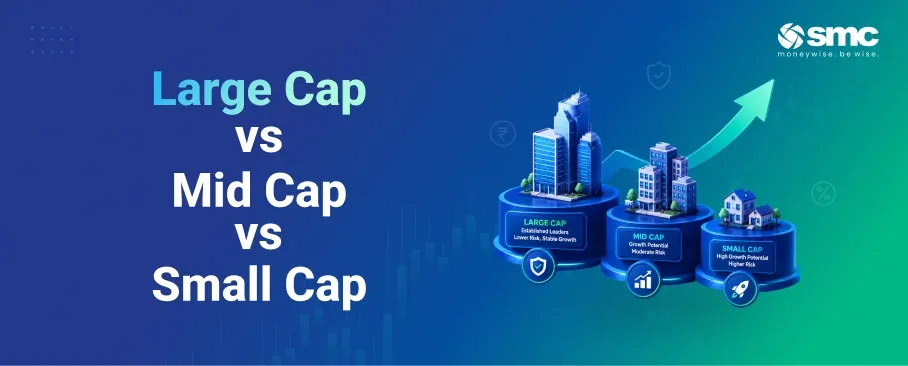


Small-cap stocks delivered a 20.8% CAGR between 2019 and 2025, but with 11 corrections exceeding 15% in the same period. Large caps returned 13.3% with roughly a third of the volatility. The best category for conservative investors is large-cap.
For growth-oriented investors with a 5-7 year horizon, mid-cap offers the strongest risk-adjusted balance. For aggressive investors comfortable with a 40%+ drawdown, small-cap stocks provide multi-bagger potential.
This guide compares all three on returns, risk, volatility, and investor suitability using SEBI classification data and 20-year performance history.
How Do Large Cap, Mid Cap, and Small Cap Stocks Compare?
How Does SEBI Classify Market Capitalisation?
SEBI introduced a rank-based classification system through a circular dated October 6, 2017. Companies are categorised by their ranking based on full market capitalisation, not by fixed rupee thresholds.
- Large Cap: 1st to 100th company
- Mid Cap: 101st to 250th company
- Small Cap: 251st company onwards
AMFI publishes this ranked list twice a year, in the first week of January and July, using the average market capitalisation over the preceding six months. Mutual funds must realign their portfolios to the updated classification within approximately one month.
Why Market Cap Thresholds Keep Changing
The rupee value for each category boundary shifts with market conditions:
Today's mid-cap threshold (₹34,700 crore) is higher than 2018's large-cap threshold (₹30,608 crore). What qualified as a large-cap company seven years ago would barely make the mid-cap cut today.
The commonly cited approximate ranges, large cap above ₹20,000 crore, mid cap between ₹5,000 and ₹20,000 crore, small cap below ₹5,000 crore, are outdated industry shorthand, not SEBI definitions. SEBI classifies by rank, not rupee value.
What Are Large-Cap Stocks?
Large-cap stocks represent India's top 100 companies by market capitalisation, established businesses with diversified revenue, institutional backing, and regular dividends.
Best for: Conservative investors, beginners, and those nearing financial goals.
Large caps fall the least during corrections and recover fastest, supported by institutional ownership. During the September 2024 to March 2025 correction, large caps fell 17%, compared to 20% for mid caps and 22% for small caps. In 2025, the Sensex gained 9-10.5% while the BSE MidCap rose only 1.1% and the BSE SmallCap declined 6.6%.
Over a five-year rolling basis, the Nifty 50 has had roughly a 1% probability of delivering negative returns. The combination of low volatility, institutional support, and regular dividends makes large caps the most accessible entry point for equity investing.
What Are Mid-Cap Stocks?
Mid-cap stocks rank 101st to 250th by market capitalisation. These are companies scaling their operations, expanding market share, and, in many cases, on a path to joining the top 100.
Best for: Growth-oriented investors with moderate risk tolerance.
Mid-caps balance growth potential with more manageable volatility than small caps. Their returns sit between large and small caps over most time periods, but the drawdowns are meaningfully lower than those of small caps during corrections.
What Are Small-Cap Stocks?
Small-cap stocks rank 251st onwards by market capitalisation. These are emerging businesses, often in early growth stages, with the potential for outsized returns and the risk profile to match.
Best for: Aggressive investors who can withstand deep corrections and remain invested for years.
The numbers tell two stories simultaneously. Five-year rolling returns reach as high as +372%, rewarding investors who hold through volatility. But the average annual drawdown of 26% over two decades means most years include a double-digit decline.
As of late 2025, roughly 80% of small-cap stocks were down over 20% from their peaks, with nearly half trading up to 40% below peak valuations. Despite this, domestic investors poured ₹52,321 crore into small-cap mutual fund schemes in 2025, a 53% increase year-on-year, suggesting that investors with long time horizons continue to see value in the correction. Liquidity remains a concern: small caps can face severe buying and selling challenges during sharp market declines.
What Are the Key Differences Between Large, Mid, and Small Cap Stocks?
The pattern is consistent across different market events: large caps fall the least and recover first, small caps fall the most and take the longest to recover, and mid caps sit in between. However, when recovery does arrive, small-cap rebounds can be the most aggressive. The Nifty Smallcap 250 surged approximately 50% annualised during the 2020-2024 bull run versus roughly 32% for the Nifty 100.
Which Market Cap Performs Best in Different Market Conditions?
Over the last 20 calendar years:
- Small caps outperformed in 9 out of 20 years, the most frequent leader
- Large caps outperformed in 7 out of 20 years
- Mid-caps outperformed in only 3 out of 20 years
When Each Segment Leads
Large caps lead during market uncertainty: They outperformed in years of significant volatility or correction: 2008, 2011, 2013, 2018, 2019, 2022, and 2025. In 2025, the Sensex gained 9-10.5% while the BSE MidCap rose only 1.1% and BSE SmallCap declined 6.6%.
Small caps lead during recoveries and bull markets: They outperformed during recovery periods (2009, 2014, 2020, 2021) and strong bullish phases (2007, 2017, 2023, 2024). The small-cap index delivered 47.5% in 2023 and 29.3% in 2024.
Mid-caps lead during stable growth: They outperformed in 2010, 2012, and 2016, typically stable economic expansion periods when broader economic growth benefits mid-sized companies disproportionately.
Who Should Invest in Large, Mid, and Small Cap Stocks?
Three Questions Before Allocating
Can you handle a 40%+ drawdown without panic-selling? If the answer is no, limit small-cap exposure. The Smallcap 250 experienced a maximum drawdown of -41.1% between 2019 and 2025.
Is your investment horizon under five years? Stick primarily to large caps. Over a five-year rolling basis, the Nifty 50 has had roughly a 1% probability of delivering negative returns.
Do you invest consistently via SIP? Systematic investment in mid/small-cap funds during downturns captures lower NAVs. Despite 16 months of muted returns, investors continued allocating to mid/small-cap schemes throughout 2025, with SIP contributions holding steady at approximately ₹28,265 crore per month.
What Portfolio Allocation Works for Each Risk Profile?
Three Allocation Models
20-Year SIP Backtesting Results
A 20-year SIP analysis with ₹1,000 per month across Nifty 50, Nifty Next 50, Nifty Midcap 150, and Nifty Smallcap 250 (total invested: ₹24 lakh):
The aggressive portfolio outperformed the conservative one by only ₹15 lakh over 20 years, while experiencing significantly higher volatility. Higher mid/small-cap allocations improved returns only marginally for long-term SIP investors.
10-Year SIP Projections (₹10,000/month)
Building the right portfolio starts with understanding risk, returns, and investment goals. Open a Demat account with SMC to invest confidently with seamless access and research-backed insights.







 1800 11 0909
 smc.care@smctradeonline.com