
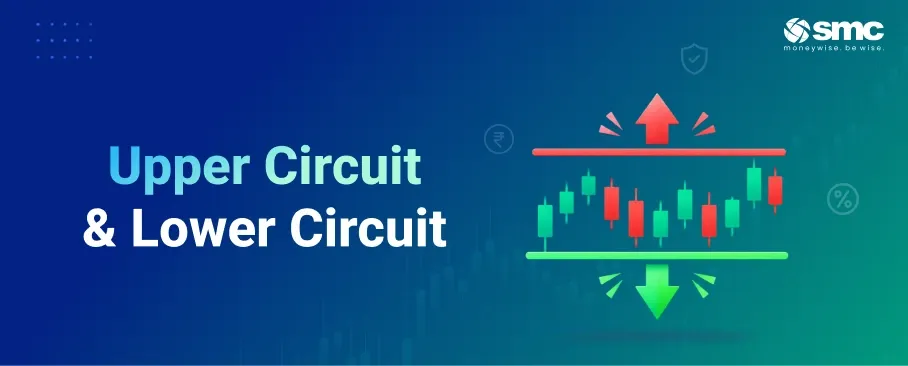


Stock markets are volatile, and share prices can rise or fall sharply due to company announcements, economic developments, or changes in investor sentiment. To manage extreme price movements, stock exchanges follow a system of price bands and circuit breakers.
If you follow the stock market, you may have come across terms such as upper circuit and lower circuit. These limits restrict how much a stock's price can move during a trading session. They help prevent excessive price volatility and give market participants time to assess changing conditions.
Understanding what the upper circuit in the share market is and how lower circuits work can help investors make more informed trading decisions.
What is Upper Circuit in Share Market?
An upper circuit is the maximum price level a stock can reach during a trading session under its applicable price band. Once the stock reaches this limit, no further trades can take place above that price during the session.
For example, if a stock has a 10% upper price band and its previous closing price was ₹200, its upper circuit price will be ₹220.
If strong buying demand pushes the stock to ₹220, it cannot trade above that price during that session.
When a stock hits the upper circuit, there may be a large number of pending buy orders and very few or no sellers. This can make it difficult for buyers to get their orders executed.
This is the basic upper circuit meaning in the stock market.
What Is Lower Circuit in Share Market?
A lower circuit is the minimum price level at which a stock can trade during a trading session under its applicable price band. Once the stock reaches this limit, it cannot trade below that price for the rest of the session.
For example, if a stock has a 10% lower price band and its previous closing price was ₹200, its lower circuit price will be ₹180.
If heavy selling pushes the stock to ₹180, it cannot trade below that price during that session.
When a stock hits the lower circuit, there may be a large number of pending sell orders and very few or no buyers. As a result, investors may find it difficult to sell their shares.
This explains the lower circuit meaning in simple terms.
How Do Upper and Lower Circuits Work for Stocks?
Stock exchanges set daily price bands to restrict excessive price movements in individual securities. These limits are generally based on the previous trading day's closing price.
On the NSE, the commonly applicable daily price bands include:
- 2%
- 5%
- 10%
- 20%
The applicable band depends on the security and exchange rules. Price bands can also be revised by the exchange as part of its surveillance process.
Let's understand this with an example.
Suppose a stock closed at ₹200 in the previous trading session and has a 20% price band.
This means the stock can trade between ₹160 and ₹240 during the session. It cannot trade above ₹240 or below ₹160 under this price band.
The applicable price band is not necessarily 20% for every stock. You should check the latest price band of the security on the respective stock exchange.
Note: Stocks with available derivative contracts generally do not have fixed daily price bands. Instead, stock exchanges apply dynamic operating ranges to prevent orders at unrealistic prices. These ranges can be revised based on market conditions and predefined exchange rules. Therefore, such stocks may experience price movements beyond the fixed percentage limits applicable to other securities.
Upper and Lower Circuits for Indices: Market-Wide Circuit Breakers
Circuit breakers also apply to market indices such as the Nifty 50 and Sensex. However, these are different from individual stock price bands.
India follows a market-wide circuit breaker mechanism with three trigger levels: 10%, 15% and 20%.
The circuit breaker is triggered if either the Sensex or Nifty 50 breaches the applicable threshold, whichever happens first. Once triggered, trading is halted across the equity and equity derivatives markets.
The duration of the halt depends on the percentage movement and the time at which the threshold is breached.
10% Rise or Fall
- Before 1 PM: Trading is halted for 45 minutes.
- At or after 1 PM and up to 2:30 PM: Trading is halted for 15 minutes.
- At or after 2:30 PM: No trading halt is imposed at this level.
15% Rise or Fall
- Before 1 PM: Trading is halted for 1 hour and 45 minutes.
- At or after 1 PM but before 2 PM: Trading is halted for 45 minutes.
- At or after 2 PM: Trading remains suspended for the rest of the day.
20% Rise or Fall
If either index moves by 20% in either direction at any time during market hours, trading remains suspended for the rest of the day.
After applicable trading halts, the market reopens through a pre-open call auction session, as prescribed by the exchange.
What Causes a Stock to Hit Upper or Lower Circuit?
A stock generally reaches its upper or lower circuit when buying or selling pressure becomes strong enough to push its price to the applicable limit. Several factors can influence this demand and supply.
1. Company Financial Results
Better-than-expected revenue, profits or business performance can increase buying interest and push a stock towards its upper circuit. Weak financial results, rising losses or declining revenue may lead to heavy selling.
2. Mergers and Acquisitions
Announcements related to mergers, acquisitions, business restructuring or major investments can influence how investors view a company's future prospects. Depending on market expectations, these developments may lead to sharp price movements.
3. Regulatory and Government Decisions
Changes in government policies, regulations, trade agreements or industry-specific rules can affect a company's business outlook. Such developments may trigger significant buying or selling activity.
4. Political and Geopolitical Developments
Political uncertainty, international conflicts and geopolitical tensions can affect investor confidence and market sentiment. Companies exposed to the affected regions or industries may experience sharp price movements.
5. Investor Sentiment and Market Speculation
Positive or negative news can sometimes trigger strong reactions from traders and investors. Speculative activity, herd behaviour and sudden changes in sentiment can also push a stock towards its price limit.
6. Interest Rate Changes
Changes in the RBI's policy rates can influence borrowing costs, liquidity and investment decisions. Their impact may be particularly significant for interest-rate-sensitive sectors such as banking, real estate and automobiles.
How Can Investors Use Circuit Limits in Their Trading Decisions?
Upper and lower circuits are useful indicators of price movement and market sentiment. However, investors should not treat them as standalone buy or sell signals.
Here are a few ways to consider circuit limits while making investment decisions:
- Understand the applicable price band: Check whether a stock has a 2%, 5%, 10% or 20% price band before placing an order.
- Monitor buying and selling pressure: A stock repeatedly hitting the upper or lower circuit may indicate strong demand or selling pressure. However, it is important to understand the reason behind the movement.
- Use limit orders carefully: Limit orders allow you to specify the price at which you are willing to buy or sell. However, placing an order at a circuit price does not guarantee execution.
- Avoid chasing stocks: A stock hitting the upper circuit may attract attention, but buying it only because of its price movement can expose you to significant risk.
- Assess liquidity: When a stock hits the lower circuit, a lack of buyers may make it difficult to exit your position. Consider liquidity and trading volumes before investing.
- Focus on fundamentals: Before investing, examine the company's financial performance, valuation, business outlook, and relevant announcements, rather than relying solely on circuit movements.
How Do Circuit Limits Help Manage Market Volatility?
Circuit filters and market-wide circuit breakers are important parts of the market surveillance framework followed by Indian stock exchanges under SEBI's regulatory framework. They help manage extreme price movements in individual securities and the broader market by restricting trading within specified limits or temporarily halting market activity.
They help by:
- Restricting excessive price movements in individual securities.
- Providing a temporary pause during extreme market-wide movements.
- Giving investors and traders time to assess important developments.
- Helping maintain orderly trading during periods of heightened volatility.
However, circuit limits do not guarantee that investors will avoid losses. A stock can still experience a sharp decline and may remain difficult to sell if there are insufficient buyers.
Investors should therefore conduct their own research and avoid making decisions based solely on a stock hitting its upper or lower circuit.
Conclusion
The upper and lower circuits are important mechanisms for managing sharp price movements in the stock market. While an upper circuit represents the maximum permitted price under a stock's applicable price band, a lower circuit represents the minimum.
Understanding what lower circuit and upper circuit are and how market-wide circuit breakers operate can help investors interpret price movements more effectively.
However, hitting an upper circuit does not automatically make a stock a good investment, just as hitting a lower circuit does not necessarily make it a bad one. Investors should consider company fundamentals, market conditions, liquidity and risk before making investment decisions.







 1800 11 0909
 smc.care@smctradeonline.com