
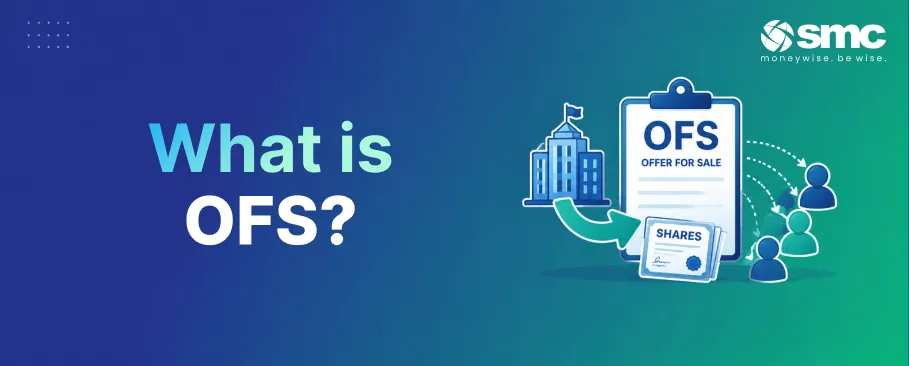


If you follow stock market news, you may have come across headlines about a company’s shares being offered through an Offer for Sale (OFS). But what exactly does OFS mean, and how can retail investors participate?
An OFS allows existing shareholders to sell their shares to investors. It can be used by promoters, governments and other eligible shareholders to reduce their stake in a company.
OFS can also be a part of an Initial Public Offering (IPO). An IPO can consist of a fresh issue, an OFS, or a combination of both. In an OFS, existing shareholders sell their shares, so the proceeds go to the selling shareholders rather than the company.
#What is Offer for Sale (OFS)?
OFS stands for Offer for Sale. It is a mechanism through which existing shareholders offer their shares to investors.
For example, if a promoter wants to reduce their holding in a company, they can sell a portion of their shares through an OFS. Investors can participate by placing bids during the specified OFS window.
Under the stock exchange OFS mechanism, eligible shareholders of listed companies can sell their holdings. It can also help promoters meet applicable minimum public shareholding requirements.
#OFS in an IPO
An IPO can have one or both of the following components:
- Fresh Issue: The company issues new shares and receives the proceeds.
- Offer for Sale: Existing shareholders sell their shares and receive the proceeds.
Therefore, an IPO can be a 100% OFS, an entirely fresh issue, or a combination of fresh issue and OFS.
This distinction is important because an OFS does not necessarily mean that the company is raising fresh money.
#How Does an OFS Work?
The process is relatively straightforward for investors:
#1. OFS Announcement
The seller announces details such as the number of shares offered, the floor price, the bidding dates, and any discounts available to retail investors.
#2. Bidding by Investors
Investors place their bids through their broker’s trading platform during the specified OFS window.
Retail investors can generally place a price bid or choose the cut-off price option under the applicable OFS rules.
#3. Allocation of Shares
If the OFS receives more bids than the shares available, investors may receive fewer shares than they applied for. Allocation takes place in accordance with the applicable OFS rules.
#4. Settlement
After the allocation and settlement process is completed, the allotted shares are credited to the investor’s Demat account.
#OFS vs IPO: What’s the Difference?
An OFS can be a component of an IPO, but the two terms are not interchangeable.
#Who Can Participate in an OFS?
Both retail and non-retail investors can participate in an OFS, subject to the conditions applicable to that particular offer.
For the retail category, the bid value is generally less than ₹2 lakh. At least 10% of the offer size is reserved for retail investors under the OFS framework.
Some OFS offers may provide a discount to retail investors, but a discount is not mandatory. If offered, the details are disclosed in the OFS announcement.
#Benefits of Offer for Sale for Retail Investors
An OFS can be an interesting opportunity for retail investors, but it is important to understand both the potential benefits and risks.
#Potential Discount
The seller may offer a discount to retail investors. If a discount is offered, the details are disclosed in the OFS notice.
#Simple Bidding Process
Retail investors can place their bids through their broker's trading platform. They can generally choose a specific price or the cut-off price under the OFS framework.
#Opportunity to Invest in Listed Companies
An OFS allows investors to buy shares being sold by existing shareholders of a listed company through the stock exchange mechanism.
#Risks of Investing Through an OFS
An OFS does not guarantee that the shares will generate returns after allotment. The market price can fall below the OFS price after the transaction.
Before participating, consider:
- #Valuation: Check whether the offer price is reasonable compared with the company's fundamentals.
- #Market conditions: Share prices can move due to broader market trends or company-specific developments.
- #Limited allocation: If demand is higher than the shares available, you may receive fewer shares than you bid for.
- #Discount is not guaranteed: A discount is available only when the seller offers one.
#How Is the OFS Price Decided?
The seller announces a floor price, which is the minimum price at which bids can generally be placed.
Non-retail investors bid first in the standard OFS mechanism. Based on the valid bids, a cut-off price is determined. Retail investors then bid on the following trading day and can generally choose the cut-off price option.
The final allocation price can differ depending on the OFS structure and whether a retail discount is offered.
#Example of an OFS
Suppose a promoter offers 10 lakh shares through an OFS at a floor price of ₹500 per share.
You want to buy 100 shares and place your bid at ₹510.
If the shares are allocated to you at ₹505, your investment would be:
100 × ₹505 = ₹50,500
If the seller offers a retail discount, the final price for eligible retail investors may be lower, depending on the terms of the OFS.
However, the market price may rise or fall after the shares are credited to your Demat account. Therefore, an OFS discount does not automatically mean a guaranteed profit.
#How to Participate in an OFS?
Before participating, check the OFS announcement for the floor price, bidding dates, retail reservation, discount and other applicable conditions.
You can then:
- Log in to your trading account.
- Select the OFS section.
- Choose the relevant company.
- Enter the quantity and bid price, or select the cut-off option where available.
- Confirm your bid.
- Check the allotment and settlement details.
The exact process may vary slightly across brokers.
#Things to Keep in Mind Before Investing in an OFS
An OFS can provide an opportunity to buy shares, but don't participate simply because the offer price is below the prevailing market price.
Before bidding, check:
- Why the shareholder is selling the stake
- The company's financial performance
- Valuation compared with peers
- OFS floor price versus the current market price
- Retail discount, if any
- Your investment objective and risk appetite
#Conclusion
An OFS provides a regulated way for existing shareholders to sell their shares to investors. It can also be part of an IPO, alongside a fresh issue.
For retail investors, the process is relatively simple, with a separate reservation and the option to bid at the cut-off price under the applicable framework. However, an OFS is not a guaranteed-return opportunity. Always consider the company's fundamentals, valuation and the reason for the stake sale before investing.






 1800 11 0909
 smc.care@smctradeonline.com