


Have you ever seen news headlines like “XYZ Company’s IPO Opens Today!” and wondered what that actually means? Or maybe someone told you they made money by investing in an IPO, and you were left curious. Let’s break it down in the easiest way possible.
In this blog, we will learn more about what an IPO cycle is, how it works, and why it is an important part of a company’s journey from private to publicly listed.
What is IPO Cycle?
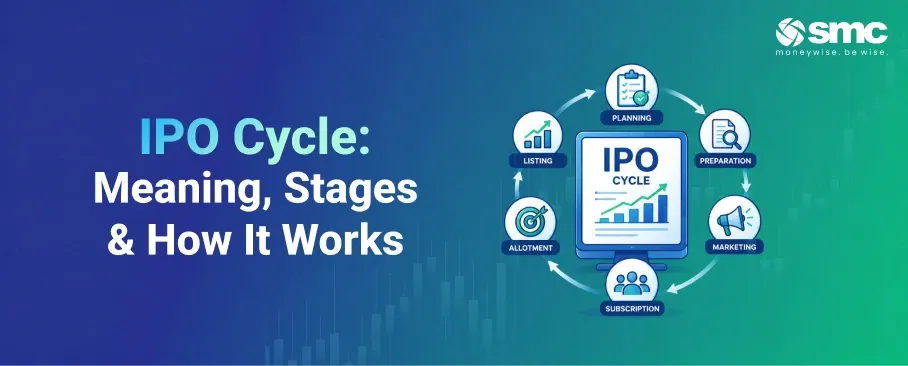
The IPO Cycle refers to the steps a private company takes to become publicly listed by offering its shares to investors. IPO stands for Initial Public Offering.
The cycle covers the stages before, during and after an IPO, including planning, regulatory review, pricing, bidding, allotment, listing and post-listing compliance.
Let’s go stage by stage.
Stage 1: The Decision – Should We Go Public?
The first step in the IPO Cycle is the company’s decision to go public. The management and board evaluate whether the company is ready to enter the public market.
Why do companies go for an IPO?
- To raise capital for expansion.
- To repay debts.
- To increase public visibility.
- To provide an exit opportunity to existing investors.
The company considers factors such as market conditions, industry trends and its financial position before moving ahead.
Stage 2: Hiring the Experts
Once the decision is made, the company appoints various professionals and intermediaries, including:
- Investment Bankers – They help with the issue structure, valuation, marketing and other aspects of the IPO.
- Legal Advisors – To handle legal documentation and regulatory requirements.
- Auditors – To audit and review financial statements.
- Merchant Bankers – They help manage the public issue and ensure compliance with applicable regulations.
Stage 3: Drafting the DRHP
One of the important steps in the IPO Cycle is preparing the Draft Red Herring Prospectus (DRHP).
The DRHP provides investors with important information about the company, including:
- Company overview
- Financial information
- Business risks
- Use of IPO funds
- Promoters’ background
Then, the DRHP is submitted to SEBI (Securities and Exchange Board of India) for review.
Stage 4: SEBI Review and Observations
SEBI reviews the offer document as part of the regulatory process and may seek clarifications or provide observations.
The company and its advisers address the applicable observations before moving ahead with the IPO. It is important to note that SEBI’s observations should not be treated as an approval or recommendation of the IPO.
Stage 5: Marketing the IPO – Roadshows & Ads
Once the regulatory process is completed, the company and its intermediaries may conduct roadshows and other investor outreach activities.
They explain the company’s business, financial performance, growth plans and the proposed IPO to potential investors.
TV advertisements, newspaper coverage and online communication may also form part of this phase of the IPO Cycle.
Stage 6: Price Band & Bidding
At this stage, the company announces key IPO details, including:
- IPO dates – Opening and closing dates.
- Price band – Minimum and maximum price per share.
- Lot size – Minimum number of shares an investor can apply for.
The IPO then opens for bidding, and investors submit their bids within the specified price range. This forms part of the book-building process, which helps determine the final issue price based on investor demand.
Stage 7: Allotment of Shares
Once the IPO closes, the next step in the IPO Cycle is allotment.
- If the IPO is oversubscribed, shares are allotted according to the applicable allotment basis. In some retail oversubscription cases, a draw of lots may be used to determine successful applicants.
- If the issue is undersubscribed, allotment is made based on valid applications received, subject to the applicable issue and minimum-subscription requirements.
The shares allotted to successful investors are credited to their demat accounts, while the blocked amount for unsuccessful applications is released in accordance with the applicable process.
Stage 8: Listing Day – The Big Moment
The company’s shares are then listed on a stock exchange, such as the NSE or the BSE.
- The shares begin trading on the exchange.
- Investors can buy and sell the shares in the secondary market.
- If the stock starts trading above its issue price, the difference is referred to as a listing gain.
However, a stock can also list below its issue price, depending on market conditions, investor demand and other factors.
Stage 9: Post-IPO Compliance
The IPO Cycle doesn’t end at listing. Once the company is listed, it has to comply with the ongoing requirements applicable to listed companies.
These include:
- Periodic financial disclosures
- Annual general meetings (AGMs)
- Disclosures to stock exchanges
- Ongoing communication with investors
The company now has greater disclosure and compliance responsibilities towards its shareholders and the market.
Why Understanding the IPO Cycle Matters for You
Understanding the IPO Cycle can help you make more informed investment decisions instead of simply following market hype. Knowing how an IPO moves from planning and regulatory review to pricing, allotment and listing can help you better understand the investment opportunity and the risks involved.
If you’re considering investing in IPOs, having a clear idea about the full process can help you approach an IPO with a better understanding.
Conclusion
So, what is the IPO Cycle? It is the series of steps a company goes through to raise funds from the public and become a listed company. Each stage from planning and regulatory review to pricing, allotment and listing plays an important role in the IPO process.
Whether you’re new to IPOs or already familiar with them, understanding the IPO Cycle can help you approach new issues with greater awareness and make decisions based on the company fundamentals and the offer, rather than market hype.

 1800 11 0909
 smc.care@smctradeonline.com