
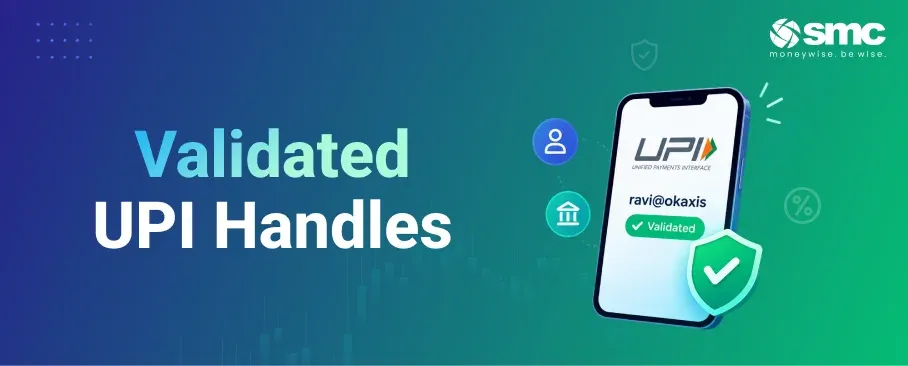


When you invest in a mutual fund or add money to your trading account, you usually make a payment through UPI or a bank transfer. But how do you know that the money is going to the right account?
This is an important question because fraudsters sometimes impersonate brokers, mutual fund companies, and other financial institutions. They may share payment details that look genuine and ask investors to transfer money to them.
To help investors verify payment details, the Securities and Exchange Board of India (SEBI) introduced validated UPI handles and the SEBI Check tool.
This initiative makes it easier to check whether a UPI ID or bank account is associated with a registered market intermediary before making an investment-related payment.
Let's understand what a UPI handle means, how validated UPI handles work, and how you can use the SEBI Check tool.
What Is a UPI Handle?
A UPI handle is the part of a UPI ID that comes after the @ symbol. It identifies the payment service provider or bank associated with the UPI address.
For example, consider this UPI ID:
rahul@okhdfcbank
Here, rahul is the username, while @okhdfcbank is the UPI handle.
A UPI ID allows you to send or receive money without having to enter the recipient's bank account number and IFSC code every time.
However, knowing someone's UPI handle does not automatically mean that the person or organization is authorized to collect investment-related payments. This is why checking payment details is important when investing.
What Are Validated UPI Handles?
Validated UPI handles are exclusive UPI IDs introduced for SEBI-registered investor-facing intermediaries, such as stockbrokers and mutual funds, to collect payments from investors.
These validated UPI IDs follow a standardized format that helps investors identify payment addresses associated with eligible SEBI-registered intermediaries
The format includes a specific suffix for the intermediary type, a validated handle ending in “@valid”, and the name of the self-certified syndicate bank (SCSB).
- Stockbrokers: The UPI ID includes the suffix .brk.
- Mutual funds: The UPI ID includes the suffix .mf.
For example:
These are illustrative examples, not actual payment IDs.
The @valid UPI handles are allocated by NPCI, while eligible intermediaries obtain the UPI IDs through the prescribed banking process
The standardized format helps investors recognize payment addresses associated with registered entities and makes it easier to verify payment details before transferring funds.
However, investors should still verify the UPI ID and recipient details before approving a transaction.
How Do Validated UPI Handles Work?
Suppose you want to make an investment-related payment through UPI. Instead of relying solely on the payment details shared with you, you can verify that the UPI ID follows the prescribed format and is associated with the intended intermediary.
Here's how the process works:
1. The intermediary uses a validated UPI handle
Eligible market intermediaries use standardized UPI IDs under SEBI's framework.
2. The investor receives the payment details
When you make a payment, the intermediary may share its validated UPI ID or an associated QR code.
3. You check the payment address
The validated UPI framework includes a distinctive green triangle with a thumbs-up symbol to help investors identify validated payment addresses.
4. You verify the details before paying
Check that the UPI ID and the recipient details match the intermediary you intend to pay. You can also use the SEBI Check tool for verification.
This additional check can help you spot discrepancies before authorizing a transaction.
Benefits of Validated UPI Handles
Validated UPI handles are intended to make investment-related payments easier to identify and verify. Here are some of the key benefits.
1. Helps investors identify legitimate payment addresses
A standardized UPI ID format makes it easier to recognize payment addresses associated with eligible registered intermediaries.
This can be useful when you are transferring money to a broker or making a mutual fund investment.
2. Helps reduce the risk of payment fraud
Fraudsters may use payment IDs that resemble those of genuine financial institutions. Checking a validated UPI handle can help investors identify discrepancies and avoid some impersonation scams.
3. Makes payment verification more convenient
Investors can use the prescribed UPI ID format, the verification indicator, and the SEBI Check tool to check payment details before making a transaction.
4. Adds another layer of investor protection
The framework encourages investors to verify payment details rather than relying solely on messages, calls, or payment instructions from someone claiming to represent a financial institution.
However, validated UPI handles do not eliminate every type of fraud. Investors should continue to check payment details carefully.
What Is the SEBI Check Tool?
The SEBI Check tool is a verification facility introduced by SEBI that helps investors check payment details associated with registered market intermediaries.
It is designed to help investors verify payment information before transferring money for investment-related transactions.
Using the facility, investors can check:
- Validated UPI IDs
- Bank account details, including the account number and IFSC code
- QR codes associated with validated payment details
This makes the tool useful for investors who make payments through UPI as well as those who use bank transfer methods such as NEFT, RTGS, or IMPS.
The SEBI Check facility is also accessible through SEBI's Saarthi app.
How to Use the SEBI Check Tool for UPI Verification
If you are making an investment-related payment, you can use the SEBI Check tool to verify the UPI ID shared by the intermediary.
Follow these steps:
Step 1: Open the SEBI Check facility
Visit the official SEBI Check facility or access it through the Saarthi app.
Step 2: Select the UPI verification option
Choose the relevant option for checking a UPI ID or payment details. Also, if you are doing a bank transfer, you can use the CHECK ACCOUNT DETAILS option.
Step 3: Enter the UPI ID or upload the QR code
Enter the validated UPI ID shared by your broker or mutual fund company. If you have a QR code, upload the QR code verification option.
If checking the account details, enter the account number and IFSC code.
Step 4: Review the verification result
Check the information displayed and confirm that it matches the intermediary you intend to pay.
Step 5: Confirm the details before making the payment
If the information matches, you can proceed with the payment after checking the details shown in your UPI app.
If the details do not match or cannot be verified, pause the transaction and confirm the correct payment information through the intermediary's official website or customer support.
What Should You Do If UPI Details Cannot Be Verified?
If the SEBI Check tool cannot verify a UPI ID or bank account, do not rush to make the payment.
A failed verification does not automatically mean that the payment request is fraudulent. There may be an error in the details entered or another reason why the information could not be verified.
Here are a few precautions you can follow:
- Check for typing errors: Re-enter the UPI ID, account number, or IFSC code carefully.
- Confirm the payment details by contacting the intermediary through its official website or customer support.
- Avoid unverified payment requests: Be cautious if someone sends payment details through an unsolicited call, message or social media account.
- Never share your UPI PIN or OTP: You do not need to disclose these details to verify a payment address.
- Do not act under pressure: Be careful if someone insists that you transfer money immediately to avoid losing an investment opportunity.
If anything appears unusual, verify the details before proceeding.
Conclusion
Validated UPI handles and the SEBI Check tool make it easier to verify payment details before making investment-related transactions. By checking the UPI ID, bank account details, or QR code and confirming that they match the intended intermediary, investors can take an extra step to protect themselves from payment fraud.

 1800 11 0909
 smc.care@smctradeonline.com