
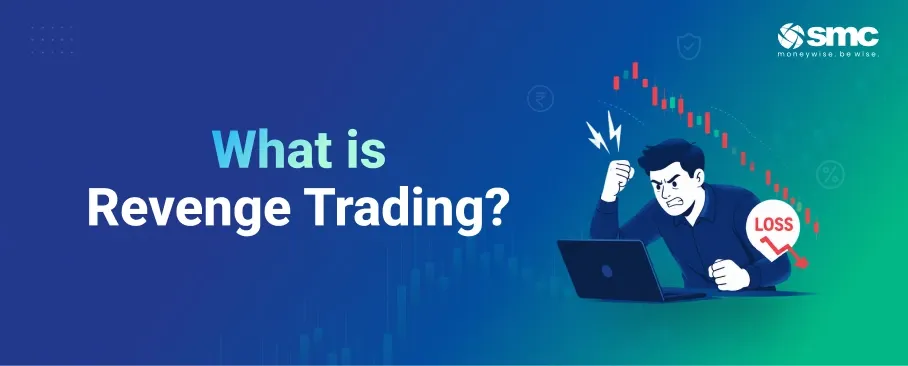


Most trading losses do not come from bad strategies; they come from what happens after a loss. That is where revenge trading begins.
Instead of accepting a controlled loss and waiting for the next valid setup, the trader tries to recover it immediately. The focus shifts from following a plan to getting back to break-even. Position sizes increase, rules are ignored, and decisions become reactive rather than deliberate.
The risk is not just the initial loss, but the sequence that follows. A single emotional trade can turn into a cluster of low-quality decisions, compounding into deeper drawdowns.
Revenge trading is an execution and behaviour problem, and it is one of the most common reasons traders underperform even when they have a viable edge.
What Is Revenge Trading?
Revenge trading is a specific pattern of emotional, loss-chasing behaviour where the dominant motive is to quickly recover prior losses or restore self-esteem. Instead of executing a pre-defined edge with controlled risk, the trader acts on impulse.
The behavioural pattern is consistent across sources:
- Immediate re-entry into the market after a loss, often within minutes
- Position sizes larger than normal risk parameters allow
- Ignoring entry criteria or trading outside the usual setup and timeframe
- Moving or removing stop-losses ("it will come back")
- Trading far more frequently than normal in a short window
Related concepts include
- Chasing losses: Attempting to recover quickly by increasing risk
- Trading on tilt: Borrowed from poker, a state where heightened emotions lead to reckless, non-systematic decisions.
Revenge trading is a subtype of emotional trading. All revenge trades are emotional trades, but not all emotional trades are revenge trades. FOMO buying, panic selling, and holding losers out of hope are distinct patterns; revenge trading specifically involves the impulse to recover a recent loss.
How Revenge Trading Starts
Emotional Triggers
Revenge trading nearly always begins with a strong emotional event:
- A large unexpected loss, especially on a high-conviction trade
- A series of smaller losses that erode confidence
- A loss perceived as "unfair"; slippage, platform issues, a news spike, or breaking one's own rules
After such events, traders experience intense frustration, anger, shame, and a burning urge to "make it back now."
Accumulated Pressures
Revenge trading is often not about a single trade. Underlying pressures amplify the emotional impact of losses:
- Time pressure: Limited trading windows around work or family
- Financial pressure: Reliance on trading income, prop-firm evaluation rules, account minimums
- Unrealistic expectations: Trying to force results in a short period
These external pressures make losses feel existential rather than statistical, strengthening the impulse to trade back immediately.
The Neuroscience of Loss Aversion
Market wins and losses activate the brain's dopamine-based reward system, similar to gambling. Wins produce dopamine surges that reinforce risk-taking. Losses create sharp dopamine drops and negative mood, strengthening the instinct to chase losses for emotional relief.
Prospect Theory research shows people feel the pain of a loss roughly twice as strongly as the pleasure of an equivalent gain. This asymmetry sits at the core of revenge trading; the trader cannot "accept" the loss and feels compelled to reverse it quickly.
Common Signs You Are Revenge Trading
Behavioural Red Flags
- Instant re-entry: Opening another trade within minutes of a loss, often in the same instrument, without waiting for a quality setup
- Sudden size increase: Increasing position size well above normal, internally justified as "I need to get it back in one trade."
- Rule-breaking: Skipping checklist steps, ignoring entry criteria, trading instruments outside the usual playbook
- Ignoring or widening stops: Moving stop-losses further away or removing them entirely
- Spamming trades: Far more trades per hour or per day than usual, often in random directions
Emotional and Physical Cues
- Strong anger or resentment toward the market or yourself
- Thoughts like "I'll show this market," "I just need one big winner," or "I can't finish the day red"
- Feeling agitated, fidgety, or physically tense at the keyboard
- Dissociation or "autopilot" behaviour, placing trades almost without conscious deliberation
If you recognise three or more of these signs during a session, you are likely to be engaging in revenge trading.
Why Revenge Trading Is So Dangerous
Account Damage
Traders often increase position size after a losing trade. When this repeats across several trades, drawdowns accelerate quickly. Most severe account losses, blown accounts, and large drawdowns come from a cluster of emotionally driven trades rather than from the underlying strategy failing.
Revenge trading changes the distribution of returns. Instead of many small controlled losses and occasional larger winners, the trader introduces rare but catastrophic downside events by stacking highly correlated, oversized, low-quality trades into a short window.
Psychological Damage
Beyond financial impact, revenge trading erodes confidence in the trading plan and in the trader's ability to follow rules.
Repeated cycles of revenge trading can contribute to shame, compulsive "win it back" behaviour, burnout, or a constant search for new systems instead of improving the execution of a sound edge. Emotional exhaustion often causes traders to miss high-quality setups when they finally appear.
How Revenge Trading Affects Your Overall Trading Performance
Damage to Edge and Expectancy
A trading edge depends on positive expectancy, proper position sizing, and execution discipline. Revenge trading undermines all three:
- Expectancy drops: Low-probability setups outside the plan drag down the win rate and average reward-to-risk
- Risk per trade explodes: Oversized positions increase return variance and can wipe out weeks of profits in one session
- Execution discipline collapses: Once rules are broken in a revenge state, further deviations become easier to rationalise
Impact on Learning
Revenge trading slows the learning curve. When losses trigger emotional spirals, traders avoid reviewing them objectively.
Emotional trades distort performance statistics, making it impossible to evaluate the true quality of a strategy. The cycle repeats: poor results, emotional reaction, more poor results.
Practical Rules to Prevent Revenge Trading
1. Cooling-Off Periods After Losses
Pre-defined breaks after losses let stress hormones subside and restore rational decision-making:
- 5-15 minutes after any stopped-out trade
- 30+ minutes or stop for the day after hitting a pre-defined daily loss limit
- At least one full day off after an unusually large loss (more than 2-3 times normal risk)
The bigger the emotional impact, the longer the break. The key is having pre-defined rules rather than deciding in the moment.
2. Hard Risk and Exposure Limits
Structural barriers prevent the spiral:
- Daily loss limit: A maximum amount of equity that, once lost, triggers an automatic shutdown for the day
- Max trades per day: Caps on the number of trades or losing trades before mandatory stop
- Position-size reduction: After a sequence of losses, reduce size by 50-80% to prevent escalation
3. Process Routines to Interrupt Emotional States
- Physical disengagement: stand up and walk away from the screen to disrupt the fight-or-flight loop
- Breathing techniques: 4x4 box breathing (inhale 4 seconds, hold 4, exhale 4, hold 4) activates the parasympathetic nervous system and shifts from reactive to rational mode
- Emotion labelling: consciously naming emotions ("I am feeling angry and ashamed") reduces limbic activation and creates space between feeling and action
- Arresting self-talk: short scripted phrases like "Stop, this is revenge, not strategy"
4. Strengthening Trading Plans and Checklists
A detailed plan reduces ambiguity and makes it easier to detect when emotion, not edge, is driving decisions:
- Exact entry criteria and invalidation conditions
- Fixed risk per trade and daily/weekly risk boundaries
- Rules for when not to trade (after news events, during low liquidity, after a set time)
- Explicit statement that no trade is a valid decision when setups are absent
5. Using Automation and Analytics as Guardrails
Technology cannot replace psychology but can enforce discipline:
- Rule-based or algorithmic systems execute only when pre-defined conditions are met
- Analytics and journaling tools track behaviour and identify emotional patterns (e.g., increased size after losses)
- Platform limits can lock trading after thresholds are hit or block rule-violating orders
6. Adjusting Timeframe and Style
Very short-term scalping demands rapid decisions and exposes traders to many emotional triggers per day. For traders with limited availability or high stress, moving to higher-timeframe strategies (swing or position trading) reduces intraday noise and opportunities to revenge trade.
7. Deeper Psychological Work
Long-term reduction of revenge trading often requires exploring underlying beliefs about money, self-worth, and success. Building tolerance for uncertainty and normalising losses as part of a probabilistic game. In severe cases of compulsive trading behaviour, professional help from a trading coach or therapist is appropriate.
Successful trading is not just about strategy; it is also about discipline, risk control, and emotional management. A reliable trading platform with the right tools can help you trade with greater confidence and control. Open a free demat account with SMC today and take the first step towards smarter, disciplined trading.

 1800 11 0909
 smc.care@smctradeonline.com