
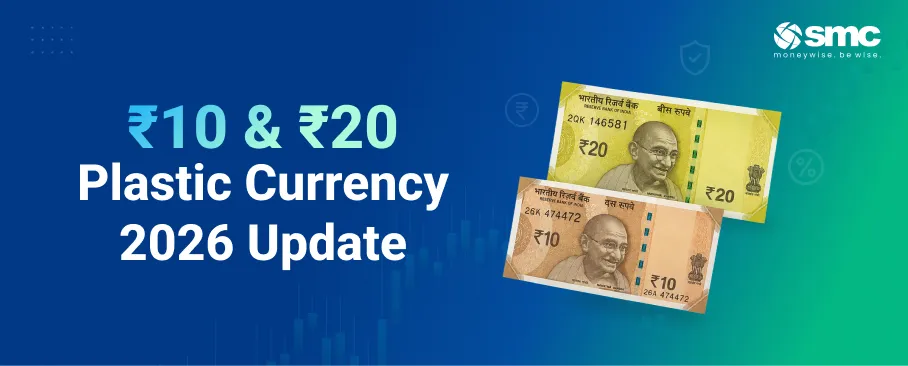


Chances are you’ve experienced this. You accepted the soiled Rs 10 note from a shopkeeper thinking, “it’s fine, everyone accepts these”. But when you use the same note at another shop, the shopkeeper simply refuses to accept it.
This has been a common problem for decades, and the RBI has finally taken concrete steps to fix it. In July 2026, the RBI’s currency printing arm floated a global tender to source polymer note material in a direction towards introducing plastic currency in India.
So, what exactly is plastic currency, and will it replace the old Rs 10 and Rs 20 notes? Here’s everything you need to know.
#What is Plastic Currency?
The plastic notes, contrary to their name, are not made out of the plastic used to make bottles and shopping bags. The polymer bank notes are made from a specially developed material, are more durable than paper, and can withstand rough handling without losing quality.
Polymer notes can have more security features than paper notes and are much more difficult to counterfeit. The security features are integrated into the material, rather than printed on top of it as is the case with paper notes.
#Why is RBI Considering Introducing Plastic Notes in India?
The biggest reason is durability. Rs 10 and Rs 20 paper notes don’t last long, and quality deteriorates much faster during the monsoon season. It is estimated that the average life of Rs 10 and Rs 20 notes in India is less than one year.
Replacing these worn-out notes is expensive. In FY25, the RBI's currency printing expenditure rose 25% to Rs 6,373 crore. During that year, the RBI removed nearly 24 billion banknotes from circulation.
Adding to the problem is the rising circulation of fake currency in the banking system. Detection of fake currency notes in the banking system rose 5.7% in FY26.
Polymer banknotes are far more resistant to moisture, dirt, and everyday wear and tear, making them last longer than paper notes. It is estimated that RBI polymer notes typically last 2 to 5 times longer than traditional bank notes. Also, with more specialised security features, they will become much harder to counterfeit.
#Countries Already Using Plastic Currency?
Polymer-based currency notes are not a new concept and have been in use since 1988. Australia was the first country to introduce polymer notes, and since then, more than 60 countries have adopted them. This includes Canada, the United Kingdom, Singapore, and New Zealand.
Many countries have reported that these polymer notes last 2.5 times longer than paper notes while offering better security.
#RBI’s Latest Polymer Currency Plan
Here’s what has happened so far.
- In July 2026, RBI’s currency printing subsidiary, Bharatiya Reserve Bank Note Mudran Private Limited (BRBNMPL), invited global suppliers to provide polymer note material for field trials.
- As per the report, the field trial is likely to begin with small denominations, Rs 10 and Rs 20 notes. There is no mention of the specific denominations in the official tender.
- The Finance Ministry has given its nod to the RBI's proposal for a pilot of ₹10 and ₹20 polymer notes.
- There is no fixed timeline for the launch of polymer banknotes, and RBI Governor Sanjay Malhotra said the project is still at a preliminary stage.
- Reports also indicate that around 100 crore of Rs 10 and Rs 20 notes will be printed for testing, which will be limited to a few cities.
For now, the RBI has not decided to replace all paper currency with polymer notes. The current exercise is only a field trial to understand the benefits and challenges better. Most likely, the field trials will be done across five climatically diverse cities.
#Why Did the RBI Discontinue the 2012 Plastic Notes Trial?
It’s not the first time the RBI has experimented with new currency notes. In 2012, the government approved a field trial of ₹10 polymer banknotes across five climatically diverse cities: Kochi, Mysore, Jaipur, Shimla, and Bhubaneswar. The plan was eventually shelved, and the reasons were entirely technical:
#Note-processing Bottlenecks: Banks' note-counting and sorting machines weren't built to handle two fundamentally different materials, paper and polymer, at the same time. Polymer notes are thinner and more slippery than paper notes, so machines struggle to count them correctly. This created operational friction and increased the turnaround time of currency management.
#Infrastructure and supply chain not ready: The broader ecosystem for printing, processing, and circulating polymer notes along with paper in India was not developed enough a decade ago to support a smooth roll-out.
#Cost-Benefit Data: Does Polymer Actually Save Money?
One of the biggest questions is whether polymer notes are worth the extra expense.
Reports from the Reserve Bank of Australia and the Bank of England indicate significant cost savings.
The Reserve Bank of Australia calculated that the switch to polymer notes resulted in savings of around $1 billion (real terms). And that’s not counting the extra savings from fewer counterfeit notes in circulation. And the Bank of England also predicted big savings when polymer notes were introduced. The switch had saved about £100 million in 10 years, it said.
#What does this mean for India?
RBI spent around ₹5,101 crore in printing replacement notes in FY24. A year later, that number increased to nearly ₹6,373 crore as more worn-out notes were withdrawn from circulation.
If polymer notes last anywhere close to estimates, RBI could significantly reduce the cost of replacing #₹10 and ₹20 notes, which wear out the fastest because they change hands so frequently.
That is perhaps the biggest reason behind RBI's pilot. While the central bank hasn't shared any cost estimates yet, a longer-lasting note could translate into meaningful savings over time.
#What Do People in Other Countries Think About Plastic Notes?
Countries like Australia, Canada, the UK, and Singapore have been using polymer notes for years. Their durability and security are well proven there. Most complaints aren't about how long they last or how secure they are. Instead, they revolve around something much simpler: the way these notes feel in everyday use. Some of the most common complaints are:
#They’re Slippery: Across countries where polymer notes have been introduced, the most common complaint has been that the notes are slippery when dry. They easily slide out of their pockets, so you need to secure them in a wallet.
#They Stick Together: Polymer notes tend to stick together, and their smooth surface makes hand counting a little harder. Cashiers and shopkeepers who handle large volumes of cash often complain that it gets difficult to shift through the notes when counting compared to paper notes.
#They Fold Differently: Over time, paper notes tend to become soft. But plastic notes don’t lose their thickness or quality so easily. Users have complained that new polymer notes fold differently and notes crease sharply along fold lines.
#Notes give a plastic feel: One of the major pieces of feedback initially received by the Bank of England from the public is that the new notes felt too plasticky and slippery. To improve the grip and make them suitable for regular use, the central bank then added raised prints on the design.
Despite the minor difficulty in using the polymer notes, the overall feedback was positive as they stay much cleaner than paper notes. Since they don’t absorb water or dirt easily, they continue to look new for much longer. However, if the polymer notes get accidentally exposed to heat or left on a hot surface, they can shrink, and colours may fade.
#Will India Fully Switch to Plastic Notes?
Not yet. For now, RBI is introducing Rs 10 and Rs 20 plastic notes only as a part of a field trial. Based on feedback from the public, RBI will decide whether to continue with plastic notes.
Even if the trial is successful, there’s no guarantee that all denominations will switch to polymer. Whether higher-value notes are introduced in plastic form will depend on operational feasibility, ATM compatibility, and printing costs.
It's worth noting that not every country using polymer notes has adopted them across all denominations. Many have introduced plastic notes only for selected values, while continuing to use paper notes for others. India could take a similar phased approach if the pilot proves successful, but there is no official timeline.
#The Bottom Line
Next time, if you receive any plastic notes, don’t be surprised. Take a closer look. It may seem like another Rs 10 or Rs 20 note, but it could mark the beginning of a major shift in how India prints and manages its currency. Years from now, it may be remembered as the note that marked the beginning of India's biggest change in physical currency since the Mahatma Gandhi series was introduced in 1996.


 1800 11 0909
 smc.care@smctradeonline.com