



An IPO can seem like a quick way to get into a company's growth story, but getting it right takes more than spotting a name in the news. Once you understand how an IPO works, from the offer document to allotment day, you can judge which ones deserve your money and which to leave alone. This guide is where that understanding starts.
In this blog, we'll explore what an IPO is, why companies list, how the process works, how to apply, how shares get allotted, and the risks worth knowing before you invest.
What is an IPO, and why do companies go public?
An initial public offering, or IPO, is the first time a company sells its shares to the public and lists them on a stock exchange. That is the plain IPO meaning: ownership shifts from a small group of promoters and early backers to a broad base of public shareholders who can buy and sell those shares on the open market.
For the company itself, an IPO is mostly about raising capital. A company may raise fresh money to fund expansion, repay debt or invest in new projects. An IPO also provides early investors with a way to exit and raises the company's public profile.
Fresh issue, offer for sale, and how IPOs are priced
Every IPO is built from one or both of two parts. Fresh Issue & Offer for Sale
In a fresh issue, the company issues new shares, and the proceeds go back into the business.
In an offer for sale (OFS), existing shareholders sell part of their holdings, so the proceeds go to them rather than to the company. Reading this split tells you where your investment actually lands.
Pricing follows one of two methods. Most mainboard IPOs use book-building, where the company sets a price band, and investors bid within it; the final price is set after bidding based on demand. In a fixed price issue, the price is stated upfront, and you apply at that single figure. Book building is more common on the mainboard because it lets the market help discover a fair price.
Mainboard versus SME IPOs
Not every IPO lists on the main board. Larger companies list on the main platforms of the NSE and BSE, and their draft offer documents are vetted by SEBI. Smaller companies list on the dedicated SME platforms, NSE Emerge and BSE SME, where the exchanges handle much of that vetting.
The rules differ in ways that matter to you. An SME issue must have at least 50 allottees, compared with a minimum of 1,000 for a mainboard IPO, and SME companies operate within a post-issue paid-up capital ceiling of ₹25 crore. The entry ticket is also higher: for SME IPOs opening on or after 1 July 2025, the minimum application size is two lots valued at over ₹2 lakh.
SME IPOs can move sharply and often trade thinly, which makes them harder to exit at the price you want. Treat them as a higher-risk corner of the market rather than a starting point.
Who can apply: the main investor categories
An IPO splits its shares among a few investor groups, and knowing which one you fall into helps set your expectations. For a typical book-built mainboard issue, at least 50% of the net offer is reserved for Qualified Institutional Buyers (QIBs), at least 15% for Non-Institutional Investors (NIIs, often called HNIs), and at least 35% for Retail Individual Investors.
As a retail investor, you fall in the last group when your total bid is up to ₹2 lakh. Within the QIB tranche, some large institutions act as anchor investors before the issue opens to the general public.
Some issues also carve out a small portion for company employees or existing shareholders of the group, usually with their own limits. As a first-time applicant, you will almost always apply in the retail category, so the 35% reservation is the pool your allotment comes from.
From DRHP to listing: how an IPO reaches the market
Behind every listing day is a set process. Following it helps you know what to read and when to act.
- #File the draft offer document: The company and its bankers file a Draft Red Herring Prospectus (DRHP) with SEBI, setting out the business, financials, risks and how the money will be used.
- #Clear SEBI's review: SEBI examines the DRHP and issues observations that the company must address, often asking for clearer risk disclosure.
- #Publish the price band: The company files the Red Herring Prospectus with the price band, lot size and bid dates.
- #Bid during the open window: You place your application while the issue is open, choosing a price within the band or bidding at the cut-off.
- #Get the allotment and listing: Shares are allotted, and the stock lists on the exchange.
That final step now happens quickly. SEBI cut the listing timeline to three working days after an issue closes, known as T+3, and this has been mandatory since December 2023. In practice, your shares can be trading within days of the issue closing.
How to apply for an IPO using ASBA and UPI
You do not hand over cash when you apply for an IPO. Applications run through ASBA, short for Application Supported by Blocked Amount. Your bank blocks the application money in your own account and debits it only if you are allotted shares. As SEBI's investor page explains, the blocked amount remains in your account and continues to earn interest until allotment, and no refund is required if you receive nothing.
Most retail investors now apply using UPI. You enter your UPI ID in the application, approve a mandate to block funds, and the money is debited automatically if shares are allotted.UPI can be used for IPO applications up to ₹5 lakh per transaction. However, applications up to ₹2 lakh by individual investors fall under the retail category, while applications above ₹2 lakh and up to ₹5 lakh fall under the NII category.
A few practical points keep your application valid. Apply once per PAN for a given IPO, since duplicate applications under the same PAN are rejected. You can apply through your bank's net banking, your broker, or a UPI app listed for public issues.
How shares are allotted in an oversubscribed IPO
Allotment is simple when an IPO is not fully subscribed: you receive the shares you applied for. The picture changes when demand outpaces supply, which is common in popular issues.
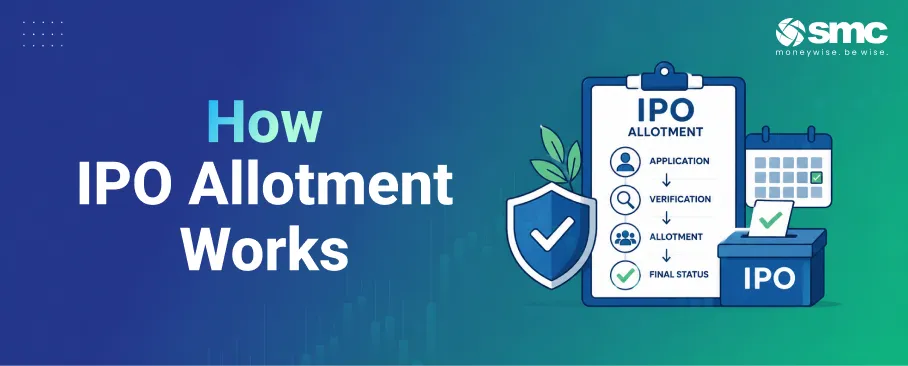
When an IPO is oversubscribed, allotments are handled separately for each investor category in accordance with the applicable rules. In the retail category, if there are more valid applications than available lots, allotment is determined by lottery.
This is why applying for more lots does not always help, and why one honest application per PAN is the rule. Once the allotment is finalised, the blocked funds of unsuccessful applicants are released. You can check your status on the registrar's website using your PAN or application number, and allotted shares are credited to your demat account.
What grey market premium (GMP) tells you, and what it doesn't
You will see grey market premium quoted everywhere in the run-up to a popular IPO, so it helps to know exactly what it is. GMP is the unofficial premium at which IPO shares change hands informally before they list. If the issue price is ₹500 and the shares trade at ₹580 in the grey market, the GMP is ₹80.
Here is the part that matters. The grey market sits entirely outside the regulated system. SEBI, the NSE and the BSE neither run it nor recognise it; there is no official source for the numbers, and no exchange guarantees any of those trades. GMP figures circulate through news sites, forums and broker networks as a rough read on sentiment.
Treat GMP as chatter, not a forecast. It is not a reliable predictor of your listing price, which is set by regulated trading on the day of listing. Basing an IPO investment decision on GMP alone means trusting an unregulated number over the company's actual disclosures.
How to size up an IPO before you invest
Once GMP is set aside, the offer document does the real work. The DRHP and RHP hold everything you need to form a view, and a few sections carry most of the weight.
- #Objects of the issue: Check how much of the money is a fresh issue funding the business, and how much is an OFS going to selling shareholders. A large OFS at a high price means more cash leaving with early investors than going into growth.
- #Valuation against peers: Look at the price-to-earnings ratio, earnings per share, and return on net worth, and compare them with those of listed companies in the same line of work. An issue priced well above its peers needs strong reasons.
- #Promoter holding and lock-ins: Promoters' minimum contribution is locked in for three years, and the remainder of the pre-issue capital is locked in for one year. When large blocks come free later, the added supply can weigh on the price.
- #Business and risk factors: Read the risk section in full. It is where the company states, in its own words, what could go wrong.
How India's IPO market has grown
It helps to see where all this activity sits. India has been through a strong run of new listings, and understanding the scale keeps the excitement in perspective.
FY25 was a busy year for the mainboard, with 80 IPOs against 76 the year before, and total capital raised of roughly ₹1.63 lakh crore, a sharp jump from about ₹619 billion in the previous year. Demand was heavy too, with average QIB oversubscription of 102 times across those issues. The momentum continued: between October 2024 and September 2025, IPOs raised about ₹1.7 lakh crore, well ahead of the prior 12-month period.
A busy market cuts both ways for you. More listings mean more choice, but a crowded, high-demand market also tends to push issue prices higher and allotment odds lower. That is the backdrop against which the risks below are worth reading closely.
The main risks of IPO investment
An IPO is still an equity investment, and the excitement around a listing can hide some real risks. Knowing them upfront keeps your expectations grounded.
Allotment odds can be low in a hot issue. In FY25, mainboard IPOs saw average QIB oversubscription of 102 times and retail oversubscription of 35 times, so many applicants in popular issues receive no shares at all. Overpricing is another risk: when an issue price already assumes rapid growth, any earnings miss after listing can push the stock below that price.
Supply is a quieter risk. As lock-in periods end, large pre-IPO holdings become sellable, and that extra supply can drag on the price. Listing gains can vary widely. Some IPOs may list above their issue price, while others may list at a discount and subsequently trade below the issue price.”
How IPO gains are taxed in AY 2026-27
Tax shapes what you actually keep, so it is worth folding into your plan from the start. For shares sold within 12 months of allotment, the profit is a short-term capital gain, taxed at 20% for listed equity where securities transaction tax applies.
Hold your shares for more than 12 months, and the profit becomes a long-term capital gain. The first ₹1.25 lakh of such gains on listed equity in a financial year is exempt, and anything above that is taxed at 12.5%. These rates follow the capital gains changes that took effect from 23 July 2024, and securities transaction tax still applies on your sale.
Where to track upcoming IPOs
You can track upcoming IPOs on SMC Global Securities’ Upcoming IPOs page, which provides details on upcoming and open IPOs, including bidding dates and price ranges. You can also check the official IPO pages of the NSE and BSE for the latest issue details and listing information.
Before applying, review the company’s offer documents, including the DRHP and RHP, to understand its business, financials, valuation and risks. An IPO making headlines can be a reason to research further, but not a reason to invest based on market buzz alone.
Conclusion
IPO investing works best when you look beyond listing-day buzz and evaluate each issue on its fundamentals. Review the offer document, understand how the money will be used, compare the valuation with listed peers, and factor in the risks before applying.
If you decide to invest, you will need a demat account to receive and hold allotted shares. You can open a demat account with SMC to get started.
Investments in securities markets are subject to market risks. Read all the related documents carefully before investing.

 1800 11 0909
 smc.care@smctradeonline.com