
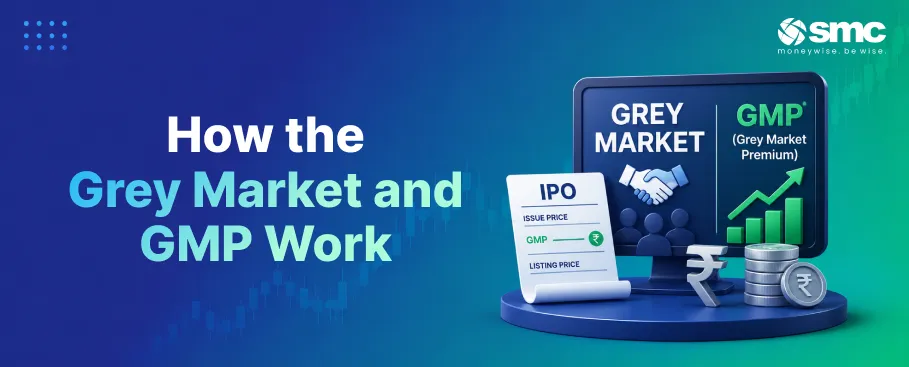


Ask any retail IPO investor how they judge a listing, and the first number they name is usually the Grey Market Premium (GMP). The pull is understandable: GMP appears on dozens of tracking sites, updates through the day, and seems to offer a preview of listing day. But the evidence is more complicated: GMP is a useful sentiment gauge and a weak predictor of the actual listing price, and treating it as a definitive signal has cost many investors on volatile listing days.
In this blog, we'll look at how the grey market and GMP work, what the evidence says about GMP and listing price prediction, and how to evaluate an IPO beyond the premium.
#How the Grey Market and GMP Work
The IPO grey market is an informal, over-the-counter market where IPO shares and applications change hands before the official listing on the NSE or the BSE. It runs entirely outside SEBI regulation, with trades executed off-exchange through a network of dealers and sub-brokers, largely on mutual trust. Activity peaks in the short window between allotment and listing, when investors try to gauge or monetise listing-day demand in advance. Because it is unofficial and unregulated, SEBI has explicitly cautioned that there is no legal investor protection if a counterparty defaults or a dispute arises.
Grey Market Premium is the extra rupee amount investors are willing to pay over the IPO issue price in the grey market before listing. In practice, the meaning of GMP is simple: it is a sentiment indicator. A high positive GMP indicates strong demand and hype; a negative or falling GMP signals weak interest or fading sentiment.
Two related grey-market terms also come up in IPO discussions:
- #Kostak rate: the price at which a full IPO application trades, letting sellers lock a fixed profit or exit allotment risk before shares are even assigned.
- #Subject-to-sauda: an agreement valid only if the seller receives an allotment; it usually commands a higher rate than plain Kostak because the counterparty has certainty of delivery.
#How GMP Is Calculated
The formula is straightforward:
- GMP = Grey Market Price − IPO Issue Price (upper band)
- Implied Listing Price = IPO Upper Band + GMP
Three examples of how this works:
- Upper band ₹200, grey market price ₹280: GMP is ₹80, implied listing ₹280 (a 40% premium).
- Issue price ₹100, grey market price ₹120: GMP is ₹20, implied listing ₹120 (a 20% premium).
- Issue price ₹100, grey market price ₹90: GMP is −₹10, implying a 10% discount to issue price.
Many tracking portals also express GMP as a percentage of issue price to compare across IPOs, so a ₹50 GMP on a ₹100 issue becomes a 50% GMP.
GMP is not quoted on a transparent electronic order book. It reflects quotes and deals among a small circle of grey-market dealers and high-risk traders, and prices move quickly on rumours, anchor-investor participation, and the broader market mood. Tracking portals aggregate dealer quotes and openly note that the data is unofficial, varies by source, and may not be accurate.
#What the Evidence Says About GMP and Listing Price
#When GMP diverges most from actual listing price
GMP is more accurate in stable markets, less so during volatile phases, and weakest in the days right after major macroeconomic announcements. High-profile IPOs with heavy media attention often see GMP overshoot the actual listing price because hype concentrates in the informal market but dissipates once real institutional flows set the opening price on the NSE and BSE.
The most common factors behind the gap between GMP and listing price:
- Broader market conditions on listing day; a sharp index fall between IPO closure and listing can turn a high-GMP issue into a discount.
- Final QIB and HNI subscription data, visible only after the issue closes, can validate or contradict pre-issue GMP signals.
- Anchor-investor behaviour, lock-in expiries, and block deals around listing day.
- Macroeconomic or regulatory news between issue close and listing.
- Aggressive initial valuations that cap how much hype the listing can sustain.
#How to Evaluate IPOs Beyond GMP
#Risks of Relying on GMP
Treating GMP as a primary signal carries concrete risks:
- #Manipulation: Grey-market quotes can be steered by a small circle of dealers with concentrated positions, who can move the apparent premium with few trades.
- #Thin liquidity: Prices reflect a narrow, illiquid market, so a handful of aggressive trades can distort the premium.
- #No legal recourse: Grey-market transactions operate outside the formal regulatory framework, so investors may not have the same protections and dispute-resolution mechanisms available in regulated markets.
- #Regulatory risk: SEBI has repeatedly flagged grey-market participation as operating in a regulatory grey zone.
Beyond structure, the behavioural problem matters just as much. GMP pushes retail investors to chase the highest-premium issues, which often means the hottest sentiment and the richest valuations rather than the best fundamentals. When those IPOs correct in the weeks after listing, which happens often, realised returns can trail the apparent GMP signal by a wide margin.
#A Fundamentals-First Evaluation Framework
A better approach treats GMP as one minor, optional input rather than a leading signal, and asks the questions that actually drive long-term outcomes.
- #Business and financials: What does the company do, and is the market opportunity real and large enough? Are revenue growth, profitability, debt, and cash flow durable, or is it unprofitable with no clear path to earnings? How does the valuation compare with listed peers: realistic, or priced for perfection?
- #Governance and ownership: Promoter holding, lock-in periods, related-party transactions, and past red flags disclosed in the Red Herring Prospectus shape the long-term risk profile. Anchor-investor quality is a better sentiment signal than GMP, because it reflects committed capital from sophisticated investors who have done deeper due diligence.
- #Demand signals from the issue itself: QIB oversubscription correlates most strongly with institutional conviction, and closing-day subscription data gives real demand information you can't see before the issue closes.
Reading the risk factors in the Red Herring Prospectus, checking contingent liabilities, and understanding how the IPO proceeds will be used all take more time than glancing at a GMP tracker. Still, they separate the IPOs likely to compound over time from those that deliver a brief listing pop before fading.
Investments in securities markets are subject to market risks. Read all the related documents carefully before investing.
#Conclusion
Grey Market Premium tells you what a narrow, unregulated circle of traders will pay for IPO shares before listing. That isn't worthless; it reflects sentiment, shows momentum shifts, and sometimes aligns with how the market prices the stock aton debut. But it is not a reliable forecast of the listing price, and it is no substitute for fundamental analysis. Glance at GMP to read the mood around an issue, then set it aside and decide on business quality, valuation versus peers, QIB subscription, anchor quality, and fit with your own risk appetite.
To apply for IPOs with trading and research support, you can open a Demat account with SMC.

 1800 11 0909
 smc.care@smctradeonline.com