
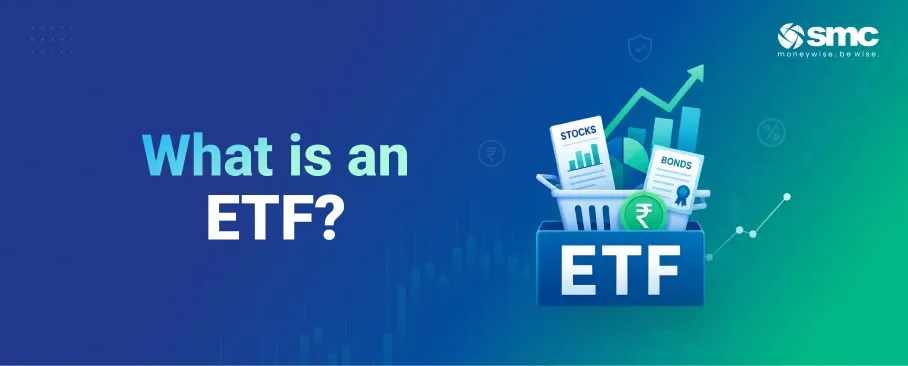


An Exchange-Traded Fund (ETF) is a pooled investment security that tracks an index, commodity, bonds, or a basket of assets and trades on stock exchanges like a regular stock. Buying one unit of a Nifty 50 ETF gives you proportional ownership in all 50 companies in the index.
India's ETF AUM crossed ₹10 lakh crore in October 2025, doubling in three years. This guide covers how ETFs work, the types available in India, their advantages and risks, how they compare to mutual funds, and the current taxation rules.
What Is an ETF in the Stock Market?
An Exchange-Traded Fund (ETF) is a pooled investment vehicle that holds a basket of securities, stocks, bonds, commodities, or a mix, and trades on stock exchanges like NSE and BSE during market hours.
Unlike mutual funds bought and redeemed through the fund house at end-of-day NAV, ETF units are bought and sold through a demat and trading account, with prices changing in real time based on market demand.
If you buy one unit of a Nifty 50 ETF, you effectively own a proportional slice of all 50 companies in the Nifty 50 index, Reliance, TCS, HDFC Bank, Infosys, and so on, in the same weightage as the index. When the Nifty 50 moves up 10%, your ETF unit moves up roughly 10% as well.
Why ETFs Grew So Fast in India
Passive investing, the strategy of tracking an index rather than trying to beat it, has reshaped how Indians invest.
According to the SPIVA India Mid-Year 2025 scorecard, 66% of Indian large-cap active funds underperformed their benchmark over six months. Over 10 years, the underperformance rate was 73.3% for large-cap funds and 81.7% for mid/small-cap funds.
ETFs, as passive instruments, eliminate fund-manager risk and offer a low-cost way to ride the broader market.
The numbers reflect this shift:
- ETF AUM crossed ₹10 lakh crore in October 2025, doubling in three years
- ETF folios surged from approximately 41 lakh in November 2020 to over 3 crore by November 2025
- ETF trading turnover rose from ₹51,000 crore in FY20 to ₹3.83 lakh crore in FY25
How Do ETFs Work?
Three mechanisms underpin ETF functioning: creation and redemption, the role of Authorized Participants, and the relationship between NAV and market price.
Creation and Redemption
ETF units are not sold to the public directly by the fund house for cash. Instead, the process works through large institutional players:
- Creation: An Authorized Participant (AP), typically a large bank or market maker, buys the underlying basket of securities (for example, all 50 Nifty stocks in proportion) and delivers the basket to the ETF issuer. The issuer provides a large block of new ETF units called a "creation unit" (typically 10,000 to 100,000 units) in return.
- Redemption: The reverse process. The AP collects ETF units from the market, hands them back to the ETF issuer, and receives the underlying securities.
- In-kind exchange: Most creation and redemption happen "in kind"; securities are exchanged for units, not cash. This structure keeps the fund tax-efficient because there is no sale event triggering capital gains inside the fund.
Retail investors never directly create or redeem units. They buy and sell existing units on the exchange through their broker, just like buying a stock.
Role of Authorized Participants
APs serve two functions that keep the ETF market healthy:
- Supply management: When demand for ETF units rises, APs create new units. When demand falls, they redeem units. This keeps supply matched to demand.
- Price arbitrage: If the ETF trades at a premium (market price above NAV), APs create new units, buying the cheaper underlying securities and selling the more expensive ETF units, pushing the ETF price back down. If the ETF trades at a discount, APs redeem units, pushing the price back up.
NAV vs Market Price
- NAV (Net Asset Value): Calculated once daily based on closing prices of the underlying securities. Reflects the "true" value of the fund.
- Market price: The real-time trading price on the exchange, fluctuating with supply and demand throughout the day.
In India, many ETFs, especially low-volume ones, show persistent gaps between market price and NAV. SEBI proposed in February 2026 to shift ETF base price determination from T-2 NAV to T-1 iNAV to reduce this pricing lag.
What Are the Key Features of ETFs?
Five structural characteristics define ETFs as an investment vehicle.
- Diversification: A single ETF unit provides exposure to an entire basket of securities. One Nifty 50 ETF unit covers 50 blue-chip companies across multiple sectors, reducing single-stock risk.
- Liquidity: ETFs trade on NSE and BSE during market hours. Investors can buy and sell anytime with real-time pricing. Popular ETFs like Nifty 50 ETFs have high trading volumes, though niche ETFs may have thinner liquidity.
- Transparency: ETF holdings mirror the underlying index and are disclosed daily. Live market prices and NAV are visible throughout trading hours. Mutual fund portfolios, by comparison, are disclosed monthly or quarterly.
- Low expense ratio: ETF expense ratios can be as low as 0.05% for index ETFs. Most equity ETFs in India charge between 0.05% and 0.50%, substantially lower than the 1%-2% charged by actively managed mutual funds.
- Passive management: Most ETFs replicate the underlying index rather than actively picking stocks. The fund manager only makes periodic adjustments during index rebalancing. This eliminates fund-manager risk and keeps operating costs low.
What Types of ETFs Are Available in India?
Six main categories of ETFs are accessible to Indian investors.
Index ETFs
Index ETFs track broad market indices like the Nifty 50, Sensex, Nifty Next 50, Nifty Midcap 150, and Nifty Smallcap 250. Nifty 50 index-linked passive funds account for approximately 40% of total passive fund AUM in India.
Examples include Nippon India ETF Nifty 50 BeES, SBI Nifty 50 ETF, and UTI Sensex ETF.
Sectoral and Thematic ETFs
These ETFs track sector-specific indices, Bank Nifty, IT, Pharma, FMCG, PSU, and CPSE. Examples include Kotak Nifty Bank ETF and Nippon India ETF Nifty PSU Bank BeES.
An emerging sub-category is smart beta or factor ETFs, which use rule-based strategies to tilt toward factors like momentum, quality, low volatility, or value. Examples include ICICI Prudential Alpha Low Volatility 30 ETF and Kotak Nifty 200 Momentum 30 ETF.
Gold ETFs
Gold ETFs track the price of physical gold at 99.5% purity. Gold ETF AUM doubled to cross ₹1 lakh crore in 2025, with folios surging to 1.14 crore by January 2026. Domestic gold prices climbed 75% in calendar year 2025.
Examples include HDFC Gold ETF, Invesco India Gold ETF, and Nippon India ETF Gold BeES. Gold ETFs eliminate storage costs, purity risks, and making charges associated with physical gold.
Silver ETFs
SEBI allowed silver ETFs in November 2021. AUM grew from approximately ₹7,473 crore in June 2024 to over ₹50,000 crore by late 2025, with folios reaching 47.85 lakh.
Domestic silver prices surged 168% in 2025, driven by industrial demand from solar and EV manufacturing and supply constraints. Examples include Tata Silver Exchange Traded Fund, Nippon India Silver ETF, and HDFC Silver ETF.
Debt and Fixed Income ETFs
Debt ETFs provide exposure to baskets of government bonds, PSU bonds, and corporate debt. The Bharat Bond ETF, a government initiative investing in AAA-rated PSU bonds, is the most prominent product in this category, with maturities available for 2025, 2030, 2031, and 2032.
Bharat Bond ETFs offer yields in the 6-7% range and suit conservative investors seeking predictable returns. Debt ETF AUM stands at approximately ₹1.2 lakh crore.
International ETFs
International ETFs track global indices like NASDAQ 100, S&P 500, and Hang Seng, providing geographic diversification and exposure to sectors like U.S. technology that Indian markets cannot fully replicate.
Examples include Motilal Oswal NASDAQ 100 ETF, Mirae Asset Hang Seng TECH ETF, and Nippon India ETF Hang Seng BeES.
How Do ETFs Compare to Mutual Funds?
For long-term passive investing, a low-cost ETF tracking a major index will likely outperform the average active mutual fund because high fees act as a significant drag on returns over time.
However, top-quartile active funds can outperform the index, especially in less efficient market segments like Indian small-caps. Mutual funds also have the advantage of a robust SIP infrastructure and no requirement for a demat account.
What Are the Advantages of Investing in ETFs?
- Cost efficiency: Expense ratios as low as 0.05% with no entry or exit loads. Lower administrative costs from passive management translate to more of the return reaching the investor.
- Diversification in one trade: A single Nifty 50 ETF purchase gives exposure to 50 stocks across sectors. Gold ETFs provide commodity exposure without physical storage. An investor can build a multi-asset portfolio using ETFs alone.
- Real-time trading and flexibility: Buy and sell during market hours at live prices. Place limit orders and stop-loss orders. Intraday trading is possible for those who want it.
- Transparency: Holdings mirror the index and are publicly disclosed daily. Live prices and NAV are available during trading hours, giving investors clarity on what they own and what it's worth at any moment.
- Lower tax drag: The in-kind creation and redemption mechanism reduces taxable events inside the fund, making ETFs slightly more tax-efficient than actively managed mutual funds that frequently buy and sell securities.
- Access to multiple asset classes: Equity, debt, gold, silver, and international markets are all accessible through ETFs. Investors don't need separate accounts or platforms for different asset classes.
- Government-backed options: Bharat Bond ETFs provide AAA-rated PSU bond exposure with fixed maturity dates, a structured product backed by the Government of India for conservative investors.
What Are the Risks of Investing in ETFs?
Market Risk
If the underlying index falls 20%, the ETF falls approximately 20%. No fund manager intervenes to protect the downside. This is the fundamental trade-off of passive investing. Mitigation: invest with a long-term horizon of five years or more.
Tracking Error
The gap between ETF returns and benchmark returns is caused by the expense ratio, cash holdings, rebalancing delays, and dividend reinvestment lag.
Even a small tracking error of 0.8%-1.2% annually can translate to ₹50,000-₹1 lakh lost on a ₹50 lakh investment over time. Choose ETFs with tracking error below 0.5%, preferring large AUM and established AMCs.
Liquidity Risk
Not all Indian ETFs are liquid. Many niche ETFs have average daily volumes below ₹10-20 lakh. Low volume means wider bid-ask spreads and higher transaction costs.
Large orders in illiquid ETFs can move the market price unfavourably. Stick to ETFs with high average daily volumes and use limit orders instead of market orders.
NAV-Price Deviation
Persistent gaps between ETF market price and NAV are common in India, particularly for low-volume ETFs. Buying at a premium or selling at a discount erodes returns compared to the benchmark.
Concentration Risk (Sectoral ETFs)
Sector-specific ETFs concentrate exposure in one industry. If that sector underperforms, the entire ETF suffers. No diversification benefit exists within a single-sector ETF.
Currency Risk (International ETFs)
Returns from international ETFs are affected by INR-USD exchange rate movements. A strengthening rupee erodes dollar-denominated returns even if the underlying foreign index performs well.
How Are ETFs Taxed in India?
The taxation framework changed with the Union Budget of July 2024. Rules differ by ETF category.
Equity ETFs (Index, Sectoral, Bank Nifty)
The ₹1.25 lakh LTCG exemption is aggregate across all equity investments (stocks, equity mutual funds, and equity ETFs) in a financial year.
Gold and Silver ETFs
Debt ETFs
International ETFs
Treated as equity ETFs for tax purposes if the fund holds 65% or more in equity of foreign companies listed on recognised exchanges. Otherwise, taxed under debt fund rules (slab rate).
Dividend Taxation
All ETF dividends are taxed at the investor's income tax slab rate. TDS of 10% applies if total dividend from a single AMC exceeds ₹10,000 per year.
Capital losses from ETFs can be set off, short-term capital losses against both STCG and LTCG, while long-term capital losses only against LTCG. Losses can be carried forward for 8 assessment years.
Why Choose SMC Global for ETF Investing?
SMC Global Securities, a SEBI-registered entity, offers a free demat and trading account. Investors can also buy and sell ETFs easily through its flagship app SMC ACE.
Key features relevant to ETF investors:
- Research and advisory: SEBI-registered analysts provide market insights, strategy templates, and real-time data analysis to inform ETF selection
- Multiple trading platforms: Web portal, mobile app, and call-and-trade facility for executing ETF orders
- Integrated access: Equities, derivatives, commodities, mutual funds, IPOs, and ETFs available under one account, no need for multiple platforms
Quick Reference
ETFs can help investors build diversified portfolios with the flexibility of real-time market trading.
From index ETFs to gold and international exposure, SMC offers direct access to multiple investment opportunities through a single platform. Open your Demat account with SMC and start investing smarter.

 1800 11 0909
 smc.care@smctradeonline.com