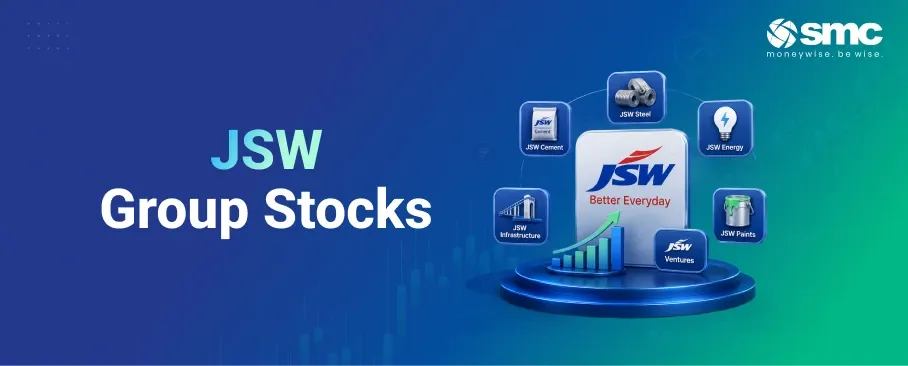


JSW(Jindal South West) Group is one of India's fastest-growing conglomerates, with five listed companies spanning steel, energy, infrastructure, cement, and investments.
For investors tracking India's infrastructure and manufacturing growth story, understanding the Jindal group of companies provides exposure to sectors directly tied to government capex, green energy transition, and industrial expansion.
This guide covers all JSW Group listed companies, their stock performance, financial fundamentals, and what drives their valuations.
Introduction to Jindal Group
JSW Group is an Indian multinational conglomerate headquartered in Mumbai, Maharashtra. Founded in 1982, the group is led by Sajjan Jindal (Chairman and Managing Director), the youngest son of the late O.P. Jindal.
The group reports revenue of approximately US$23 billion, employs over 37,000 people, and operates across 10+ sectors with a global footprint spanning India, the United States, Europe, South America, and Africa.
Unlike some conglomerates with a single holding company structure, JSW operates through multiple separately listed and unlisted entities. Promoter-group control is maintained through shareholding across each listed company, ranging from mid-40% to over 80% depending on the entity.
Jindal Group Business Segments
JSW Group's primary business verticals include:
List of JSW Group Companies + Stocks
The JSW share list includes five publicly traded companies. Here's a quick comparison of all listed entities:
Data as of April 21, 2026
JSW Steel Share: Performance & Market Position
Suited for: Investors seeking exposure to India's largest domestic steel producer with infrastructure-linked demand.
Jindal Steel is the group's flagship company and a constituent of the Nifty 50 index. With an installed capacity of 35.7 MTPA (targeting 51.5 MTPA by FY2030-31), it holds approximately 15.5% domestic market share in India's steel consumption.
Financial Performance (Consolidated):
FY25 revenue declined 3.5% YoY despite record production volumes (27.79 MnT), primarily due to lower steel realisations from weak global prices and elevated Chinese exports hitting 111 MnT.
Shareholding Pattern (Dec 2025):
- Promoters: 45.31%
- FIIs: 25.38%
- DIIs: 11.06%
Key Positives:
- Domestic sales at 92% of consolidated volume provide insulation from export volatility
- Value-added products (VASP) constitute 62% of the sales mix
- December 2025 JFE Steel JV expected to deleverage balance sheet by Rs 37,000 crore
Key Risks:
- Net Debt/EBITDA at 3.34x is elevated (within management's 3.75x cap)
- P/E of 40x trades at a premium to Tata Steel (27x) and SAIL (24x)
- Cyclical exposure to global steel prices and coking coal costs
JSW Energy Share: Growth & Financial Overview
Suited for: Investors seeking India's fastest renewable energy transition story among integrated power utilities.
Jindal Energy has transformed from a thermal-heavy utility to a renewable-focused power company. Current installed capacity stands at 13.1 GW (as of August 2025), with 57% from renewable sources (wind, solar, hydro).
Financial Performance (Consolidated):
Growth Targets (FY2030):
- Generation capacity: 30 GW (23% CAGR from FY25)
- Energy storage: 40 GWh
- RE share: 70% of portfolio
- Capex commitment: Rs 1.3 lakh crore
The company's investor presentation outlines its pathway to becoming a 30 GW power producer by FY2030.
Shareholding Pattern (Dec 2025):
- Promoters: 69.26%
- FIIs: 9.50% (down from 13.43% in Mar 2025)
- DIIs: 14.39% (up from 10.94% in Mar 2025)
Key Positives:
- Locked-in capacity of 30.3 GW provides visibility on growth
- O2 Power acquisition (4.7 GW platform) accelerates RE transition
- Green hydrogen project (3,800 TPA) adds optionality
Key Risks:
- Net debt increased from Rs 40,231 crore (Mar 2025) to Rs 63,166 crore (Sep 2025)
- Q3 FY26 results showed revenue 13% below estimates
- Execution risk on aggressive capacity additions
Other Subsidiaries & Future Stocks to Watch
JSW Infrastructure
India's second-largest private commercial port operator. Current capacity stands at 177 MTPA with a target of 400 MTPA by FY30. The company operates with zero net debt and has grown third-party cargo share from 5% (FY19) to 48% (H1 FY25), reducing dependence on captive JSW Group cargo.
Promoter holding at 83.61%, FIIs at 6.92%, and DIIs at 2.43% (March 2026).
JSW Cement
Listed in August 2025 at Rs 147/share and it currently trades at Rs 128. The company focuses on green cementitious products (PSC, PCC, GGBS) and operates seven plants across southern, eastern, and western regions.
FY25 posted a net loss of Rs 164 crore. Still in investment mode with IPO proceeds allocated for a new integrated unit in Rajasthan (Rs 800 crore) and debt repayment (Rs 520 crore).
JSW Holdings
A Core Investment Company holding stakes in other JSW entities. Trades at 102x of earnings and is almost debt-free, but pays no dividends despite consistent profits. Suited for investors seeking indirect exposure to JSW Group at a discount.
Upcoming IPOs to Watch:
- JSW One Platforms: B2B e-commerce arm achieved unicorn status ($1B valuation) in May 2025. Plans IPO within 18-24 months. FY25 GMV reached Rs 12,500 crore.
Growth Drivers for JSW Companies
Government Infrastructure Push
India's National Infrastructure Pipeline outlay exceeds Rs 111 lakh crore. Steel consumption grew 11.5% in FY25, the fourth consecutive year of double-digit growth.
JSW Steel supplied materials for landmark projects including Mumbai-Ahmedabad Bullet Train and Mumbai Trans-Harbour Sea Link.
Green Steel and Energy Transition
JSW Steel targets carbon neutrality by 2050, with a 4 MTPA green steel facility at Salav. JSW Energy's 57% renewable portfolio positions it to capture India's 500 GW clean energy target by 2030.
Policy Support
The PLI Scheme for Specialty Steel has seen a total committed investment of Rs 43,874 crore across participating companies. Additional policy tailwinds include:
- Provisional safeguard duty on steel imports (12%) was enforced in April 2025
- EU's CBAM creating export market for low-carbon steel
Capacity Expansion Pipeline
Risks & Challenges
Commodity Cyclicality
Steel is inherently cyclical. FY25 saw compressed margins from elevated imports (10.5 MnT finished steel) and weak global prices driven by record Chinese exports (111 MnT in 2024).
Leverage Concerns
Leverage across the JSW group remains mixed, with JSW Steel and JSW Energy reflecting relatively higher debt levels, particularly post-acquisitions.
In contrast, JSW Cement and JSW Infrastructure maintain a more conservative balance sheet, with low to minimal leverage supporting financial stability.
Competitive Intensity
JSW Steel competes with Tata Steel (larger global revenue), SAIL (government-backed), and faces structural threat from Chinese overcapacity. JSW Energy competes against NTPC (4x larger MCap), Adani Green (pure-play RE), and Tata Power.
Conclusion
JSW Group offers diversified exposure to India's infrastructure and manufacturing growth story through five listed entities.
JSW Steel and JSW Energy represent the core holdings for most investors, while JSW Infrastructure provides a capital-efficient port play and JSW Holdings offers discounted NAV access to group companies.
The group's aggressive capex plans across steel, energy, and infrastructure position it to capture India's multi-decade infrastructure buildout. However, elevated leverage at JSW Steel and execution risk at JSW Energy warrant monitoring.
For long-term investors, the JSW share list represents a blend of cyclical value (steel) and structural growth (renewable energy, ports).
Evaluating group stocks like JSW requires clarity on fundamentals and sector trends. Open a Demat account with SMC to invest in equities with reliable market access and research support.

 1800 11 0909
 smc.care@smctradeonline.com